Last updated 2026-08-14
TL;DR
Killing mosquitoes takes layers: dump standing water every 3-4 days, apply an EPA-registered barrier spray on a 10-14 day cycle during the season, and add larvicide dunks to anything you can't drain. No single step eliminates mosquitoes; the combination is what gets your yard usable again.
How do you get rid of mosquitoes for good?
You don't, not permanently, and anyone who tells you otherwise is selling something. Mosquitoes fly in from neighboring yards, ditches, and wetlands, so "for good" isn't realistic. What is realistic: knocking the population in your yard down to the point where you can eat dinner on the patio without slapping your arm every 20 seconds. That takes three layers working together. First, you remove the water they breed in, because a female mosquito can go from egg to biting adult in as little as 7 to 8 days under warm conditions, according to the CDC [1]. Second, you kill larvae in any water you can't drain, using a larvicide like Bti (Bacillus thuringiensis israelensis), which the EPA has registered specifically because it targets mosquito and blackfly larvae without the broad toxicity of adult-killing sprays [2]. Third, you treat the vegetation where adult mosquitoes rest during the day with a barrier spray, reapplied on a schedule, because that's the only step that knocks down the adults already flying around. Skip any one layer and the other two do less work. Spray your bushes but leave a clogged gutter full of water, and you're refilling the population every week. Dump the water but never touch the shrub line, and you're still getting bit by mosquitoes drifting in from three yards over. Most pest control companies, us included, sell the barrier spray piece because it's the one homeowners can't easily do themselves at the right concentration or schedule. But the water removal part is free and it's the highest-leverage thing you can do this weekend.
How do you get rid of mosquitoes in your backyard?
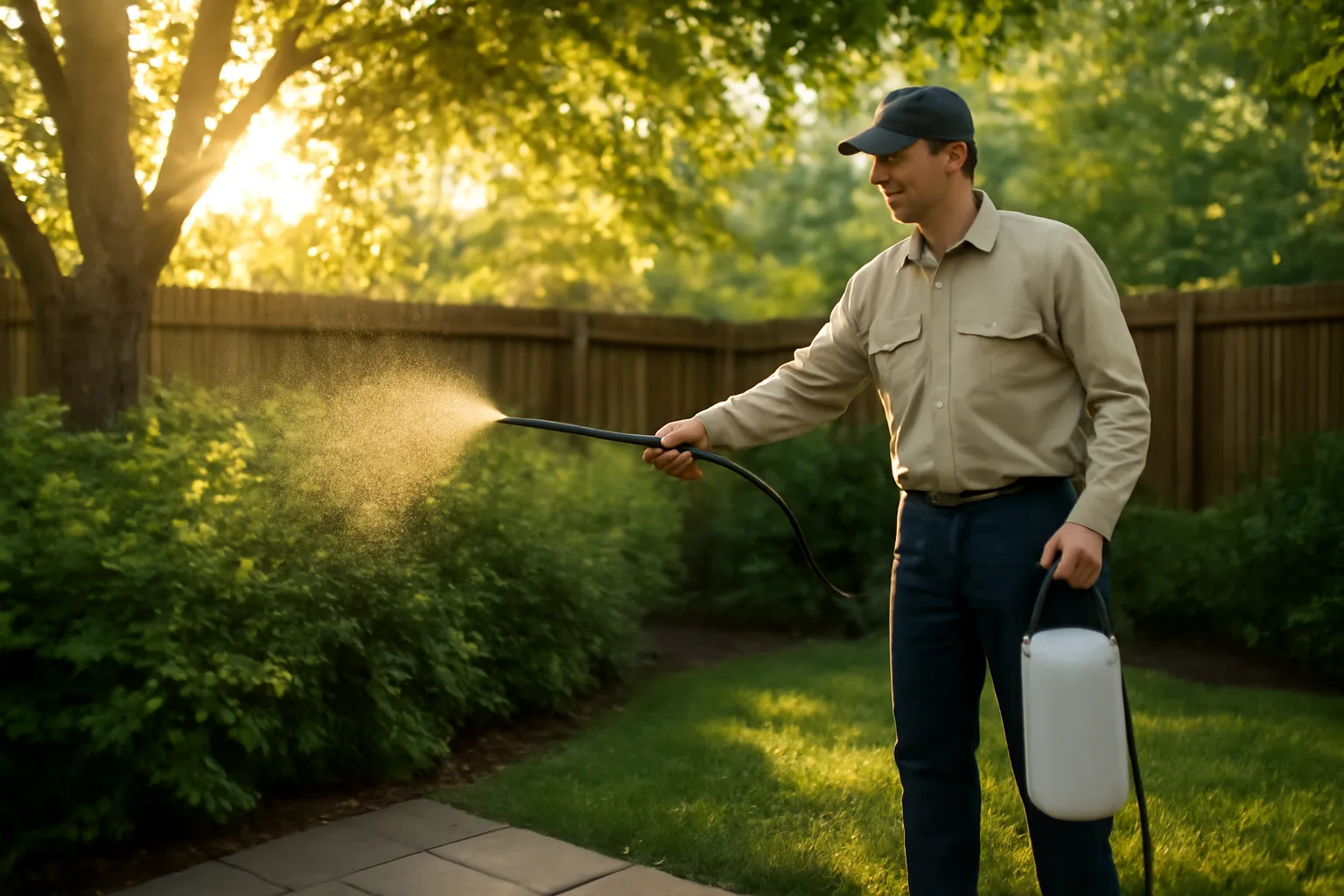
Start with a walk-around, not a spray can. Standing water is the actual root cause in most yards: a bottle cap holds enough water for larvae, and a neglected birdbath can produce hundreds of mosquitoes in a single season. Walk the property and check these spots specifically: gutters (especially if they sag or have leaf buildup), tarps and pool covers, tire swings, plant saucers, unused kiddie pools, corrugated drainage extensions, and any low spot in the lawn that holds water after rain for more than 3 to 4 days. The EPA's mosquito control guidance calls this step "source reduction" and lists it as the first line of defense before any spray. For water you can't drain, like a decorative pond, a rain barrel, or a low area that floods after storms, use a Bti-based dunk or granule. These are sold as "mosquito dunks" and are labeled for use in standing water; they kill larvae for roughly 30 days per application depending on the product label [2]. They don't hurt fish, birds, or pets when used as directed, which is why they're the go-to for anything you can't just tip over. Once the water sources are handled, the next layer is the vegetation. Adult mosquitoes rest on the undersides of leaves in shaded, humid spots during the heat of the day: hedges, ivy, tall grass, the shady side of a fence. A barrier spray applied to that foliage, not fogged into open air, is what knocks down the resting adult population. Most professional programs, including ours, run this on a 10 to 14 day cycle through the season because the residual breaks down with sun, rain, and new plant growth. If you want a professional to walk your yard and map out the wet spots and resting zones for you, a free yard assessment does exactly that before any product goes down. DIY foggers and backyard misting foggers you run yourself can help for a single evening's event, but they don't have the residual or the coverage of a proper barrier application, and overuse trains resistant mosquito populations over time, a concern public health entomologists have flagged in resistance surveillance work [3].
What kills mosquitoes fastest indoors and outdoors?
| Bti dunks/granules | Standing water you can't drain | Days (targets larvae, not adults) | ~30 days per application (label-dependent) [2] | |
|---|---|---|---|---|
| Barrier spray (pyrethroid) | Shaded shrubs, fence lines, resting sites | Hours | 10-14 days typical, weather-dependent | |
| Misting system | Whole-yard coverage, automated | Minutes per cycle | Runs on timed cycles through season | |
| Indoor aerosol | Flying insects already inside | Minutes | Not residual, spot treatment | |
| Repellent (DEET/picaridin on skin) | Personal protection outdoors | Immediate | 2-8 hours depending on concentration [6] | If you're deciding between a barrier program and an installed misting system for a yard with heavy mosquito pressure, that's exactly the kind of call a site visit settles faster than guessing. |
Indoors and outdoors call for different tools, and mixing them up wastes money. Outdoors, for adult mosquitoes already flying around, the fastest knockdown comes from a barrier spray containing a synthetic pyrethroid (like bifenthrin or permethrin), applied to shaded foliage and the underside of leaves. These are EPA-registered products applied per label directions by licensed applicators in most states; they are not labeled as "safe" or "non-toxic," they're registered for a specific use pattern at a specific concentration, and the label is the law [4]. A pyrethroid barrier typically starts knocking down mosquitoes within hours and holds a residual effect for 2 to 3 weeks depending on weather, which is why 10 to 14 day retreatment cycles are standard in the pest control industry. Indoors, you want something different: an aerosol labeled for indoor flying insect use, a plug-in repellent, or simply screens and door sweeps that stop entry in the first place. Pyrethroid barrier sprays meant for outdoor foliage are not labeled for indoor broadcast use, and using an outdoor product indoors violates the label, which is also against federal law under FIFRA [5]. For a single mosquito that got into the bedroom at 11pm, the fastest real fix is a flyswatter, a vacuum, or turning off the lights and waiting by the door with a phone flashlight (mosquitoes are drawn to CO2 and heat, not light, but they do tend to rest on nearby surfaces you can spot and swat). An indoor aerosol works too, but for one bug, chasing it with a can of pesticide is overkill. A quick side-by-side on where each tool actually belongs: | Method | Best for | Speed | How long it lasts |
How do you keep mosquitoes away without spraying every week?
You can't fully replace spraying with prevention alone, but you can stretch the time between treatments and cut down on bites in the meantime. Fans matter more than people think. Mosquitoes are weak fliers; a box fan or ceiling fan on a patio disrupts their flight enough that a lot of species simply won't stick around, which is part of why porches with fans running feel noticeably less buggy than still air. Standing water removal, covered above, is the single biggest lever, because you're cutting off reproduction rather than just repelling adults. Personal repellents matter for the moments you're outside between treatments. The CDC recommends EPA-registered repellents containing DEET, picaridin, IR3535, oil of lemon eucalyptus (OLE), para-menthane-diol (PMD), or 2-undecanone, and states plainly that products registered with the EPA "have been evaluated for effectiveness" [6]. Concentration matters more than brand: a 20% picaridin product and a 20% DEET product perform similarly; lower concentrations just mean more frequent reapplication, not less effectiveness. Products with citronella oil alone tend to give shorter, weaker protection than the CDC-recommended actives listed above. Clothing helps more than most repellent marketing admits. Light-colored, loose clothing that covers arms and legs cuts exposed skin area, and permethrin-treated clothing (different product, different label than skin repellents) adds a contact-kill layer that regular clothing doesn't have. Timing your outdoor plans matters too. Most common backyard species, including Culex and Aedes mosquitoes, are most active at dawn and dusk, though Aedes aegypti and Aedes albopictus (the ones that spread Zika and dengue in the US) are notably aggressive daytime biters as well, per CDC species guidance [7]. If you're hosting an evening event, that's the exact case where a lot of homeowners look at a mosquito control near me search a week out instead of the day before, because barrier sprays need a little time to settle onto foliage and knock down the population before guests arrive.
What plants repel mosquitoes, and does a mosquito repellent plant actually work?
A mosquito repellent plant is any plant that contains compounds mosquitoes find irritating or that mask the CO2 and skin-scent cues they use to find you. The honest answer on whether they work: mildly, and only right around the crushed or brushed leaf, not across an open yard. Citronella, lemongrass, lavender, marigold, catnip, basil, and rosemary all get cited constantly as mosquito repellent plants, and there's some real chemistry behind a few of them. University extension research on citronella and related essential oils shows the compounds can repel mosquitoes when the oil is extracted, concentrated, and applied to skin, but simply having the live plant growing in a pot gives off far less of the active compound into the air than an extracted oil product would . In practice, that means your patio citronella plant is doing something, just not nearly as much as the tiki torch citronella oil marketed next to it implies. Marigolds contain pyrethrum-related compounds and are sometimes planted around vegetable beds for this reason, but again, the effect is localized and modest, not a yard-wide shield. Catnip contains nepetalactone, which some lab studies found repellent to mosquitoes in concentrated form, though field performance around a live plant is much weaker than the lab result suggests. The realistic way to use these plants: put them near seating areas as a mild, pleasant-smelling extra layer, not as your primary defense. Crush a few leaves and rub them on skin or clothing for a short, weak boost. Don't skip your barrier spray or your standing-water check because you planted a pot of lemongrass by the back door. If you want the deeper chemistry rundown on which oils have real data behind them versus which are folklore, our natural mosquito repellent guide breaks down the actual research by compound.
How do you get rid of mosquitoes in the house?
Indoor mosquitoes almost always mean an entry point or a tiny breeding site you haven't found yet, not a house-wide infestation. First, check screens on every window and door for tears, gaps, or ones that don't seal at the bottom. A gap the width of a pencil is enough. Second, check door sweeps; mosquitoes walk in under doors more often than people expect. Third, look for indoor standing water: an overwatered houseplant saucer, a clogged AC condensate line, a floor drain that holds water, even a forgotten vase. These small indoor water sources can produce a mosquito or two within the CDC's cited 7-to-10-day development window [1], which explains the mystery mosquito that keeps showing up in the same room even though you swatted the last one three days ago. For active mosquitoes already inside, an indoor-labeled aerosol handles a quick knockdown, but for a persistent low-grade problem, a plug-in repellent device near the entry point plus fixing the screen does more long-term good than repeated spraying. Bug zappers are mostly a myth for mosquito control specifically; entomology research has found they kill far more non-target insects than mosquitoes, since mosquitoes aren't strongly drawn to UV light the way many moths and beetles are. If mosquitoes are coming in en masse rather than one at a time, the actual problem is almost always outside: a heavy resting population right next to a door that gets opened and closed all day. In that case the indoor fix is temporary and the real fix is the outdoor barrier treatment covered earlier in this piece.
When do mosquitoes go away for the season?
Mosquitoes typically become inactive once nighttime temperatures drop consistently below the mid-50s Fahrenheit, since most common species slow down significantly below about 50°F and stop flying and biting around consistent cold snaps in the low 50s and below. That's a general rule, not a hard science fact you can set a calendar to, and your local extension office or health department will have a better read on your specific first-frost timing than any national article can give you. In the northern US, that often means late September through October, depending on the year. In the Gulf Coast, Florida, and parts of the Southwest, mosquitoes can stay active nearly year-round in warm winters, which is exactly why some pest control programs in those regions don't have a true off-season. Cold doesn't kill the species outright, and this is the part homeowners get wrong most often. Many mosquitoes overwinter as eggs (laid in a spot that will flood come spring) or as adult females that find a sheltered, humid spot, like a crawl space, culvert, or hollow log, and go into a dormant state called diapause. When spring temperatures return and rain refills the low spots, the eggs hatch and the population rebuilds from near zero within a few weeks. That overwintering biology is exactly why seasonal timing matters for treatment. Starting a barrier program too late in spring means you're fighting an already-established population instead of catching it while it's still small. Most professional programs recommend the first application once daytime temperatures are consistently holding in the 50s, well before mosquitoes are biting in force, because that early treatment window has an outsized effect on the whole season's population curve.
How do you get rid of ticks in your yard?
Ticks and mosquitoes get lumped together in yard pest control, but they behave differently, so the fix isn't identical. Ticks don't fly or jump; they climb tall grass and shrubs at the edge of your lawn and "quest," waiting with front legs extended to grab onto a passing host. The CDC and university tick research point to the same core strategy: shrink the habitat first. Mow the lawn regularly, clear leaf litter and brush, and create a barrier of wood chips or gravel, at least 3 feet wide, between your lawn and any wooded edge or stone wall. The CDC specifically notes that "ticks are most often found in wooded and brushy areas with high grass and leaf litter" and recommends creating this kind of buffer zone . That gravel or mulch strip works because ticks dry out and die in open, sunny conditions; they need shade and humidity to survive. After habitat management, targeted pesticide applications (often called tick tubes for rodent-targeted permethrin, or perimeter barrier sprays for the yard edge) reduce tick populations in the specific zones where they concentrate: yard edges, stone walls, wood piles, and under play equipment, rather than needing to treat the whole lawn. Keep play structures, decks, and patios at least 9 feet from wooded areas where possible, per the same CDC yard guidance . Deer are the other half of the tick life cycle in a lot of suburban and rural yards, since adult ticks feed and mate on deer before dropping off to lay eggs. Fencing that excludes deer, where practical, reduces the tick population your yard sustains over multiple seasons, though it's a bigger structural change than most homeowners take on just for ticks alone. For personal protection while you're doing yard work in tick season, EPA-registered repellents with the same actives recommended for mosquitoes (DEET, picaridin, IR3535, OLE) also work against ticks, and permethrin-treated clothing adds a contact-kill layer. If you want a closer look at which repellent actives hold up best specifically against ticks versus mosquitoes, our tick repellent breakdown covers the differences by active ingredient and reapplication interval.
What's the difference between a barrier spray and a misting system?
A barrier spray is a manual application, usually every 10 to 14 days during the season, where a technician (or a homeowner with a backpack sprayer) treats shaded foliage, fence lines, and other resting sites with a residual pyrethroid product. A misting system is a plumbed, installed setup with nozzles around the yard's perimeter that automatically release a fine mist of insecticide on a timer, usually at dawn and dusk. Barrier sprays cost less up front and require no permanent equipment; you're paying for labor and product on a recurring schedule. Misting systems cost more to install because you're paying for the plumbing, tank, and nozzle network, but they run automatically and some homeowners like the set-and-forget aspect, especially on large or oddly shaped properties where a technician can't easily reach every resting site. The tradeoff most extension entomologists point to: misting systems apply pesticide on a fixed timer regardless of actual mosquito pressure or weather, which means more total product going into the yard over a season compared to a barrier program that a technician can adjust based on what they see on-site (heavier rain that week, new growth needing extra attention, a spike in activity near a specific water feature). Some state pesticide regulators have raised the same concern about scheduled automatic misting relative to targeted applications. Neither approach eliminates mosquitoes, and anyone promising full eradication from either method isn't being straight with you. Both knock the population down meaningfully when maintained on schedule and paired with the source reduction covered earlier in this piece. We do a free yard assessment specifically because the right choice between a barrier plan and an installed misting system depends on your yard's layout, not a one-size answer.
What actually works vs. what's mostly a waste of money?
Worth doing: draining standing water weekly, Bti dunks in anything you can't drain, an EPA-registered barrier spray on a 10-to-14-day cycle during peak season, screens and door sweeps in good repair, and EPA-registered personal repellent for the hours you're outside at dawn and dusk. Mostly a waste, based on the entomology research available: bug zappers for mosquito control specifically (they catch mostly non-target insects), ultrasonic mosquito repellent devices (no credible peer-reviewed evidence supports these working, and the FTC has taken action against ultrasonic pest repellent marketing claims in the past), and citronella candles as a sole strategy for anything beyond a couple feet of table space. Genuinely helpful but limited: mosquito-repellent plants (real but mild, localized effect), fans on the patio (surprisingly effective for the cost), and wearing lighter, looser clothing during peak biting hours. If you're only going to do one free thing this week, walk your yard for standing water. It's the step with the best return for zero dollars spent, and it's the step a spray program can't fully make up for if you skip it.
Frequently asked questions
How do I get rid of mosquitoes fast for a weekend party?
Drain any standing water within 100 feet of your seating area, run box fans on the patio (mosquitoes are weak fliers), and get a barrier spray applied to shaded shrubs and fence lines at least a day or two ahead so the residual has time to knock down the resting population before guests arrive. A same-day spray helps less than one done 24-48 hours out.
How do you get rid of mosquitoes in the house overnight?
Check screens and door sweeps for gaps first, since that's usually the entry point. Use an indoor-labeled aerosol or a plug-in repellent for immediate knockdown, and check for small indoor water sources like plant saucers or a clogged AC drain line that could be breeding a new mosquito every week.
What plants repel mosquitoes the best?
Citronella, lemongrass, lavender, marigold, and catnip all contain compounds with some repellent effect in lab studies, but a live potted plant releases far less of the active compound than an extracted oil product would. Treat them as a mild extra layer near seating areas, not a replacement for a barrier spray or standing-water removal.
When do mosquitoes go away for the year?
Most species slow down and stop biting once nighttime temperatures consistently drop into the low-to-mid 50s Fahrenheit, which in northern states often lands in late September or October and much later, or not at all, in warm-winter regions like Florida and the Gulf Coast. Check your local extension service for your area's typical timing.
How do I get rid of ticks in my yard without chemicals?
Mow regularly, clear leaf litter and brush, and build a 3-foot-wide barrier of wood chips or gravel between your lawn and any wooded edge, since the CDC notes ticks concentrate in shaded, humid areas with tall grass and leaf litter. Keeping play equipment and patios at least 9 feet from wooded areas also cuts exposure.
Do mosquito barrier sprays kill ticks too?
Some barrier products labeled for both mosquitoes and ticks will knock down ticks in treated zones, but tick control usually needs habitat management (mowing, leaf litter removal, a gravel buffer) as the core strategy, since ticks live in grass and brush rather than resting on the same shaded shrub foliage mosquitoes prefer.
Does a mosquito repellent plant actually keep mosquitoes away from my whole yard?
No. A mosquito repellent plant like citronella or lemongrass has a real but localized effect, generally limited to the immediate area around the crushed or brushed leaf. It won't create a mosquito-free zone across an open yard the way a barrier spray or standing-water removal program will.
How often should I spray my yard for mosquitoes?
Most professional barrier programs run on a 10-to-14-day cycle through the active season, since pyrethroid residuals break down from sun, rain, and new plant growth over roughly that window. Heavy rain or fast growth can shorten the effective window, which is one reason a site visit beats guessing at a fixed schedule.
What kills mosquito larvae in standing water without hurting fish or pets?
Bti (Bacillus thuringiensis israelensis), sold as mosquito dunks or granules, targets mosquito and blackfly larvae specifically and is labeled safe for use around fish, birds, and pets when applied per the product label. It typically controls larvae for about 30 days per application, depending on the specific product.
Why do I keep getting mosquitoes in my house even after I spray?
Repeated indoor mosquitoes almost always mean either an unfixed entry point (a torn screen, a gap under a door) or a small indoor water source still breeding new mosquitoes every week or two. Spraying kills the mosquitoes present that day but doesn't fix either root cause, so they keep coming back.
Are ultrasonic mosquito repellent devices worth buying?
No credible peer-reviewed research supports ultrasonic devices reducing mosquito bites, and regulators including the FTC have taken action over misleading ultrasonic pest repellent marketing claims in the past. Money is better spent on EPA-registered repellents, screens, and standing-water removal.
What's the fastest way to get rid of mosquitoes in my backyard this week?
Drain or treat every standing water source you can find (this takes an afternoon), then get an EPA-registered barrier spray applied to shaded shrubs and resting sites. The spray knocks down existing adults within hours to a day; the water removal stops next week's population from replacing them.
Sources
- CDC, Mosquito Life Cycle: Mosquitoes can develop from egg to biting adult in as little as 7-8 days under warm conditions
- CDC, Mosquito Control: Insecticide Resistance: Overuse of insecticide contributes to resistant mosquito populations over time
- EPA, Federal Insecticide, Fungicide, and Rodenticide Act (FIFRA) overview: Using a pesticide in a manner inconsistent with its labeling violates federal law
- CDC, Preventing Mosquito Bites: CDC recommends EPA-registered repellents (DEET, picaridin, IR3535, OLE, PMD, 2-undecanone) that have been evaluated for effectiveness
- CDC, Mosquito Species in the United States: Aedes aegypti and Aedes albopictus are aggressive daytime biters, unlike many other common species
- University of Florida IFAS Extension, Natural Products for Mosquito Repellency: Extracted essential oils like citronella show repellent activity in concentrated applied form, distinct from live plant exposure
- CDC, Preventing Ticks in the Yard: Ticks concentrate in wooded, brushy areas with tall grass and leaf litter, and a wood chip or gravel buffer helps create a barrier