Last updated 2026-08-14
TL;DR
There's no single trick that gets rid of mosquitoes and ticks for good. The combination that actually works is removing standing water weekly, treating vegetation with a barrier spray on a 10-14 day cycle during your active season, and using EPA-registered repellents on skin when you're outside. Barrier treatments knock populations down; they don't eliminate them.
How do you get rid of mosquitoes for good?
You don't, not permanently, and anyone promising total elimination is selling something. Mosquitoes fly in from neighboring yards, wetlands, and storm drains that aren't yours to control, so the real goal is knocking the population down enough that you can sit on your patio at 7pm without getting eaten. The CDC frames this correctly: control is about reducing mosquitoes "to a tolerable level," not zeroing them out [1]. The combination that actually moves the needle has three parts. First, source reduction: dumping, draining, or treating any standing water on your property, since a female mosquito can lay 100 to 200 eggs at a time in water that's been sitting for as little as a few days [2]. Second, a residual barrier treatment applied to shrubs, tall grass, and shaded resting spots on a repeating cycle, typically every 10 to 14 days during the season your local mosquitoes are active. Third, personal repellent on exposed skin when you're outdoors during peak biting hours (usually dawn and dusk for most Culex and Aedes species). Skipping any one of these leaves a gap. Skip source reduction and you're re-treating a breeding factory. Skip the barrier spray and you're relying on repellent alone, which only protects the person wearing it, not the whole yard. Skip repellent and you're exposed during the window between barrier applications, especially after a hard rain washes some of the residual off foliage. If you want the yard-scale version of this handled instead of doing it all yourself, that's the whole pitch behind a mosquito control service: someone maps your property's actual mosquito habitat and treats it on schedule instead of you guessing.
How do you keep mosquitoes away long-term?
Long-term suppression is a maintenance habit, not a one-time fix. Treat it like mowing the lawn: skip it for a month and you're starting over. The backbone is the standing-water check. Walk your property once a week and dump, scrub, or cover anything holding water: clogged gutters, saucers under potted plants, tarps, kiddie pools, bird baths, low spots in the yard, even bottle caps. Mosquito eggs of species like Aedes aegypti can survive dry conditions for months and hatch as soon as they're re-flooded, so a container that dried out in June can start producing mosquitoes again after an August storm [3]. On top of that, a barrier spray applied to the vegetation where adult mosquitoes rest during the day (the undersides of leaves, mulch beds, fence lines, tall grass) provides residual knockdown for roughly 2 to 3 weeks depending on the product and weather, which is why most professional programs re-treat on a 10 to 14 day cycle rather than a monthly one. Rain, heat, and UV break the residue down faster than most homeowners expect. Misting systems are the other long-term option, usually PVC tubing installed around the yard perimeter that releases a fine pesticide mist on a timer, a few times a day or by remote trigger before you go outside. They cost more upfront and require the same EPA-registered product discipline as a spray (applied per label, not a "safer because it's automatic" shortcut), but they remove the guesswork of remembering a schedule. For most yards a technician-applied barrier on a set cycle beats an automated mister on cost. A mister beats manual sprays on convenience if you can afford the install. Either way, pair it with mosquito repellent for anyone spending real time outside, since no barrier treatment covers 100 percent of a yard 100 percent of the time.
How do you get rid of ticks in your yard?
Ticks aren't mosquitoes with different wings; they don't fly in from three yards over, they live where you let leaf litter and tall grass live. That means yard-level control actually works better on ticks than on mosquitoes, because the population you're treating is largely the population that's already there. The CDC and university extension programs converge on the same core moves. Keep grass mowed short. Clear leaf litter, brush, and tall grass at the edge of lawns, especially where the yard meets woods. Create a 3-foot-wide barrier of wood chips or gravel between lawn and wooded areas or stone walls, since ticks don't like crossing dry, open material and this measurably reduces migration into the yard [4]. Stack woodpiles neatly and in dry areas to avoid attracting rodents, which are a primary host for immature ticks carrying Lyme disease. Chemically, a licensed applicator (or a careful homeowner using an EPA-registered acaricide per label) can treat the wooded perimeter, stone walls, and tall grass edges, the specific microhabitat where ticks quest for hosts, rather than blanket-spraying the whole lawn. The CDC notes that a single, well-timed application in late May or June targeting the nymph stage can reduce tick populations, though it does not guarantee elimination of tick-borne disease risk [4]. Deer are a major host for adult ticks, so anything that reduces deer traffic (fencing, removing deer-attracting plants) reduces the number of ticks completing their lifecycle in your yard. If you have pets or kids who use the yard heavily, this is one of the areas where a professional program pays for itself, because the treatment zones matter more than the total square footage sprayed. See tick repellent for what to put directly on skin and clothing when you're in tick habitat anyway.
What plants repel mosquitoes, and do they actually work?
A mosquito repellent plant is any plant that's marketed as deterring mosquitoes, usually because it contains aromatic compounds (citronellal, geraniol, linalool) that mosquitoes find irritating or that mask the CO2 and body odor they use to find you. Citronella, lemongrass, catnip, marigold, lavender, basil, and rosemary all show up on these lists constantly. Here's the honest problem: the plant sitting in a pot doesn't repel anything. The compound has to be released and concentrated near your skin to matter, which is why citronella candles and plant-based sprays work only weakly and only up close. Research on catnip has found that intact plants release nepetalactone too slowly to meaningfully repel mosquitoes, while crushing the leaves releases enough of the compound to produce a real, temporary effect [5]. In other words, a live plant in the yard is mostly decorative as pest control; you'd have to crush the leaves and rub the oil on skin (with the same caution as any essential oil, since it can irritate skin at higher concentrations) to get anything close to a repellent effect. So plant them if you like them in the garden, they don't hurt, but don't count a border of lemongrass as your mosquito control plan. If you want the plant-adjacent approach that's actually been tested at meaningful concentrations, look at EPA-registered plant-oil repellents like oil of lemon eucalyptus, which the CDC lists as an effective active ingredient for skin application, not the raw plant itself [6]. More on that distinction in natural mosquito repellent.
How do you get rid of mosquitoes in the house?
Indoor mosquitoes almost always mean one of two things: a door or window screen with a gap, or a breeding source inside the house itself (a clogged floor drain, an overwatered houseplant saucer, a forgotten vase of water). Start with the screens. Check every window and door screen for tears or gaps around the frame; a hole the size of a pencil eraser is enough for mosquitoes to get through repeatedly. Make sure door sweeps seal fully, since mosquitoes will walk through gaps at the threshold, more than fly through open doors. Next, hunt for indoor standing water. Houseplant saucers, unused vases, pet water bowls left out too long, even a slow drain in a basement or bathroom that holds a puddle can be enough for Culex mosquitoes to breed indoors, and they can complete an egg-to-adult cycle in as little as 7 to 10 days in warm water [2]. Empty and dry these weekly. For mosquitoes already inside, a fan is underrated: mosquitoes are weak fliers and struggle against even a moderate breeze, which is part of why porches with ceiling fans see fewer bites. Indoor foggers and plug-in repellents exist, but they're a stopgap, not a fix, if the entry point is still open. If you keep finding mosquitoes inside after sealing screens and drying out standing water, the likely source is right outside the door: a shaded, humid resting spot in foundation plantings that's feeding mosquitoes into the house every time it opens.
How do you get rid of mosquitoes in the backyard?
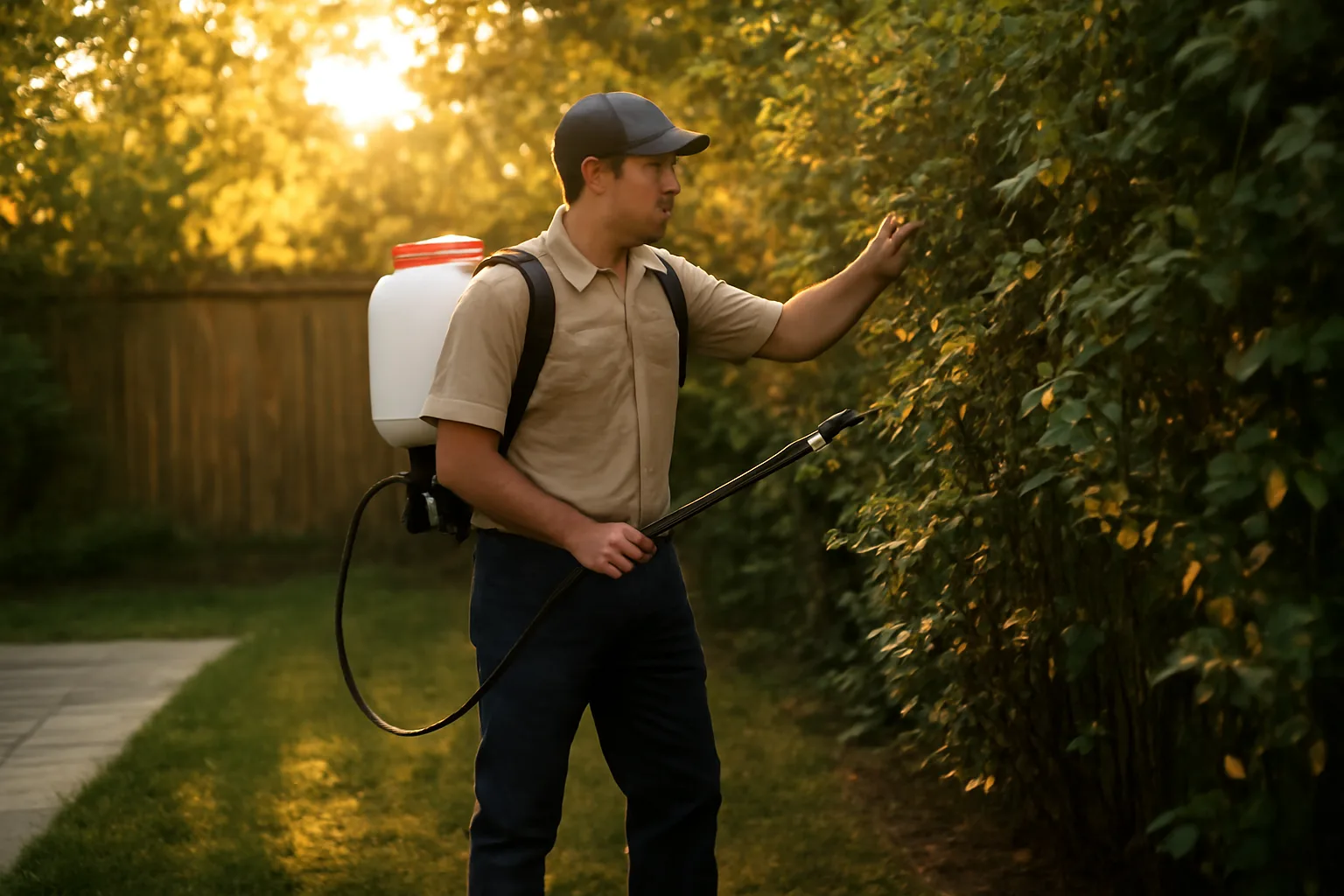
Backyard control comes down to habitat, more than bugs. Adult mosquitoes rest in shaded, humid vegetation during the day (the underside of hostas, dense shrubs, ivy, tall grass along fences) and only become active fliers around dusk. That resting habitat is exactly what a barrier treatment targets. Walk the yard and rank your problem spots: dense shade, anything near standing water, compost piles, wood piles, and anywhere air doesn't move much. These are the priority zones for treatment, not the open lawn in full sun, which mosquitoes mostly avoid. A typical professional barrier treatment uses an EPA-registered pyrethroid or similar product, applied to these resting areas with a backpack or truck-mounted sprayer, and re-applied on a 10 to 14 day cycle through the mosquito season. That cycle length isn't arbitrary; it matches roughly how long the residue keeps working before rain, sun, and new plant growth wear it down. Between treatments, keep running your weekly standing-water check, since a barrier spray does nothing to stop a new hatch from a gutter you forgot about. Add a box fan or two on the patio for the evenings you're actually out there, since moving air disrupts a mosquito's ability to track your CO2 plume. And if the yard backs up to woods, a marsh, or a neighbor who doesn't manage their own standing water, expect to need more frequent treatment than a yard in an open subdivision; that's normal, not a sign the treatment failed. If you'd rather have someone map the resting zones and run the cycle for you, mosquito control near me is the search that gets you a local option, or you can Get a free yard assessment directly.
When do mosquitoes go away for the season?
Most mosquito species become inactive once nighttime temperatures fall consistently below about 50°F (10°C), and populations drop sharply after the first hard frost, though the exact date varies a lot by region and species [1]. In the Gulf Coast and much of the Southeast, that might not happen until late November or not fully at all in a mild winter. In the Upper Midwest or Northeast, a hard frost by mid-to-late October usually ends the season outright. Mosquitoes don't actually die off entirely at the population level. Many species overwinter as eggs (laid in a location that will flood next spring), as larvae in ice-covered water, or as adult females that find a sheltered spot (a culvert, a crawl space, tree bark crevices) and go dormant until temperatures rise again [1]. That's part of why the first warm week in spring can produce a sudden mosquito spike: the overwintering population wakes up all at once. Because the season's start and end dates genuinely differ by region and even by year, your county or state extension service or local health department is the best source to confirm when your specific area's season realistically starts and stops rather than relying on a national average. Treatment programs should track that local window rather than a fixed calendar, ramping up in spring and tapering as nights consistently cool.
What's the difference between barrier sprays and misting systems?
| How it works | Sprayed on vegetation and resting areas by a technician | Fixed nozzles on tubing release mist automatically | |
|---|---|---|---|
| Typical cycle | Every 10-14 days during active season | Multiple times daily, or on-demand | |
| Upfront cost | None (pay per treatment/season plan) | Installation cost for tubing, tank, and nozzles | |
| Ongoing cost | Recurring per-visit or seasonal plan | Refill product plus system maintenance | |
| Coverage | Targeted at known resting/breeding zones | Whole perimeter, wherever nozzles are placed | |
| Best for | Most residential yards, seasonal use | High-pressure properties, frequent outdoor entertaining | A barrier plan is the lower-commitment option: no equipment on your property, a technician comes on a schedule, and you can pause or stop between seasons. A misting system is a bigger investment but removes the need to remember anything, since it's automated, and some homeowners like being able to trigger an extra burst of mist right before a backyard party. Neither one is "safer" than the other by default. Both rely on the same category of EPA-registered active ingredients, and both should be applied exactly per the product label, not more frequently just because you can. If your property has heavy tree cover, a pond, or borders a wetland, ask whoever quotes you (including through a free yard assessment) which option their treatment plan is actually built around, since a misting system installed by a company that doesn't also monitor breeding sites is only solving half the problem. |
Both use EPA-registered pesticides applied per label, but the delivery method, cost, and maintenance are pretty different, and the right choice depends on how bad your mosquito pressure is and what you're willing to manage. | Factor | Barrier spray (technician visit) | Misting system (installed) |
How do I know if I have a mosquito problem or a tick problem (or both)?
The habitat tells you more than the bite does. Mosquitoes need standing water and shaded resting vegetation; ticks need leaf litter, tall grass, brush, and a host animal (deer, rodents, pets) moving through it. A lot of yards have both, especially anywhere with a wooded edge. Check for mosquito signs first: any standing water anywhere on the property, even small amounts, and dense shaded plantings where you get swarmed the moment you brush past them at dusk. Check for tick signs separately: walk the edge where lawn meets woods or a stone wall, and if you're pushing through tall grass or leaf litter without meaning to, that's tick habitat regardless of whether you've seen one. The practical test that works for both: after 15-20 minutes outside at dusk in shaded areas, are you getting bitten repeatedly (mosquitoes), or after a walk through brush and tall grass, do you find ticks crawling on pants or socks (ticks)? Both problems are worth addressing. The CDC's tick prevention guidance and mosquito control guidance are separate documents for a reason. It's genuinely two different pest management approaches even though a lot of general pest services bundle them into one seasonal plan for convenience.
What should you expect from a professional mosquito and tick service?
A legitimate program starts with someone walking your property, more than quoting a flat price over the phone. Duskproof and most reputable local companies run this as a free yard assessment: someone identifies your standing-water sources, the resting vegetation, and (if you're also dealing with ticks) the yard-edge habitat, then builds a treatment plan around what's actually on your property rather than a generic package. From there, expect either a seasonal barrier plan on a repeating cycle (commonly every 10 to 14 days through your local active season) or, for heavier pressure or bigger budgets, an installed misting system. Ask specifically what active ingredient is used, whether it's EPA-registered (it should be, and the technician should be able to tell you the product name and label), and what the re-treatment interval is and why. Be skeptical of any company promising to eliminate mosquitoes or ticks entirely. That's not how residual pesticide chemistry, insect biology, or property boundaries work; a barrier treatment reduces the population that rests and breeds on your treated property, but mosquitoes still fly in from elsewhere and ticks still arrive on wildlife you don't control. The honest pitch is a meaningful reduction on a maintained schedule, not eradication. If you're ready to get a property-specific plan instead of guessing at DIY sprays every few weeks, Get a free yard assessment and have someone map out what your yard actually needs.
Frequently asked questions
How do you get rid of mosquitoes fast?
There's no true instant fix, but the fastest short-term relief is a fan on your patio (mosquitoes are weak fliers), an EPA-registered skin repellent, and eliminating any standing water within eyeshot. For a fast yard-wide knockdown, a professional barrier spray applied to resting vegetation works within hours, though it needs re-treatment every 10-14 days to hold.
How do you keep mosquitoes away from a patio or deck?
Run a box fan or ceiling fan, since mosquitoes struggle to fly against moving air. Remove any standing water within 20-30 feet, apply repellent to skin, and consider citronella or other candles as a minor supplement, not a primary defense. A barrier spray on the surrounding shrubs and shaded ground cover cuts down the resting population nearby.
How do you get rid of ticks on your body or clothes?
Check your whole body after being outside in brush or tall grass, paying attention to hairline, armpits, behind knees, and waistband. Remove an attached tick with fine-tipped tweezers, pulling straight up steadily, per CDC guidance [4]. Put worn clothing in a hot dryer for 10 minutes, which kills remaining ticks even if the clothes aren't dirty.
What plants repel mosquitoes best?
Citronella, lemongrass, catnip, marigold, lavender, and basil are the most commonly cited, thanks to aromatic oils mosquitoes dislike. But research on catnip found the intact plant releases too little compound to repel mosquitoes meaningfully; crushing leaves released more [5]. Treat these as garden bonuses, not a real substitute for repellent or barrier treatment.
How do you get rid of mosquitoes in the house permanently?
Permanent indoor control means sealing every gap in window and door screens, fixing door sweeps, and eliminating any indoor standing water (plant saucers, vases, slow drains). Mosquitoes can complete their life cycle in standing water in as little as 7-10 days [2], so a forgotten water source indoors keeps reintroducing them even after you seal the entry points.
When do mosquitoes go away for the winter?
Most mosquitoes become inactive once nights consistently drop below about 50°F, with populations crashing after the first hard frost [1]. Timing varies widely by region: parts of the Northeast see this by mid-October, while the Gulf Coast may see mosquitoes active into late November or year-round in mild winters. Check your local extension service for your area's typical window.
How do you get rid of mosquitoes in your backyard without chemicals?
Eliminate every source of standing water weekly, mow tall grass, thin dense shaded vegetation where adults rest, and run fans on areas you use in the evening. This reduces the population meaningfully but won't match the knockdown of an EPA-registered barrier treatment; a chemical-free approach works best combined with strict water management, not alone.
How do you get rid of ticks in your yard without spraying pesticide?
Mow grass short, remove leaf litter and brush, and build a 3-foot-wide barrier of wood chips or gravel between lawn and wooded edges; the CDC notes this barrier measurably reduces tick migration into yards [4]. Reducing deer access with fencing also helps, since deer are a major host for adult ticks completing their life cycle.
What is a mosquito repellent plant, exactly?
It's a plant marketed as deterring mosquitoes because it contains aromatic compounds like citronellal or geraniol that mosquitoes tend to avoid. The catch is the intact plant releases very little of that compound into the air; you'd typically need to crush leaves and apply the oil to skin to get a noticeable, temporary repellent effect [5].
How often should a yard be treated for mosquitoes?
Most professional barrier programs re-treat every 10 to 14 days through the local mosquito season, since rain, sunlight, and new plant growth wear down the residual product over roughly that window. Heavier rainfall or unusually humid stretches can shorten the effective window, which is why a fixed monthly schedule is often too infrequent.
Do mosquito misting systems work better than sprays?
Misting systems automate delivery and can trigger extra bursts on demand, which suits high-pressure properties or frequent entertaining, but they cost more upfront and still use the same category of EPA-registered pesticide as a technician-applied barrier spray. Neither eliminates mosquitoes; both reduce populations on a schedule, and the better fit depends on budget and how much manual scheduling you want to manage.
Can I get rid of mosquitoes and ticks with the same treatment?
Some professional programs bundle both into one seasonal plan, but the target habitats differ: mosquito treatment focuses on standing water and shaded resting vegetation, while tick treatment focuses on yard-edge leaf litter, tall grass, and wooded borders. A good assessment identifies both zones separately even if they're treated on the same visit.
Why do I still get bitten after a barrier treatment?
Barrier treatments reduce the population resting and breeding on your treated property; they don't stop mosquitoes flying in from a neighbor's yard, a nearby wetland, or storm drains outside your control. Rain also degrades residual product faster than expected. This is expected reduction, not elimination, which is why the 10-14 day re-treatment cycle exists.
Sources
- CDC, Mosquito Control Overview: Mosquito control aims to reduce populations to a tolerable level, and mosquitoes become inactive with cold weather, overwintering as eggs, larvae, or dormant adults
- EPA, Mosquito Life Cycle: A female mosquito can lay 100 to 200 eggs at a time and complete the life cycle from egg to adult in about a week to 10 days in favorable conditions
- CDC, Aedes aegypti and Aedes albopictus Mosquitoes: Aedes mosquito eggs can survive desiccation for extended periods and hatch once flooded again
- CDC, Preventing Ticks in the Yard: A 3-foot-wide barrier of wood chips or gravel between lawns and wooded areas restricts tick migration, and mowing, clearing leaf litter, and a well-timed acaricide application reduce tick populations
- Bernier, U.R. et al., "Comparative Analysis of Catnip and Its Major Compound Nepetalactone for Repellent Efficacy", Journal of Medical Entomology / PubChem summary, PMID 15218921: Intact catnip plants release repellent compound too slowly to meaningfully repel mosquitoes, while crushed leaves release more
- CDC, Preventing Mosquito Bites: CDC lists oil of lemon eucalyptus among effective EPA-registered active ingredients for skin-applied mosquito repellents