Last updated 2026-08-14
TL;DR
"Mosquito Squad" is a franchise brand name, but the underlying service model (barrier sprays on a 10-14 day cycle, plus source reduction) is standard across the industry. Expect $50-100+ per treatment or $400-1,200 per season depending on lot size and region, with EPA-registered products applied to vegetation and resting surfaces. No spray eliminates mosquitoes; it knocks the population down between visits.
What is Mosquito Squad and how does the service actually work?
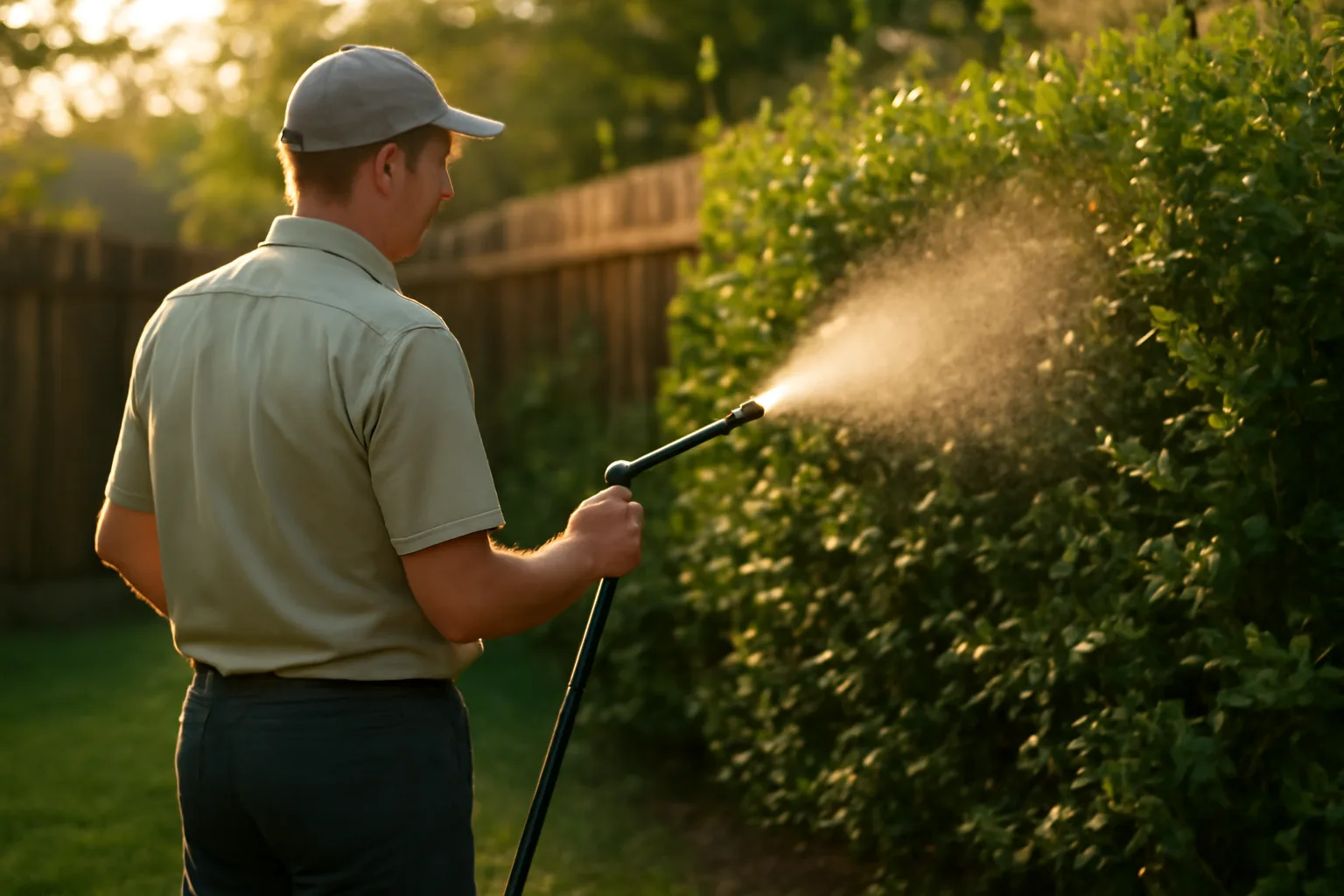
Mosquito Squad is a pest control franchise brand, one of several national companies (Mosquito Joe and various local outdoor pest companies run similar models) that sell yard-based mosquito reduction as a subscription-style service rather than a one-time spray. The core product is a barrier treatment: a technician sprays vegetation, mulch beds, the undersides of decks, fence lines, and other shaded resting spots with an EPA-registered pesticide, usually a synthetic pyrethroid, on a repeating schedule through mosquito season. The reason this article uses "Mosquito Squad" as a jumping-off point rather than a review of one company is that the service model itself matters more than the logo on the truck. Whether you hire a national franchise, a regional outdoor pest control company, or someone advertised through mosquito control near me, you're buying the same basic mechanics: perimeter spraying, a repeat cycle, and (with better companies) an inspection for standing water and harborage sites on your property. Most programs run on a 10 to 14 day retreatment cycle during the warm months, since that roughly matches how long a pyrethroid barrier stays effective on foliage before UV exposure, rain, and new plant growth wear it down. Some companies also install or service standing misting systems as an alternative to human-applied barrier visits; more on that tradeoff below. One honest note: this is a knockdown-and-suppression service, not an eradication service. No barrier treatment, misting system, or fogging program eliminates mosquitoes from an area. Mosquitoes fly in from neighboring yards, storm drains, and wetlands constantly, so the goal of any professional program is to keep the population low enough that you can use your yard, not to get it to zero.
How do professional mosquito barrier treatments actually get rid of mosquitoes?
Barrier treatments work by coating the surfaces mosquitoes land on and rest in during the day, not by fogging the open air where they're flying. Mosquitoes spend most daylight hours resting on the undersides of leaves, in tall grass, under decks, and in dense shrubs; when they land on a treated surface they pick up a lethal dose of pesticide through contact. The active ingredients are almost always synthetic pyrethroids (permethrin, bifenthrin, lambda-cyhalothrin) or, in more targeted programs, pyrethrins with a synergist. These are EPA-registered pesticides, and the label is the law: a licensed applicator has to follow the rate, target sites, and re-entry interval printed on that label. "EPA-registered" means the product cleared the agency's review process for its labeled uses. That is not the same claim as "safe" or "non-toxic," and no reputable company should tell you otherwise. Under the Federal Insecticide, Fungicide, and Rodenticide Act, EPA may register a pesticide only if it determines the product "will not generally cause unreasonable adverse effects on the environment" when used according to the label, a standard defined at 7 U.S.C. Section 136a and 136(bb) [1]. That's a narrower and more honest claim than "harmless." A thorough visit does three things: sprays the barrier (vegetation, mulch, fence lines, structure foundations), treats standing water that can't be dumped (with a larvicide like Bti in ornamental ponds or gutters), and flags things you should fix yourself, like a tarp holding water or a clogged downspout. Skipping that third step is the most common corner companies cut, and it's the difference between a program that actually reduces your baseline mosquito pressure and one that just resprays the same breeding sources every two weeks.
How to get rid of mosquitoes in your backyard
Getting rid of mosquitoes in a backyard means combining source reduction with a barrier treatment. Doing only one of these gets you partial results at best. Start with water: a female mosquito can complete her entire life cycle, egg to biting adult, in as little as 7 to 10 days in warm weather, and she only needs a small amount of standing water to lay eggs [2]. Walk your yard weekly during mosquito season and dump, drain, or cover anything holding water: plant saucers, clogged gutters, tarps, kiddie pools, old tires, birdbaths that don't get refreshed, and low spots in the lawn. The CDC's guidance is blunt about this: "Once a week, empty and scrub, turn over, cover, or throw out any items that hold water" [3]. This single habit does more for your baseline mosquito count than most sprays. After source reduction, a barrier treatment on the 10-14 day cycle handles the mosquitoes flying in from elsewhere, since your neighbors' yards, the storm drain down the block, and nearby woods or wetlands are all still producing mosquitoes you can't control. A mosquito control program sprays the shaded, humid resting spots (shrub undersides, tall grass, wood piles, under decks) where adult mosquitoes hide during the day. Two supporting tactics: run fans on your patio (mosquitoes are weak fliers and avoid moving air above roughly 1-2 mph), and mow tall grass, since tall grass is both a resting site and holds humidity mosquitoes need to survive.
How to keep mosquitoes away long-term (more than kill the ones you see)
Keeping mosquitoes away long-term is a maintenance problem, not a one-spray problem. The mosquitoes you kill today are replaced by new adults emerging from eggs laid a week or two ago, so the strategies that actually hold a low population are the ones you repeat all season. The three habits that matter most: weekly standing-water checks, a repeating barrier treatment (professional or DIY) every 10-14 days during warm months, and structural fixes that remove permanent breeding habitat, like re-grading a soggy corner of the yard or screening a rain barrel. None of these alone holds a population down for a full season; together, they do. If you're doing this yourself rather than hiring a company, backpack or hose-end sprayer applications of a labeled pyrethroid concentrate, applied to the same resting surfaces a pro would target, work on the same 10-14 day logic. The tradeoff is time, equipment, and getting the label rates and target sites right yourself. A natural mosquito repellent approach (essential oil sprays, plants, citronella) can reduce nuisance biting on a patio for an evening but has a much shorter effective window and doesn't reduce the yard's overall mosquito population the way a barrier spray or thorough source reduction does. This is also where a company like Mosquito Squad or a similar local outdoor pest control service earns its fee: consistency. A homeowner who's diligent for three weeks and then skips a month during vacation gives the population time to rebound. A scheduled service doesn't skip.
When do mosquitoes go away for the season?
Mosquitoes typically go dormant or die off once nighttime temperatures consistently drop into the 50s Fahrenheit, since most species become inactive below about 50°F and stop biting altogether well before a hard frost. That said, this is regional and species-dependent, and there's no single national date. In the northern US and Canada, mosquito activity usually wraps up by mid to late October. In the Gulf Coast, Florida, and the desert Southwest, some species stay active nearly year-round whenever temperatures stay mild and there's water present. Culex and Aedes species, the ones that carry West Nile virus and can transmit Zika or dengue in some US regions, are both temperature-sensitive in this way, but exact cutoffs vary by species and local climate. Adult mosquitoes of many species don't actually die when it gets cold; some (like Culex females) overwinter as adults in protected spots like culverts, crawlspaces, and sheds, then re-emerge in spring. Others survive the winter as eggs laid in the mud of dry containers or ephemeral pools, hatching once the site floods again in spring. This is why a mild winter or an early warm spell can produce mosquitoes weeks ahead of a normal schedule. Because the calendar shifts by region and by year, your local mosquito control district, county extension office, or state health department is the best source for when spraying programs typically start and stop in your specific area; a program in coastal Louisiana runs on a very different calendar than one in Minnesota.
How to get rid of mosquitoes in the house
Getting rid of mosquitoes already inside your house starts with finding where they're getting in, since a home with mosquitoes indoors almost always has a gap somewhere: a torn screen, a door that doesn't seal, or a vent without mesh. Check window screens for tears, make sure screen doors close fully and don't have gaps at the bottom, and look at dryer vents, attic vents, and any weep holes in brick veneer. For mosquitoes already inside, a few approaches work in combination. An indoor aerosol labeled for flying insects, used according to the label directions, will knock down what's currently in the house; these products are EPA-registered for indoor use specifically because outdoor barrier products are not labeled or tested for that exposure scenario, so don't substitute one for the other. A fan in the room helps too, for the same reason fans work outdoors: mosquitoes are weak fliers. Check for indoor breeding sources, which is an overlooked cause of a persistent indoor mosquito problem. Overwatered houseplants with saucers, a slow leak under a sink, a humidifier reservoir that isn't cleaned, or even a forgotten vase of flower water can support a small breeding population indoors, especially in humid climates. If you keep finding mosquitoes inside despite fixing screens and doors, walk the house specifically looking for standing water rather than just spraying repeatedly. A screened porch or three-season room is worth treating as its own zone: seal gaps, and if it opens directly onto a yard with a barrier treatment, that program helps reduce what's landing on the screen looking for a way in.
How do you get rid of ticks in your yard, and how is that different from mosquito control?
Getting ticks out of a yard relies on the same barrier-spray logic as mosquito control but targets different zones, since ticks don't fly and don't rest on leaf undersides the way mosquitoes do. Ticks quest from the tips of grass and low vegetation, waiting for a host to brush past, so tick treatments focus on the yard perimeter, especially the transition zone where lawn meets woods, along stone walls, and around leaf litter. The CDC recommends landscaping steps alongside any spray: keep grass mowed short, create a wide barrier of wood chips or gravel between lawn and wooded areas to discourage tick migration, remove leaf litter, and stack woodpiles neatly and in dry, sunny spots [4]. Research from the Connecticut Agricultural Experiment Station on integrated tick management has found that combining landscape modification with targeted acaricide application reduces host-seeking tick abundance in treated residential yards compared to untreated controls [5]. For sprays, the same pyrethroid and pyrethrin products used for mosquito barrier work are also labeled for ticks, applied specifically to yard edges, tall grass, and leaf litter zones rather than broadcast across the whole lawn (ticks aren't typically a problem in short, sunny, regularly mowed turf). A tick repellent applied to skin and clothing before you're in the yard is a separate, complementary layer, not a replacement for yard treatment. Companies offering both mosquito and tick programs (this is common; Mosquito Squad and similar franchises typically sell them as a combined seasonal package) will usually do a single visit that treats both zones, since the technician is already walking the property.
What plants repel mosquitoes, and does planting them actually work?
A mosquito repellent plant is a plant that contains compounds mosquitoes find irritating or that mask the CO2 and body-heat cues mosquitoes use to find a host, but the honest answer is that having these plants in your yard does very little on its own. Citronella grass, lemongrass, catnip, marigolds, lavender, rosemary, and basil are the usual suggestions, and most of that reputation comes from the essential oils these plants contain, not the living plant itself. The compounds are real and some (notably oil of lemon eucalyptus, and catnip's nepetalactone in lab studies) have shown repellent activity when extracted, concentrated, and applied to skin. But an intact plant releases very little of that oil into the air just sitting in a pot on the patio; you'd need to crush the leaves and rub the oil on yourself to get anything close to the effect of a bottled repellent. EPA's registered skin-applied repellent active ingredients include oil of lemon eucalyptus and its refined derivative PMD, tested and registered specifically for that purpose, unlike an ornamental plant standing in a garden bed [6]. So: plant them if you like them in a garden, and don't expect them to replace a barrier spray, but don't count on a few pots of citronella to keep a patio bite-free either. If you want a repellent effect from these plants, you're better off with a mosquito repellent product that actually concentrates and delivers the active compound, or a broader natural mosquito repellent approach that's honest about what's proven versus folklore.
Barrier spray vs. misting system vs. DIY: which should you actually pick?
| Professional barrier service | Technician sprays vegetation/resting sites every 10-14 days | ~$50-100+ per visit or roughly $400-1,200+ per season depending on lot size and region | Most homeowners; combines inspection with treatment | |
|---|---|---|---|---|
| Installed misting system | Nozzles plumbed around the property, timed or remote-triggered automatic spray | Installation often $2,000-6,000+, plus refill/service costs | Large or high-use outdoor properties, frequent entertainers | |
| DIY backyard spray | Homeowner applies labeled pyrethroid concentrate with hose-end or backpack sprayer | Concentrate products typically $20-50 per treatment's worth | Budget-conscious homeowners willing to do it consistently | These cost ranges are typical industry figures, not fixed prices; get a free yard assessment from a local company to get an actual number for your property, since lot size, vegetation density, and region all move the price. Misting systems have a real drawback worth saying plainly: because they spray on a timer or by remote regardless of whether mosquitoes are actually active, they tend to use more pesticide over a season than a targeted 10-14 day barrier visit, and some mosquito control experts and extension entomologists have raised concerns about non-target impact on pollinators when systems are set to spray during the day or too frequently. If you get a misting system, dusk-only or motion-triggered settings and infrequent full-property cycles matter for that reason. DIY works, but it only works if you actually do it every 10-14 days without fail through the whole season, and you accept the trial and error of learning where the resting sites are on your specific property. Most people who go the professional route do so for the consistency, not because the spray itself is impossible to buy. |
The right choice depends mostly on lot size, how much control you want over the schedule, and whether you'd rather have a person walk your property or a system spray automatically. Here's how the three main options actually compare. | Option | How it works | Typical cost | Best for |
What does a mosquito barrier treatment actually cost, and what's in a typical visit?
A single mosquito barrier treatment visit typically runs $50 to $100 or more, and a full-season program (roughly April through October in much of the US, longer in warmer climates) usually lands between $400 and $1,200 or more depending on lot size, vegetation density, and region. Larger, heavily wooded, or more humid properties cost more because there's more surface area to treat and mosquito pressure is higher to begin with. A typical visit includes a walk of the property to check for new standing water, spraying of shrub lines, mulch beds, tall grass, and the undersides of decks and porches, treatment of the tree line and fence line where mosquitoes rest during the day, and (if the company offers it) larvicide tablets or dunks in any ornamental water features that can't be drained. Good companies will also flag things outside the scope of the spray, like a neighbor's uncovered pool or a drainage issue, since those sources will keep feeding the population no matter how often you spray. This is the point where mentioning Mosquito Squad specifically is useful: it, like most national outdoor pest franchises, sells this service as a seasonal program with a free initial yard assessment rather than a one-time spray, precisely because a single visit doesn't hold a population down. Any company running a legitimate program, whichever brand is on the invoice, should be offering you the same basic structure: inspection, barrier application, repeat cycle, and an honest conversation about what the spray can and can't do. If you want a number specific to your yard rather than a national range, get a free yard assessment and have a technician walk the property; lot size, tree cover, and local mosquito pressure all move the price more than the brand does.
Are these mosquito and tick sprays safe for kids, pets, and pollinators?
EPA-registered pyrethroid products used for mosquito and tick barrier treatments are not labeled as "safe" outright; they're approved for specific uses at specific rates when applied according to the label, and the label sets a re-entry interval (often once the spray has dried, typically a few hours) before people and pets should walk on treated surfaces. Ask your applicator for the specific product's label and re-entry time rather than assuming a blanket answer, since it varies by product and by state. Pyrethroids are toxic to bees and other pollinators on direct contact, which is why responsible application avoids spraying open flowers and blooming plants directly and instead targets non-flowering foliage, resting surfaces, and structural elements. EPA's ecological risk assessments for pyrethroid insecticides, including its 2018 problem formulation for bifenthrin under registration review (EPA docket EPA-HQ-OPP-2010-0384), identify acute contact toxicity to bees and other pollinators as a key risk driver, which is part of why label language restricts application to blooming vegetation [7]. If pollinator gardens are important to you, tell your technician; a good company will spray around them rather than through them. For pets, keep animals off treated grass and vegetation until the spray has dried, per the product label, and ask specifically about cats, since cats are more sensitive to some pyrethroid formulations than dogs. For fish and aquatic life, larvicides like Bti (Bacillus thuringiensis israelensis) used in ponds and water features are generally considered to have low toxicity to fish and mammals at labeled rates, which is why Bti, not a pyrethroid, is the standard product for water that can't be drained. The honest summary: these are real pesticides with real label restrictions, not harmless treatments, and "EPA-registered" means reviewed and approved for labeled use, not a safety guarantee independent of how it's applied.
Frequently asked questions
How do I get rid of mosquitoes fast?
There's no truly instant fix; the fastest real reduction comes from dumping all standing water immediately (this removes breeding sites within minutes) combined with a barrier spray of resting areas like shrubs, mulch beds, and shaded fence lines. A professional visit or a labeled DIY pyrethroid application knocks down existing adults within hours, but new mosquitoes will keep arriving from nearby sources.
How do I keep mosquitoes away from my patio during a party?
Run box fans nearby (mosquitoes are weak fliers and struggle in moving air), light citronella candles or use an EPA-registered spatial repellent device, and make sure a barrier treatment was applied within the last 10-14 days if you have one scheduled. None of these alone is as effective as combining them.
How do I get rid of ticks in my yard without spraying?
Mow grass short, remove leaf litter and brush piles, and create a wide barrier of wood chips or gravel between lawn and wooded edges, since ticks avoid dry, sunny, open ground. Research from the Connecticut Agricultural Experiment Station supports these landscaping changes as reducing tick presence in treated zones, even without pesticide use.
What plants repel mosquitoes best?
Citronella grass, lemongrass, catnip, marigolds, lavender, rosemary, and basil are the commonly cited mosquito repellent plants, mostly because of the essential oils they contain. An intact, unbruised plant releases very little of that oil, though, so these plants have a modest effect at best compared to an applied repellent product.
How do I get rid of mosquitoes in my house?
Check screens and doors for gaps, look for indoor standing water (plant saucers, humidifiers, slow leaks), and use an EPA-registered indoor flying-insect aerosol per its label for mosquitoes already inside. A fan in the room also helps, since mosquitoes fly poorly against moving air.
When do mosquitoes go away for the year?
Most species become inactive once nights consistently drop into the 50s Fahrenheit, typically mid to late October in the northern US, later or not at all in the Gulf Coast, Florida, and parts of the Southwest. Some adults overwinter in sheltered spots rather than dying, so a warm spell can bring them back early.
How often should a mosquito barrier treatment be reapplied?
Most professional programs, including Mosquito Squad-style franchise services, run on a 10 to 14 day cycle through the warm season. That interval roughly matches how long a pyrethroid barrier holds up on foliage before rain, UV exposure, and new plant growth reduce its effectiveness.
Is a misting system better than a barrier spray service?
Misting systems automate spraying but tend to use more pesticide over a season since they spray on a timer regardless of mosquito activity, and can pose more pollinator risk if not set carefully. A targeted 10-14 day barrier visit from a technician who inspects the property first is usually the more efficient option for most yards.
How much does mosquito yard treatment cost?
A single visit typically runs $50 to $100 or more, and a full season generally costs $400 to $1,200 or more depending on lot size, vegetation, and region. Get a free yard assessment for a number specific to your property, since national averages don't account for local mosquito pressure or lot complexity.
Can I get rid of mosquitoes permanently?
No. Mosquitoes fly in from neighboring yards, storm drains, and natural water sources regardless of what you do on your own property, so no spray, system, or plant eliminates them permanently. The realistic goal of any program is sustained suppression, not eradication.
Do bug zappers or ultrasonic devices get rid of mosquitoes?
Bug zappers kill mostly non-biting insects attracted to light and have limited effect on mosquito populations, since female mosquitoes hunt by CO2 and body heat rather than light. Ultrasonic repellent devices lack consistent scientific support for effectiveness against mosquitoes.
What's the difference between mosquito control and tick control in a yard program?
Mosquito control targets flying adults resting in shaded, humid spots like shrub undersides and mulch beds. Tick control targets a completely different zone: the lawn-to-woods transition, tall grass, and leaf litter, since ticks quest from vegetation tips rather than flying. Many companies combine both in a single seasonal visit.
Are mosquito barrier sprays safe for kids and pets?
EPA-registered barrier products are approved for labeled use, not certified as universally safe; each product's label sets a re-entry interval (commonly a few hours, until the spray dries) before people and pets should be on treated grass. Ask your applicator for the specific product label and re-entry time for your treatment.
Sources
- Federal Insecticide, Fungicide, and Rodenticide Act (FIFRA), 7 U.S.C. Section 136a: EPA may register a pesticide only if it will not generally cause unreasonable adverse effects on the environment when used per the label
- CDC, Mosquito Life Cycle: Mosquitoes can complete their life cycle from egg to adult in about a week to 10 days in warm weather and need very little standing water to breed
- CDC, Controlling Mosquitoes at Home: CDC recommends weekly emptying, scrubbing, turning over, covering, or discarding items that hold water
- CDC, Preventing Tick Bites on People: Yard modifications like clearing leaf litter, mowing short, and creating buffer zones reduce tick presence around homes
- Williams SC, Ward JS, Worthley TE, Stafford KC, "Managing Japanese Barberry (Ranunculales: Berberidaceae) Infestations Reduces Blacklegged Tick (Acari: Ixodidae) Abundance and Infection Prevalence with Borrelia burgdorferi", Environmental Entomology, PMID 19825285: Landscape modification methods reduce tick populations in treated residential/woodland edge zones
- US EPA, Find the Repellent that is Right for You: EPA-registered skin repellent active ingredients include oil of lemon eucalyptus (PMD), which has been tested and registered for that use
- US EPA, Bifenthrin: Problem Formulation for Registration Review, Docket EPA-HQ-OPP-2010-0384: EPA risk assessments for pyrethroids like bifenthrin identify pollinator risk from direct spray contact