Last updated 2026-08-14
TL;DR
The best yard mosquito protection combines source reduction (dumping standing water weekly), a repellent-treated perimeter of vegetation, and a professional barrier spray on a 10-14 day cycle during peak season. No single method eliminates mosquitoes; layering methods cuts bites the most. Misting systems help large or wooded lots but need real maintenance.
How do you get rid of mosquitoes in your backyard?
You get rid of most backyard mosquitoes by combining three things: eliminating standing water, treating vegetation where they rest, and keeping up a repeat treatment schedule instead of a one-time spray. No single step does the whole job. Mosquitoes breed in water and spend most of their life resting in shady, humid vegetation, not flying around biting you, so a plan has to hit both the breeding side and the resting side. Start with water. The CDC states that female mosquitoes lay eggs in or near standing water and that eggs can hatch into biting adults within about a week under warm conditions [1]. Walk your property every 5 to 7 days during the season and dump anything holding water: saucers under potted plants, clogged gutters, tarps, kiddie pools, birdbaths that aren't refreshed, and old tires. A bottle cap of water is enough for some species to breed in. Next, treat the vegetation. Adult mosquitoes rest on the undersides of leaves in shrubs, tall grass, and ground cover during the heat of the day. A barrier spray applied to these resting sites, more than open lawn, is what actually knocks down the population you see at dusk. This is where a lot of DIY efforts fail: people spray the grass and skip the shrub line, which is where the mosquitoes actually are. Finally, commit to a schedule. Most EPA-registered residual barrier products break down within 2 to 3 weeks depending on the active ingredient, rainfall, and UV exposure, which is why professional programs run on a 10 to 14 day cycle through the season rather than a single application [2]. If you're comparing your options before committing to a schedule, our mosquito control overview walks through what a full program includes. Be honest with yourself about what "get rid of" means here. Barrier treatments reduce populations, they don't eliminate mosquitoes from an open yard next to woods or wetlands. Anyone promising zero mosquitoes forever is overselling.
How do you keep mosquitoes away without spraying every day?
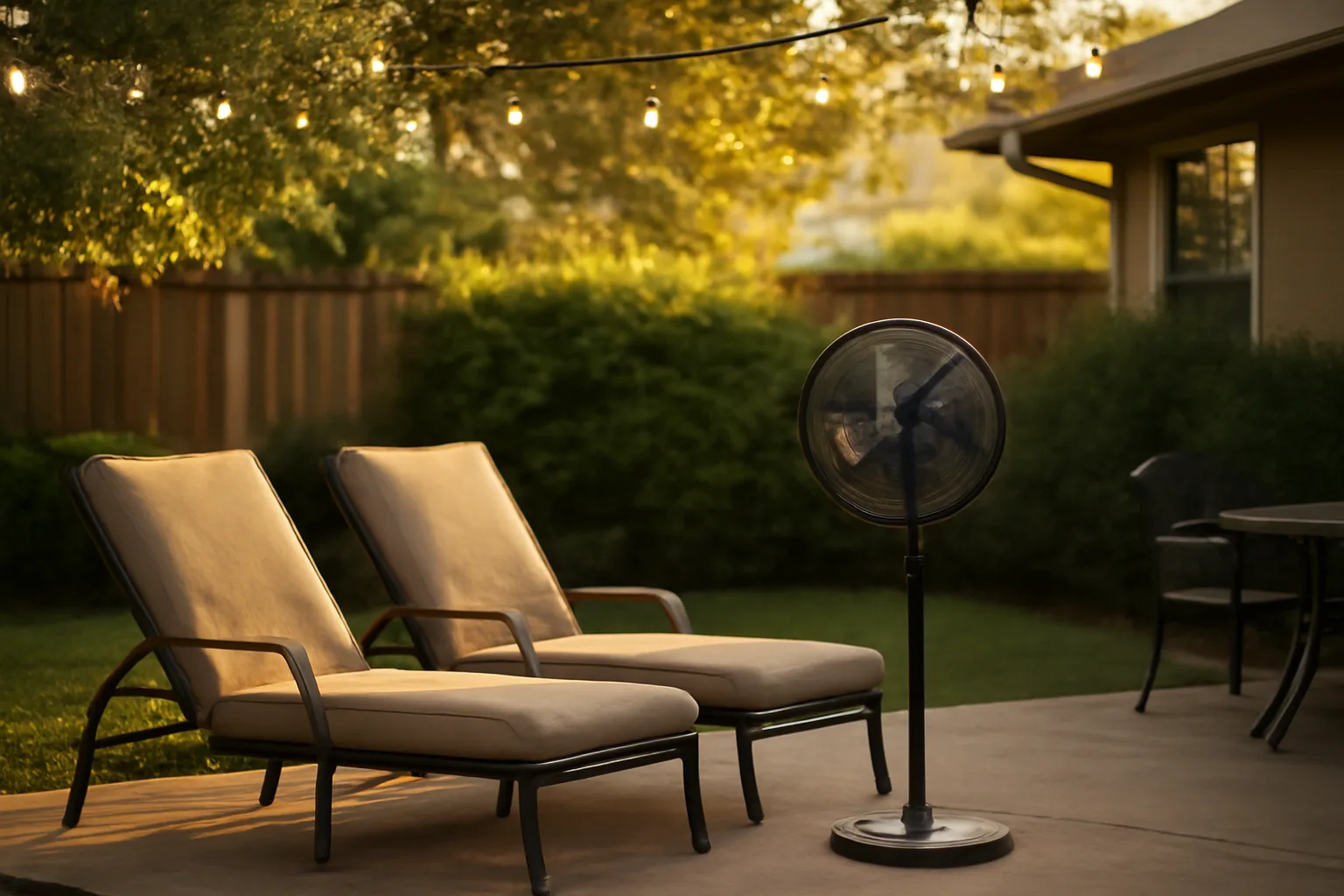
You keep mosquitoes away between treatments by reducing what attracts them: standing water, dense unmown vegetation, and carbon dioxide/body heat sources like crowded seating areas near shade. A treated barrier lasts roughly 2 to 3 weeks, so the gap is filled by habitat control and personal repellents, not daily spraying. Fans matter more than people think. Mosquitoes are weak fliers, and a box fan or ceiling fan moving air across a patio measurably cuts landing rates because it disrupts their flight and disperses the CO2 plume they track. This is one of the few genuinely free, chemical-free interventions with a real mechanism behind it, though there's not a large body of controlled yard trials quantifying the exact percentage reduction outdoors. Mow regularly and thin dense shrub borders where mosquitoes rest during the day. Keep grass under about 3 inches where you can, since tall grass holds humidity and shade that adult mosquitoes prefer. For personal protection between service visits, the CDC and EPA recommend repellents containing DEET, picaridin, IR3535, oil of lemon eucalyptus (OLE), para-menthane-diol (PMD), or 2-undecanone, all of which are registered by the EPA specifically because they've been evaluated for effectiveness and human safety data under label use [3]. Products should always be applied according to the label; the EPA registration is not a blanket safety claim, it means the product met specific efficacy and toxicology data requirements for its labeled use. Our natural mosquito repellent guide and mosquito repellent comparison break down which actives actually have data behind them versus which are mostly marketing.
What plants repel mosquitoes, and does planting them actually work?
Plants like citronella grass, lavender, marigold, catnip, lemon balm, and rosemary contain compounds mosquitoes tend to avoid, but an intact, unbroken plant sitting in a pot does not release enough of that compound to repel mosquitoes across a yard. The oils have to be extracted, concentrated, and applied to skin (like citronella oil or oil of lemon eucalyptus) to work as a repellent at meaningful strength. Here's the honest version: a border of lemongrass or lavender looks nice, may offer a very localized, mild effect if you brush against the leaves and release oil, and does zero to keep mosquitoes off you 15 feet away on the patio. If a homeowner tells you "plant marigolds and you're covered," that's not backed by controlled outdoor trials. Extension entomologists generally frame these plants as a nice-to-have complement, not a mosquito control method on their own. A mosquito repellent plant, in the strict sense, is one whose extracted oil is registered by the EPA as an active ingredient, like oil of lemon eucalyptus (from Corymbia citriodora) or citronella oil, which is used in candles and some skin-applied products [3]. The plant itself sitting in your garden bed isn't doing that job for you. If you like the idea of a living border, pair it with something that actually works: source reduction and a barrier spray program. Treat the plants as decoration with a pleasant side benefit, not your primary defense.
How do you get rid of mosquitoes in the house?
Indoor mosquitoes almost always trace back to either an entry point (a torn screen, a gap under a door) or an indoor breeding site (a plant saucer, a forgotten vase, a clogged drain). Fix the entry and eliminate the water source, and most indoor mosquito problems resolve within days since adult mosquitoes typically live only 2 to 4 weeks [4]. Check window and door screens for tears; even a small gap lets mosquitoes in repeatedly. Check under sinks and around drains, since some species (notably Culex) can breed in small amounts of standing water in drains, sump pump pits, and even overflow trays for AC units or humidifiers. For mosquitoes already inside, a few tools help: a plug-in trap or a simple bowl of soapy water near a light can attract and drown them, a handheld vacuum works for stragglers on curtains or ceilings, and an indoor-labeled aerosol (check the label for indoor use) handles the rest. Avoid outdoor-only barrier products indoors; label restrictions exist for a reason tied to ventilation and exposure. If mosquitoes keep reappearing indoors despite a clean house and intact screens, the source is probably outside your door, in gutters, a window well, or a neighbor's yard. Getting the outdoor population down is what actually stops the indoor problem long-term.
How do you get rid of ticks in your yard?
You reduce yard ticks by narrowing the humid, shaded habitat they need to survive, treating the perimeter where lawn meets woods or tall grass, and controlling the wildlife (deer, rodents) that carry ticks onto your property. Ticks don't jump or fly; they quest from vegetation and grab onto a passing host, so habitat control at ground level matters more than broad lawn spraying. The CDC recommends yard modifications including keeping grass mowed short, removing leaf litter and brush, and creating a wide barrier of wood chips or gravel between lawn and wooded areas to reduce tick migration into recreational yard areas [4]. Stack woodpiles neatly and off the ground, since damp piles are prime rodent (and by extension tick) habitat. A licensed applicator can treat the yard perimeter, leaf litter zones, and stone walls with an EPA-registered acaricide following label directions; this is typically done in late spring and again in late summer/early fall to catch nymph and adult tick activity peaks. Exact timing depends on regional tick species and climate, so check with your local extension office. Fencing to exclude deer, keeping bird feeders (which attract rodents) away from play areas, and treating pets with a vet-recommended tick preventive round out a full yard plan. For repellents you apply to skin or clothing for tick protection during yard work, see our tick repellent guide.
What's the difference between a barrier spray and a misting system?
| Setup | None, technician visits | Installed nozzles, reservoir | |
|---|---|---|---|
| Frequency | Every 10-14 days | Daily or timed, often dusk/dawn | |
| Adapts to resting sites | Yes, technician targets them | No, fixed nozzle locations | |
| Upfront cost | Lower | Higher (installation) | |
| Best for | Most suburban/residential yards | Heavily wooded or high-pressure lots | We walk through this decision in more depth in our mosquito control guide, including what a technician actually looks for during a yard assessment. |
A barrier spray is a liquid treatment applied by a technician (or homeowner) to vegetation, mulch beds, and shaded resting sites, typically every 10 to 14 days through the season; a misting system is a fixed network of nozzles installed around the property that automatically releases a fine mist on a timer or remote trigger, usually daily or at dusk/dawn. Both use EPA-registered active ingredients, but the delivery method, cost, and commitment are very different. Barrier spray is the more common starting point for most homeowners. It requires no permanent hardware, works on any yard size, and a service technician can adjust the plan seasonally. The tradeoff is that it's a scheduled visit, not an always-on system, so the population starts climbing back in the days before the next treatment. A misting system is a bigger upfront commitment: it requires installed plumbing, a reservoir, and periodic refills, and it treats the same fixed nozzle zones every time rather than adapting to where mosquitoes are actually resting that week. For a heavily wooded lot, a rental property near standing water, or someone who wants a near-daily automatic release, a misting system can make sense. For most suburban lots, a barrier program on a 10 to 14 day cycle covers the need at lower cost and complexity. | Feature | Barrier spray | Misting system |
When do mosquitoes go away for the season?
Mosquitoes typically become inactive once temperatures consistently drop below about 50°F (10°C), since most species stop flying and feeding at that point, though the exact date varies enormously by region and can shift year to year with weather. In much of the northern U.S., that's late October or November; in the Gulf Coast, Florida, and parts of the Southwest, mosquitoes can remain active nearly year-round because temperatures rarely stay below that threshold [5]. Mosquitoes don't die off entirely in cold climates either. Many species overwinter as eggs (laid in a location that will flood in spring), while some adult females of certain species (like Culex) go dormant in protected spots like sheds, culverts, or hollow trees and re-emerge when temperatures warm. This matters for scheduling: a barrier program should extend into the shoulder season, not stop the day it feels cool outside, since a stretch of 60-degree afternoons in October can still bring mosquitoes out even after a few cold nights. Your local mosquito control district or extension office is the best source for typical first-frost and mosquito-season-end dates in your specific area, since a date that's accurate for zone 7a is meaningless in zone 9b. For season-start planning, see our companion piece on timing treatments; the same logic in reverse applies to figuring out when to stop.
How much does professional mosquito treatment cost, and is it worth it?
Professional mosquito barrier treatment programs are generally quoted per visit or per season based on yard size, vegetation density, and treatment frequency, and pricing varies enough by region and provider that any single national number is more misleading than helpful. Rather than publish a generic figure, most reputable local companies (including services structured around a recurring 10-14 day cycle) quote after walking the actual property, since a quarter-acre lawn with a wooded back edge costs meaningfully more to treat than a small fenced yard. What you're paying for isn't a magic fix, it's population suppression maintained over the season. A single treatment can reduce mosquito activity noticeably within 24 to 48 hours, but that effect fades as the residual breaks down and new adults emerge from nearby untreated areas, which is the entire reason for the repeat cycle instead of a one-time job. Whether it's worth it depends on how much your yard actually gets used. If you're hosting outdoor dinners, have kids who play outside at dusk, or live near a wooded lot or wetland with heavy pressure, a season-long program usually pays for itself in actual usable outdoor time. If your yard sees light use and you don't have a standing water or vegetation problem nearby, DIY source reduction plus personal repellent might be enough. The honest way to figure out which situation you're in is a walk-through. That's the whole idea behind a free yard assessment: a technician looks at your specific water sources, vegetation, and shade before recommending a barrier plan or a misting system, rather than guessing from a phone call. You can get a free yard assessment through Duskproof if you want that specific-to-your-yard read rather than a generic estimate.
Do bug zappers, citronella candles, and ultrasonic devices actually work?
Bug zappers, citronella candles, and ultrasonic devices are, at best, minor and localized helpers, not real mosquito control, and the research on several of them is genuinely unflattering. This is one area where the marketing badly outpaces the data. Bug zappers (UV light traps) actually attract and kill mostly non-biting insects. A frequently cited field study by entomologists at the University of Notre Dame found that mosquitoes made up a tiny fraction of the total insects killed by residential zappers over a season, meaning they're mostly killing beneficial and harmless bugs while barely denting the mosquito population . If anything, they can slightly increase local insect activity by drawing bugs toward your patio. Citronella candles create a small localized scent cloud that can offer modest, short-range reduction in landing rate right next to the candle, but that effect drops off fast with distance and wind, and it does nothing for the yard as a whole. Ultrasonic repellent devices, the plug-in or wearable kind claiming to emit sound that repels mosquitoes, have not held up in controlled testing; multiple independent evaluations have found no meaningful reduction in mosquito landing or biting rates from these devices. If you see one marketed with strong claims and no cited independent study, that's a signal to skip it. Spend the money instead on source reduction, a fan for the patio, and a real repellent with an EPA-registered active ingredient for personal protection between barrier treatments.
What can I do myself before calling a professional service?
Before you spend money on a service, do a full source reduction pass and see how much it changes things; this costs nothing but time and it's the single highest-leverage step available to any homeowner. Walk the property weekly, dump every container holding water, clear gutters, and check anywhere water can pool for more than 4 to 7 days, since that's roughly the window many mosquito species need to complete their larval stage in warm weather [1]. Thin dense shrub borders and mow regularly so adult mosquitoes have fewer shaded daytime resting sites. If you have a pond, water feature, or rain barrel you can't drain, consider a larvicide product labeled for that use, such as those containing Bti (Bacillus thuringiensis israelensis), which targets mosquito larvae and is commonly used in situations where standing water can't be removed [2]. Add a fan to your main outdoor sitting area and stock a couple of EPA-registered repellent options (different actives suit different situations, like DEET for longer outdoor stretches versus picaridin for a lighter feel). If you've done all that and you're still getting eaten alive at dusk, that's usually a sign the pressure is coming from beyond your fence line, a neighbor's yard, nearby woods, a drainage ditch, or standing water you can't control. That's the point where a barrier spray program or an assessment from a local provider starts to make sense, since a technician can identify resting sites and pressure sources a homeowner might miss on a casual walk-through.
Frequently asked questions
How do I get rid of mosquitoes fast in my backyard?
Dump all standing water immediately, since that removes active breeding sites, then apply an EPA-registered barrier spray to shrubs and shaded resting areas. A single treatment can reduce visible activity within 24 to 48 hours, but it fades over 2 to 3 weeks, so fast relief still needs a repeat schedule to hold.
How do I keep mosquitoes away from my patio without spraying myself?
Run a box fan or ceiling fan on the patio, since mosquitoes are weak fliers and struggle in moving air. Combine that with removing nearby standing water and thinning shrubs where they rest during the day. A professional barrier treatment on a 10-14 day cycle covers the rest.
How do you get rid of ticks in a yard naturally?
Mow grass short, clear leaf litter and brush, and create a wide barrier of wood chips or gravel between lawn and wooded edges, a modification the CDC recommends for reducing tick migration into yards. Keep woodpiles off the ground and limit deer and rodent access, since both carry ticks onto the property.
What is a mosquito repellent plant and does it actually work in a garden bed?
A mosquito repellent plant is one whose extracted oil (like lemon eucalyptus or citronella) is used as an EPA-registered repellent active ingredient. The intact plant growing in your yard releases very little of that compound, so it looks nice but doesn't meaningfully repel mosquitoes across the yard.
What plants repel mosquitoes the best?
Citronella grass, lavender, lemon balm, catnip, marigold, and rosemary all contain compounds mosquitoes tend to avoid, but as growing plants they offer only mild, localized effect at best. For real repellency you need the extracted, concentrated oil applied to skin, not the plant itself sitting in a bed.
How do I get rid of mosquitoes in my house?
Check screens for tears, check drains and any indoor standing water (plant saucers, sump pits, AC overflow trays), and eliminate those sources. Adult mosquitoes live only 2 to 4 weeks, so fixing entry points and water sources usually resolves an indoor problem within days.
When do mosquitoes go away for the year?
Most mosquito species become inactive once temperatures consistently stay below about 50°F, which is typically late October or November in northern U.S. climates and much later, or year-round, in warmer regions like Florida and the Gulf Coast. Check your local extension office for typical dates in your zone.
Do citronella candles actually keep mosquitoes away?
They provide only a small, short-range effect right around the candle itself, and that drops off quickly with distance and wind. They're not a real substitute for source reduction or a barrier treatment; treat them as a minor supplement at best.
Do bug zappers reduce mosquito bites?
Not much. A widely cited University of Notre Dame field study found mosquitoes made up only a small fraction of insects killed by residential zappers over a season, meaning they're mostly killing harmless bugs while barely affecting mosquito numbers around you.
How often should a yard mosquito barrier spray be reapplied?
Most EPA-registered residual barrier products lose effectiveness within 2 to 3 weeks depending on rain, UV exposure, and the specific active ingredient, which is why professional programs typically run on a 10 to 14 day repeat cycle through the season rather than a single application.
Is a misting system better than a barrier spray service?
Not necessarily better, just different. Misting systems suit heavily wooded lots or homeowners wanting daily automatic treatment, but require installation and maintenance. A scheduled barrier spray works for most suburban yards at lower cost and adapts to actual resting sites each visit.
How do you get rid of ticks that are already on my dog or in the house?
Use a veterinarian-recommended tick preventive on pets and check them after outdoor time, since pets can carry ticks indoors. Indoors, vacuum thoroughly (especially along baseboards and pet bedding) and treat the yard perimeter to reduce ticks getting onto pets in the first place.
Sources
- CDC, Life Cycle of Culex Mosquitoes: female mosquitoes lay eggs in or near standing water and eggs can hatch within about a week in warm conditions
- EPA, Find the Insect Repellent that is Right for You: EPA-registered repellent actives include DEET, picaridin, IR3535, oil of lemon eucalyptus, PMD, and 2-undecanone
- CDC, About Mosquitoes: adult mosquitoes typically live 2 to 4 weeks
- CDC, Preventing Ticks in the Yard: yard modifications like mowing, clearing leaf litter, and creating barriers reduce tick habitat and migration into yards
- CDC, Where Mosquitoes Live: mosquito activity is temperature-dependent and varies by region and season
- Nasci RS et al., Journal of the American Mosquito Control Association, evaluation of insect electrocution traps: mosquitoes make up a small percentage of insects killed by residential UV bug zappers