Last updated 2026-08-14
TL;DR
CDC-recommended repellents (DEET, picaridin, IR3535, oil of lemon eucalyptus, 2-undecanone) protect skin for 2 to 8 hours depending on concentration. Yard barrier sprays are a separate tool: they knock down resting mosquito populations for 10 to 21 days but don't replace personal repellent when you're actually outside getting bitten. Combine both plus standing-water removal for real relief.
What's the difference between skin repellent spray and yard mosquito spray?
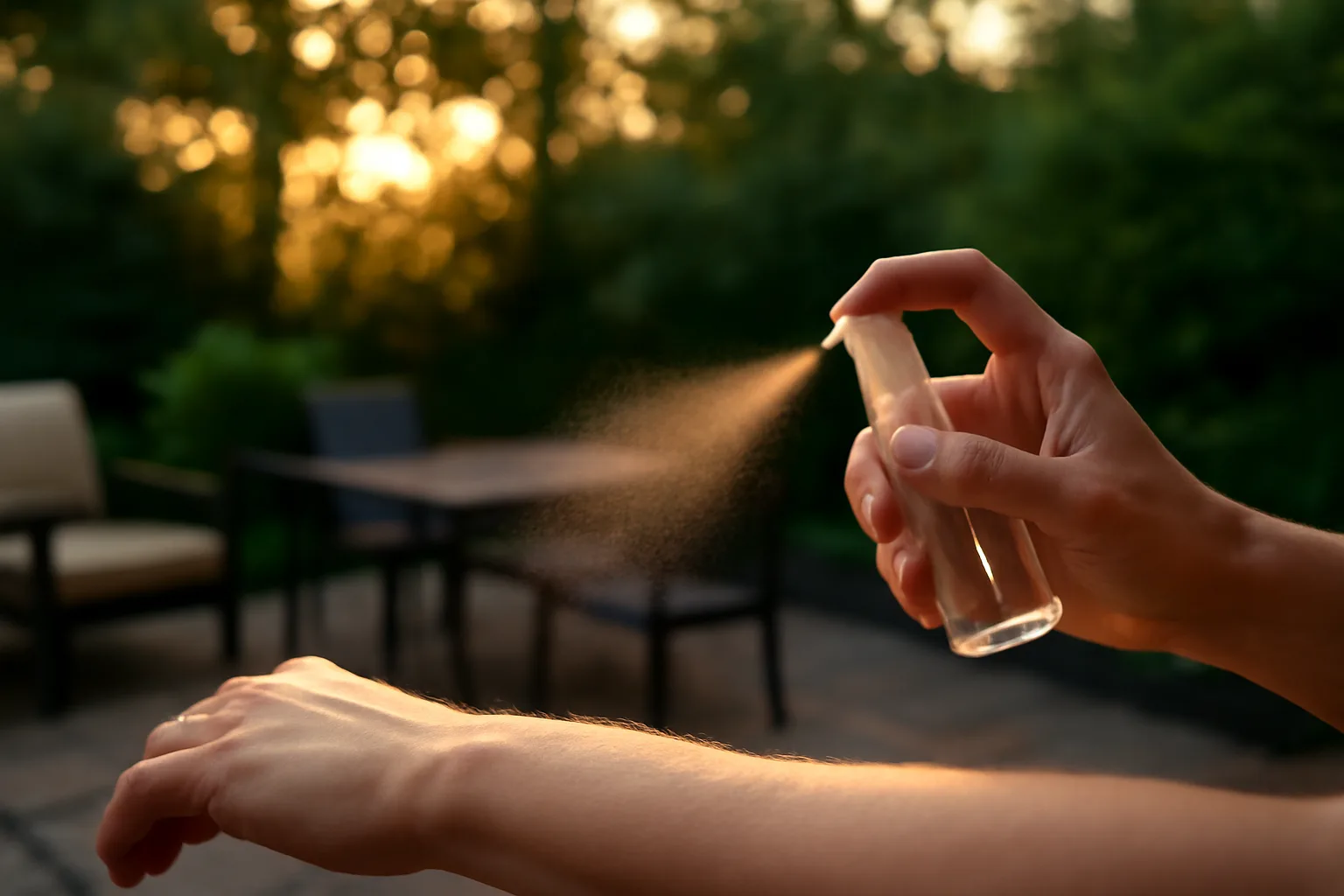
Skin repellent spray goes on you: it's a chemical that confuses a mosquito's ability to find you by smell, and it wears off in hours. Yard mosquito spray (barrier treatment) goes on your landscape: it's a residual insecticide applied to shrubs, foliage, and shaded resting spots that kills or knocks down mosquitoes that land there over a period of days to weeks. People conflate these because both get called "mosquito repellent spray," but they solve different problems. A can of picaridin in your bag protects you on a hike or at a barbecue three towns over. A barrier treatment on your own property is what keeps your backyard usable without you having to spray yourself every time you step outside to grill. Most homeowners end up using both. Skin repellent for travel, hikes, and any yard that hasn't been treated. A seasonal barrier plan (or an installed misting system) for the yard you actually live in. Neither one eliminates mosquitoes. The CDC is direct about the tradeoff: repellents "prevent bites" from insects that are already active, they don't reduce the population [1].
How to get rid of mosquitoes (the short answer, and the real one)
There's no single spray that gets rid of mosquitoes for good. The real answer is layered: remove standing water, treat the yard's resting spots on a schedule, and use personal repellent when you're exposed anyway. Skipping any one layer means the other two work harder for less result. Start with water. A mosquito can complete its entire life cycle, egg to biting adult, in as little as 7 to 10 days in warm weather, and it only needs a bottle cap of standing water to do it [2]. Bird baths, clogged gutters, tarps, saucers under potted plants, and old tires are the usual suspects. The EPA's guidance is blunt: "look for and remove standing water" weekly, because that's where the population you're fighting actually comes from [3]. Next, treat the resting habitat. Adult mosquitoes don't fly around in open sun all day; they hide in the underside of leaves, in dense shrubs, under decks, and in tall grass, then come out at dusk to feed. A barrier spray applied to those surfaces is what knocks the resting population down between generations. This is the part most homeowners skip because they don't see it happening, and it's usually the highest-leverage move after water removal. Last, personal repellent covers the gap. No treatment, yard-wide or otherwise, gets every mosquito, so if you're going to be outside at dusk, use a CDC-recommended repellent on exposed skin. For a property-wide plan, a mosquito control service will assess breeding sites and set a barrier schedule instead of guessing.
Which mosquito repellent spray actually works? (DEET vs picaridin vs natural options)
| DEET 10-30% | 2-8 hours (scales with %) | Yes | Most-studied option [4] |
|---|---|---|---|
| Picaridin 20% | ~8-12 hours reported in some studies | Yes | Less odor, doesn't damage plastics |
| OLE / PMD | ~6 hours in CDC-cited data | Yes | Not for kids under 3 [1] |
| IR3535 | Several hours, varies by formulation | Yes | Also used in some sunscreens |
| Citronella candles/oil (unregistered) | Minutes, highly variable | No | Not on the CDC list [1] |
The CDC and EPA maintain a short list of active ingredients with data behind them: DEET, picaridin, IR3535, oil of lemon eucalyptus (OLE, the synthesized version, chemical name PMD), and 2-undecanone [1]. If a spray doesn't contain one of these, treat the marketing claims with skepticism. DEET is the oldest and most studied. Concentrations of 10% to 30% are common in consumer products; the EPA notes protection time scales with concentration, not effectiveness against a wider range of species, so a 30% formula lasts longer per application but doesn't necessarily repel "better" than a 10% one [4]. The American Academy of Pediatrics has said DEET products up to 30% are fine for children over 2 months old [5]. Picaridin (20% concentration) performs comparably to DEET in published trials and has less odor and less plastic-damaging potential, which is why a lot of newer sprays default to it. Oil of lemon eucalyptus (the registered PMD version, not raw essential oil) is the one plant-derived option the CDC actually recommends, with efficacy in the same range as low-concentration DEET in some trials [1]. The CDC specifically warns that OLE should not be used on children under 3 [1]. | Active ingredient | Typical protection time | CDC/EPA recommended | Notes |
How long does mosquito repellent spray actually last?
Personal skin repellent lasts roughly 2 to 8 hours depending on the active ingredient and its concentration, and it degrades faster with sweating, swimming, or rain. Yard barrier spray lasts 10 to 21 days on foliage before it needs reapplication, which is why most services run on a 2-to-3-week cycle instead of a one-time visit. On the personal side: EPA-registered labels list reapplication intervals, and higher percentages generally buy more hours, not stronger protection per hour [4]. A 10% DEET product might need reapplication in around 2 hours; a 30% product can run 5+ hours. Picaridin and OLE labels vary by manufacturer, so check the specific product. On the yard side: barrier treatments break down from UV exposure, rain, and plant growth (new leaf surface isn't coated). That's the entire logic behind a natural mosquito repellent approach still needing a repeat schedule, and it's why any service promising a single spray for the whole season is overselling it. A 10 to 14 day cycle during peak season is a reasonable, commonly used interval; some properties with heavy rain or dense vegetation need the shorter end of that range.
How to keep mosquitoes away without spraying your body every hour
Combine source reduction, a treated yard perimeter, and situational tools like fans and timing. Mosquitoes are weak fliers, so a box fan on a patio can cut landings noticeably; most references from extension entomologists point to this as one of the few passive tricks with a real mechanical basis (mosquitoes struggle to fly against wind over roughly 1 mph). Timing matters too. Culex and Aedes species (common yard biters and disease vectors in the US) are most active at dawn and dusk, though Aedes albopictus (Asian tiger mosquito) will bite during the day in shade, which is a common reason people get bitten on a shaded porch at noon [6]. Screen doors and windows help more than people expect; a single 1/16-inch gap under a screen door is enough for a mosquito to get through. Light matters less than people think, standard porch bulbs don't attract mosquitoes the way they attract moths, though some bug-specific "yellow" bulbs claim reduced attraction with limited independent data behind the claim. For an actual property, a barrier plan applied to shrubs, eaves, and shaded resting areas covers the yard while you're not thinking about it. That's the model behind a seasonal mosquito control near me search for most homeowners: a free assessment of where mosquitoes are breeding and resting, then a recurring treatment instead of reactive spraying.
What plants repel mosquitoes, and do they actually work?
Citronella, lemongrass, lavender, marigold, catnip, basil, and rosemary are the plants most often labeled "mosquito repellent plants," and the honest answer is: the oils inside them can repel mosquitoes, but a living plant sitting in a pot doesn't release enough of that oil into the air to protect a patio. A mosquito repellent plant is one that contains compounds (citronellal, geraniol, linalool, and similar terpenes) shown to repel mosquitoes when extracted and concentrated, usually by crushing the leaves or distilling the oil. That's a different thing from the plant just growing in your garden. Catnip's active compound, nepetalactone, has shown repellent activity in lab studies at roughly comparable or even higher potency than DEET in some early research, but that's testing concentrated oil on skin or in a chamber, not a catnip plant standing in a bed doing nothing [7]. So: plant them if you like them, and crushing the leaves for a quick, short-lived personal application in a pinch isn't crazy. But don't let a few pots of lavender replace an actual barrier plan or a registered repellent spray if you're serious about not getting bitten.
How to get rid of mosquitoes in the house
Find the entry point and the water source first, then deal with what's already inside. Indoor mosquitoes almost always trace back to either a gap in screens/doors or a small water source inside (a plant saucer, a clogged drain, an unemptied humidifier tray). Walk the house for standing water: houseplant saucers, pet water bowls left too long, and drain traps that have dried out (a dry P-trap lets mosquitoes and other insects come up through the drain). Check screens for tears and make sure door sweeps seal at the bottom; a 1/16-inch gap is enough. For mosquitoes already inside, a fan is genuinely effective at moving them away from a room since they're weak fliers. Indoor aerosol sprays labeled for flying insects (EPA-registered pyrethroid products) will knock down what's inside, applied per the label directions, in a ventilated space, away from food surfaces and pets per the label warnings. If mosquitoes keep reappearing indoors after you've checked screens and water, the source is probably outside near an entry point (a porch light near a door, dense shrubs against a wall) and worth addressing as part of an outdoor plan rather than chasing individual bugs inside.
How to get rid of mosquitoes in the backyard
Eliminate standing water weekly, treat resting vegetation, and consider a fan or citronella supplement for the exact area you sit in. This is the order that matters: water first, because it's where new mosquitoes come from; vegetation treatment second, because it's where existing adults hide; personal tools last, because they only help while you're actively using them. Check gutters (a clogged, sagging gutter holds water for weeks), tarps and pool covers (they pool water after every rain), and any container that holds even an inch of water for more than 4 days, roughly the minimum time for larvae to develop in warm conditions [2]. Empty and scrub bird baths weekly since scrubbing removes eggs stuck to the sides. For the yard's shaded, humid pockets (under decks, dense hedges, ivy beds) an EPA-registered barrier spray applied by a service or via a consumer backpack sprayer on a repeat schedule is the piece that actually reduces the number of mosquitoes resting on your property between your outdoor evenings. This is different from fogging "as needed"; residual barrier products are formulated to bond to foliage and break down over roughly 2 to 3 weeks, which is the basis for a recurring 10-14 day service cycle rather than a single treatment. An installed misting system is the other route: fixed nozzles around the yard perimeter release a fine mist on a timer or remote trigger, which some homeowners with heavy mosquito pressure or frequent outdoor entertaining prefer over waiting on a technician visit. Either approach needs to be paired with the water removal step above, or you're treating symptoms while the nursery keeps producing new adults.
How to get rid of ticks (and how is that different from mosquito control?)
Ticks don't fly and don't breed in standing water, so tick control is almost entirely about vegetation management: mow grass short, clear leaf litter and brush at the yard's edge, and treat the specific zones ticks live in rather than the whole lawn. The CDC's core guidance for reducing yard tick populations includes keeping grass mowed, removing leaf litter, clearing tall grass and brush around the house and at lawn edges, and creating a 3-foot-wide barrier of wood chips or gravel between lawns and wooded areas to restrict tick migration into recreational areas . That barrier strip is one of the few tick-specific yard modifications with directly stated CDC backing, and it's worth doing even if you do nothing else. Ticks quest from the tips of grass and low brush, waiting for a host to brush past, rather than jumping or flying, so treating tall grass, stone walls, wood piles, and the wooded perimeter of a property (not the open lawn) is where a barrier product does the most good. Products used for tick control often overlap with mosquito barrier products (many pyrethroid-based sprays label for both), which is why a combined mosquito-and-tick service plan is common rather than two separate treatments. For personal protection while working or playing in tick habitat, EPA-registered repellents effective against ticks include the same core list as mosquitoes (DEET, picaridin, IR3535, OLE) plus permethrin-treated clothing, which the CDC notes remains effective through multiple washes when factory-treated . A tick repellent applied to clothing and gear, more than skin, is generally the more effective route for ticks specifically, since they're usually picked up from brushing against vegetation at ankle to knee height.
How do you get rid of ticks from your yard specifically?
Cut grass short, clear leaf litter, install a wood-chip or gravel barrier at the woodland edge, and treat the shaded perimeter, not the open lawn, since that's where ticks actually live and quest for hosts. Ticks need humidity to survive and die quickly in direct sun and dry, mowed grass, so the fix is largely mechanical before it's chemical: keep grass under about 3 inches, stack wood piles away from the house and off the ground, and move play structures and seating away from the wooded edge . If deer visit the property, a physical deer fence reduces the tick-bearing hosts that reintroduce ticks each season, though this is a bigger project than most homeowners take on for tick control alone. Where mechanical control isn't enough, a licensed applicator treating the wooded perimeter, stone walls, and brush edges with an EPA-registered acaricide on a seasonal schedule addresses the areas DIY mowing can't reach, particularly along property lines shared with undeveloped land. This is typically a separate line item from mosquito barrier treatment, though many services, including mosquito control providers, offer both as a combined seasonal plan since the application equipment and timing overlap.
When do mosquitoes go away for the season?
Most mosquito species become inactive once nighttime temperatures drop consistently below about 50°F, though the exact date varies hugely by region and by species, and some overwinter as eggs or adults rather than truly "disappearing." There's no fixed calendar date because mosquito activity tracks temperature and daylight, not the calendar. In much of the northern US, that's late September through October; in the Gulf Coast and southern states, mosquitoes can remain active nearly year-round during warm winters. Local mosquito control districts and agricultural extension offices track this regionally and are the most reliable source for your specific area rather than a national rule of thumb, since a frost date in Minnesota and one in coastal Georgia aren't comparable. Some species survive winter as eggs that hatch the following spring when water and temperature conditions return (this is how Aedes species persist through freezing winters), while others overwinter as adult females in sheltered spots and re-emerge on the first warm days. That's part of why a single fall frost doesn't always mean "done for the year," and why a warm early spring can bring mosquitoes back weeks ahead of the historical average. Check your state or county extension service or local health department for a season timeline specific to your area rather than relying on a generic date.
DIY spray vs a professional barrier or misting service: what's the real tradeoff?
DIY backpack or hose-end sprays cost less upfront and give you control over timing, but they require you to correctly identify resting sites, mix product to label rate, reapply every 2 to 3 weeks yourself, and store/handle an EPA-registered pesticide safely. A professional barrier service or installed misting system costs more but removes the guesswork on timing, coverage, and rotation of active ingredients (which matters for resistance management over multiple seasons). A DIY approach makes sense for a small, simple yard where you're comfortable reading and following an EPA label exactly, buying your own equipment, and remembering the schedule without prompting. It tends to fall apart during a busy summer when the 2-week reapplication slips to 4, and mosquito pressure creeps back up in the gap. A quote-based service (like a seasonal barrier plan run on a 10 to 14 day cycle, or a fixed misting system installed around the yard's perimeter) trades DIY savings for consistency: a technician identifies breeding and resting sites specific to your property during a free assessment, then keeps the schedule on a calendar instead of relying on you to remember it mid-August. This is the approach Duskproof runs for homeowners who want the yard handled rather than managed. Either path, DIY or professional, works better paired with the standing-water removal habits covered above; neither one is a substitute for that weekly walk-around. If you want a professional read on your specific yard, mosquito repellent options and a barrier plan both start with a walkthrough. You can get a free yard assessment to see what a technician finds on your property before committing to anything.
Are mosquito repellent sprays safe for kids, pets, and pregnant people?
The CDC and EPA-recommended active ingredients (DEET, picaridin, IR3535, 2-undecanone) are considered appropriate for use during pregnancy and for children over 2 months old when applied per the label; oil of lemon eucalyptus specifically should not be used on children under 3 [1]. "EPA-registered" means the product's label claims have been reviewed for that specific use, not that the product is harmless; always follow label directions on concentration, application area, and reapplication interval. For infants under 2 months, the CDC recommends physical protection (mosquito netting over strollers and carriers) instead of any repellent product [1]. For children generally, adults should apply the repellent to their own hands first and then to the child's skin, avoiding hands, eyes, and mouth. For pets, most EPA-registered mosquito yard barrier products list pet reentry intervals (commonly a few hours until treated surfaces dry) directly on the label; check the specific product's label rather than assuming a personal repellent or yard barrier product is automatically fine for animals, since permethrin in particular is well documented as dangerous to cats. Never apply a product to skin or a yard where the label doesn't explicitly say it's approved for that use.
Frequently asked questions
What's the best mosquito repellent spray for skin?
The CDC's recommended list (DEET, picaridin, IR3535, oil of lemon eucalyptus, and 2-undecanone) all show real effectiveness in trials [1]. DEET and 20% picaridin are the most-studied and widely available; picaridin has less odor. Choose based on how long you need protection, and check the label's specific reapplication interval rather than assuming a higher percentage always means better protection.
How often do I need to reapply mosquito spray on my skin?
It depends on the active ingredient and concentration: 10% DEET may need reapplication within about 2 hours, while 30% DEET can last 5+ hours. Picaridin and oil of lemon eucalyptus vary by product formulation, so check the specific label. Sweating, swimming, and rain all shorten protection time regardless of the product.
Do mosquito repellent plants actually keep mosquitoes away?
The oils inside plants like citronella, lemongrass, and catnip do repel mosquitoes when concentrated and applied to skin, but a living plant in a pot doesn't release enough oil into the air to meaningfully protect a patio. Crushing leaves for short-lived personal use works better than relying on the plant sitting there passively.
How do I get rid of mosquitoes in my house fast?
Check for standing water in plant saucers or dry drain traps, seal gaps in screens and door sweeps, and use a fan to move mosquitoes away from you since they're weak fliers. An EPA-registered indoor flying-insect spray, applied per the label in a ventilated space, will knock down what's already inside.
When do mosquitoes go away for the year?
Most species slow down once nighttime temperatures drop consistently below roughly 50°F, but the exact timing varies by region and species; some overwinter as eggs or sheltered adults rather than fully disappearing. Southern and Gulf Coast states can see activity nearly year-round. Check your local extension service or health department for your area's typical timeline.
How do you get rid of ticks from your yard?
Keep grass mowed short, clear leaf litter and brush, and install a 3-foot barrier of wood chips or gravel between lawns and wooded areas, a specific method the CDC recommends to restrict tick migration [8]. Treat the shaded, wooded perimeter rather than the open lawn, since that's where ticks actually quest for hosts.
Is DEET or picaridin better for mosquito repellent spray?
Both perform comparably in published trials when used at effective concentrations (DEET 10-30%, picaridin 20%) [1][4]. Picaridin has less odor and doesn't damage plastics or synthetic fabrics the way DEET can. Neither is definitively "better"; pick based on scent preference, skin feel, and how long you need protection.
How can I keep mosquitoes away from my patio without spraying constantly?
A box fan cuts mosquito landings noticeably since they're weak fliers, and removing standing water within about 20 feet of the patio addresses the source rather than the symptom. For longer-term relief, a seasonal barrier treatment on nearby shrubs and shaded areas reduces the resting population that would otherwise fly in at dusk.
How long does a yard mosquito barrier spray last?
Most residual barrier products remain effective on foliage for roughly 2 to 3 weeks (commonly cited as a 10 to 14 day service cycle) before rain, UV exposure, and new plant growth reduce coverage. This is why a single treatment doesn't hold up all season and recurring applications are standard practice.
Can I use mosquito repellent spray and sunscreen together?
Yes, but apply sunscreen first and let it absorb, then apply repellent on top, per CDC guidance on combining products [1]. Avoid using a combined sunscreen-plus-DEET product, since sunscreen typically needs reapplication more often than the repellent, which would mean overapplying the DEET component.
What's the difference between a mosquito misting system and a barrier spray service?
A misting system is fixed nozzles installed around the yard that release repellent on a timer or trigger; a barrier spray service is a technician applying residual product to foliage on a recurring visit schedule, typically every 10 to 14 days. Misting systems cost more upfront but need no scheduled visits once installed.
Do ultrasonic mosquito repellent devices work?
Independent testing hasn't shown consistent effectiveness for ultrasonic devices against mosquitoes; they aren't on the CDC's or EPA's list of recommended repellent methods [1][3]. If you're relying on one as your only mosquito defense, treat it as unproven and pair it with source reduction and a registered repellent instead.
Is it safe to spray mosquito repellent around pets?
Personal skin repellents (DEET, picaridin) aren't formulated for animals and shouldn't be applied to pets. Yard barrier products list pet reentry times on the label, usually a few hours until surfaces dry; permethrin specifically is documented as dangerous to cats. Always check the specific product label before letting pets back into a treated yard.
Sources
- CDC, Mosquito Bite Prevention: CDC-recommended repellent active ingredients, protection times, and age restrictions for oral lemon eucalyptus and infants
- EPA, Mosquito Life Cycle: Mosquito life cycle from egg to adult can take as little as 7-10 days in warm conditions
- EPA, Repellent Registration and DEET: DEET concentration determines duration of protection rather than repellent efficacy
- American Academy of Pediatrics, HealthyChildren.org: Insect Repellents: DEET products up to 30% concentration are considered acceptable for children over 2 months old
- CDC, Aedes albopictus (Asian Tiger Mosquito) fact sheet: Aedes albopictus is a daytime-biting mosquito species active in shaded areas
- CDC, Preventing Ticks in the Yard: CDC-recommended tick yard controls including mowing, leaf litter removal, and a 3-foot wood chip or gravel barrier
- CDC, Preventing Tick Bites: Permethrin-treated clothing remains protective through multiple washings and EPA-registered repellents are effective against ticks