Last updated 2026-08-14
TL;DR
Real mosquito control means removing standing water first, then adding a barrier treatment on a 10-14 day cycle during your local season. No spray or plant eliminates mosquitoes; the goal is knocking populations down enough to use your yard again. Ticks need separate yard treatment aimed at leaf litter and lawn edges, not open lawn.
How do you get rid of mosquitoes for good?
You don't, not permanently, and anyone promising total elimination is selling you something. Mosquitoes fly in from neighboring properties, wetlands, and storm drains no matter what you do to your own yard. The realistic goal is population suppression: fewer bites, fewer mosquitoes resting in your shrubs, enough control that you can eat dinner on the patio in July without slapping your ankles every ninety seconds. The two things that actually move the needle are source reduction and barrier treatment, in that order. Source reduction means finding and dumping standing water, because that's where mosquitoes lay eggs and where larvae live before they can fly anywhere. The CDC notes that some mosquito species can complete their entire life cycle, egg to biting adult, in as little as one week under warm conditions [1]. A bottle cap of water is enough for some species to breed in. Barrier treatment is the second layer. This is a residual insecticide applied to vegetation, foundation lines, and shaded resting spots where adult mosquitoes hide during the day. Done on a schedule, it kills mosquitoes that land on treated surfaces and keeps knocking back the population between visits. Skip the source reduction and rely on spray alone, and you're just paying to treat a breeding factory. Do both, and you actually notice the difference within a week or two. If you want a professional to walk your specific property and point out what's breeding mosquitoes that you can't see (a clogged gutter, a low spot that pools after rain), a free yard assessment does that before any treatment is scheduled.
How do you keep mosquitoes away long term?
Long term control is a routine, not a one-time fix. Mosquitoes have short life cycles and new adults emerge constantly through the warm months, so anything you do once and forget stops working in about two weeks. The routine that works: walk your property every week (or after heavy rain) and dump anything holding water, treat vegetation and shaded harborage areas on a repeating schedule, and personally use repellent when mosquito activity spikes despite your yard-level control. The EPA's registered repellent search tool lists active ingredients backed by efficacy data, including DEET, picaridin, IR3535, oil of lemon eucalyptus, and 2-undecanone [2]. For skin application during peak outdoor time, that's still your best individual defense layer on top of yard-level treatment. Timing the barrier treatment matters more than most people think. Most professional programs run on a 10 to 14 day cycle through the active season because that roughly matches how fast new adult mosquitoes emerge and how long residual insecticide stays effective on foliage after rain and UV exposure break it down. Stretch the interval to three or four weeks and you're giving a full generation of mosquitoes a gap to build back up before the next treatment. If you're comparing mosquito repellent options for personal use against yard-wide barrier programs, think of them as different jobs: repellent protects the person wearing it, barrier treatment protects the space. You want both if mosquitoes are bad where you live.
What plants repel mosquitoes, and does a mosquito repellent plant actually work?
A mosquito repellent plant is any plant whose leaves or oils contain compounds mosquitoes seem to avoid, usually citronella, geraniol, or similar terpenes. The plants most commonly named are citronella grass, lemon eucalyptus, lavender, marigold, catnip, and lemongrass. Here's the honest answer: having these plants in your yard does very little on its own. The oils have to be extracted, concentrated, and applied to skin or crushed and rubbed on to release enough compound to matter, the way oil of lemon eucalyptus is processed into an EPA-registered repellent [2]. A potted citronella plant sitting on the patio releases nowhere near that concentration into the air. University extension entomology programs have consistently found that intact repellent plants provide negligible protection compared to applied repellents, and no controlled field study shows a meaningful drop in bites from planting them alone; a widely cited controlled study on catnip oil's active compound, nepetalactone, found it repellent in lab assays but that finding is about extracted oil applied at a concentration, not a potted plant on a patio [3]. That doesn't mean skip the plants. Lavender, marigold, and lemongrass are attractive, low-maintenance, and some gardeners like that they aren't magnets for other pests. Just don't let a few pots on the porch replace an actual mosquito plan. If you want a natural-leaning option that's actually tested for repellency, natural mosquito repellent products made from concentrated plant oils (applied to skin, more than growing nearby) are a different category entirely from having the plant itself in a bed. For a deeper look at natural insect repellent for mosquitoes and which plant-derived actives actually carry EPA registration and efficacy data, that's worth reading before you buy anything marketed as "natural."
How do you get rid of mosquitoes in your house?
Finding mosquitoes indoors almost always means they're coming in through gaps, not breeding inside, unless you have standing water somewhere in the house (a clogged drain, a plant saucer, a humidifier reservoir). First, check window and door screens for tears or gaps at the frame; a hole the size of a pencil eraser is enough entry for a mosquito. Second, check for any standing water indoors: overwatered houseplant trays, a slow drain, a dehumidifier tank that doesn't get emptied. Third, if you're seeing them repeatedly despite tight screens, they may be resting in dark areas during the day (under furniture, behind curtains) and only becoming active at dusk when they're most likely to bite. For a house with a real ongoing problem, an indoor aerosol labeled for flying insects, used per the label directions, handles what's already inside. It won't fix an open door or a torn screen. A plug-in repellent device or a fan pointed at problem doorways (mosquitoes are weak fliers and struggle against airflow) both help reduce entry. None of this replaces sealing the actual gaps mosquitoes are using to get in. If mosquitoes are pouring in from an outdoor breeding source right next to an entry door, that's a yard problem showing up indoors, and no amount of indoor spray fixes it until the outdoor source gets addressed.
How do you get rid of mosquitoes in the house without spraying inside constantly?
The sustainable fix is exclusion plus outdoor source control, and spray becomes a backup instead of the main plan. Exclusion means screens without holes, door sweeps that actually seal, and weatherstripping around window frames. Mosquitoes need surprisingly little space to get through, so a screen door that doesn't latch flush or a window screen with a pet-sized tear is a highway, not a minor gap. Outdoor source control matters here too, because most indoor mosquitoes started as adults resting outside near an entry point. If your barrier treatment covers the foundation line, doorway shrubs, and shaded resting areas near entrances, fewer mosquitoes are hanging around the door in the first place, which means fewer sneaking in every time it opens. Combine that with dumping any standing water within about 50 to 100 yards of the house (gutters, birdbaths, tarps, kiddie pools, plant saucers) since that's typically within flight range of the species that most commonly breed near homes, and indoor sightings usually drop off within a couple of weeks.
When do mosquitoes go away for the season?
Mosquito activity drops off once nighttime temperatures consistently fall below the mid-50s Fahrenheit, and most adult mosquitoes die off or go dormant once there's a hard frost, but the exact timing depends heavily on where you live. In the Gulf Coast and much of the Southeast, mosquito season barely pauses and can run close to year-round in warm winters. In the Northeast, upper Midwest, and mountain West, the season typically runs from around April or May through the first hard frost in October. Some species overwinter as adults in protected spots (culverts, crawl spaces, tree holes) and can become active again on unusually warm winter days, which is why you'll sometimes see mosquitoes in January during a warm spell even in a colder climate. Others overwinter as eggs that survive freezing and hatch the following spring when water returns. Because "first frost" and "last frost" vary by hundreds of miles and multiple weeks even within a single state, your local Cooperative Extension office or state health department is the most reliable source for when to expect your season to open and close; the CDC also maintains general guidance on mosquito life cycle and activity patterns [1]. Treatment programs generally scale down or pause once nightly lows drop consistently below the range mosquitoes need to stay active, and pick back up again in spring.
How do you get rid of mosquitoes in the backyard specifically?
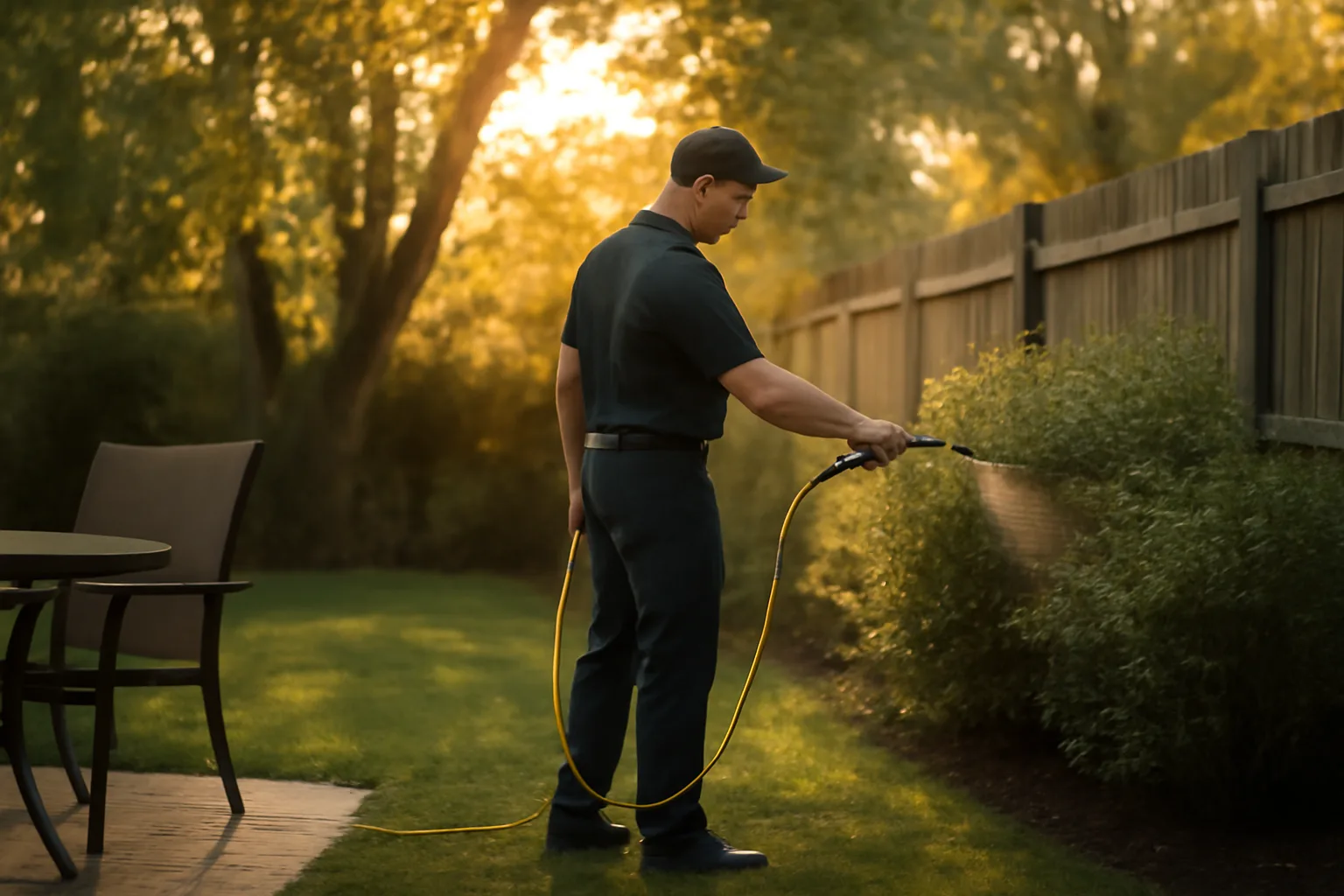
Backyard mosquito control comes down to four things: eliminate standing water, cut back overgrown vegetation where adults rest during the day, treat the perimeter and shaded harborage areas, and keep it up on a schedule through the season. Start with a slow walk around the entire property after it rains. Check gutters, low spots in the lawn, tarps, wheelbarrows, unused planters, and anything else that can hold even a half inch of water for more than a few days. The CDC's mosquito control guidance for around the home specifically calls out draining or discarding items that collect water weekly, since many common species can develop from egg to adult in under 10 days in warm weather [1]. Next, trim back dense shrubs and tall grass, especially anything shaded and close to where people sit. Adult mosquitoes rest in cool, humid, shaded vegetation during the heat of the day and become active near dusk. Opening up airflow and light in these areas makes them less attractive as daytime hiding spots. A barrier treatment applied to that same vegetation, along fence lines, under decks, and around foundation plantings, is what handles the mosquitoes you can't remove by cleaning up water and trimming plants. Backpack or truck-mounted sprayers apply an EPA-registered insecticide to these surfaces per the product label, and it stays active on the leaf surface for roughly two weeks under normal weather, which is why professional programs re-treat on that 10 to 14 day cycle rather than once a season. For yards with heavier pressure (near woods, wetlands, or a neighborhood with a lot of untreated standing water nearby), an installed misting system that releases a fine treatment on a timer is the other option, and it's worth having a technician walk the property to compare that against a standard barrier plan before deciding. That's exactly what a free yard assessment is for: someone looks at your specific water sources, vegetation, and pressure level and tells you which approach fits, rather than guessing from a general guide like this one.
How do you get rid of ticks, and how is that different from mosquito control?
Getting rid of ticks means treating leaf litter, tall grass, and the wooded or brushy edges of your property, not the open lawn where you'd focus most mosquito work. Ticks don't fly or jump; they climb onto grass and shrub tips and wait for a host to brush past, a behavior called questing. The CDC recommends creating a tick-safe zone by mowing the lawn frequently, clearing leaf litter and tall grass, and placing a 3-foot-wide barrier of wood chips or gravel between lawns and wooded areas or stone walls to restrict tick migration into recreational areas [4]. CDC guidance states this barrier "restricts tick migration into recreational areas," and that matters more than most homeowners expect: ticks are extremely sensitive to dry, hot, sunny conditions and rarely cross open, dry mulch or gravel to get onto a lawn. Professional tick treatment for yards targets the same zones: the wood line, stone walls, leaf litter, and tall grass edges, using a product labeled for tick control applied on a schedule similar to mosquito barrier work, often the same 10 to 14 day cycle during peak tick season (spring and fall in most regions, though it varies by species and climate). If you're dealing with ticks specifically, a tick repellent applied to skin and clothing is your personal layer of defense on top of yard treatment, especially before hiking, gardening, or letting kids play near brush.
How do you get rid of ticks from your yard specifically?
| Target zone | Shrubs, shaded vegetation, foundation lines, standing water | Wood line, leaf litter, tall grass edges |
|---|---|---|
| Typical cycle | 10-14 days during active season | Often 10-14 days during peak spring/fall activity |
| Key prevention step | Eliminate standing water | Create a dry mulch/gravel barrier zone |
| Personal protection layer | Skin repellent (DEET, picaridin, etc.) | Tick repellent, permethrin-treated clothing |
Removing ticks from a yard takes the same layered approach as mosquitoes: reduce the habitat first, then treat, then keep both up. Start with the tick-safe zone the CDC describes: mow regularly, remove leaf litter, stack woodpiles neatly and in dry areas, and keep playground equipment, patios, and decks away from yard edges and in sunny spots rather than shaded ones [4]. Deer are a major host for adult ticks in many regions, so fencing to discourage deer from entering the yard, and removing plants that attract them, helps too. A study published by the CDC's Emerging Infectious Diseases journal on a residential tick-control landscaping intervention found that reducing deer access and applying targeted habitat management measurably lowered tick encounters compared to untreated properties [5]. Wildlife-proofing brush piles and clearing tall grass around stone walls (a common rodent and tick habitat edge) rounds out the physical work. Chemical treatment for ticks is typically applied as a targeted spray to the wood line, ground cover, and grass edges bordering wooded or brushy areas rather than a blanket lawn treatment, since that's where questing ticks actually concentrate. Products used for this are EPA-registered for tick control and applied according to the label; state extension services (like those run through land-grant universities) generally publish local guidance on peak tick activity windows since timing varies by species and region. One comparison homeowners often ask about: | Factor | Mosquito barrier treatment | Tick yard treatment |
What's the difference between a barrier spray and a misting system?
A barrier spray is a scheduled visit where a technician applies EPA-registered insecticide to vegetation, foundation areas, and resting sites, typically every 10 to 14 days through the season. A misting system is a permanently installed set of nozzles, usually along the perimeter of a property, that automatically releases a fine treatment on a timer, often at dawn and dusk when mosquitoes are most active. Barrier treatment is the more common choice for most residential yards. It requires no installed equipment, costs less up front, and works well when reapplied on schedule. The tradeoff is that effectiveness fades as the interval between visits stretches, particularly after heavy rain washes residue off leaf surfaces. Misting systems cost more to install and maintain but deliver treatment automatically and more frequently, which can matter for properties with heavy mosquito pressure from nearby wetlands, woods, or persistent neighborhood breeding sites the homeowner doesn't control. Some homeowners are also cautious about the increased pesticide application frequency and broader continuous release compared to a scheduled visit, which is a fair tradeoff to weigh; there isn't a universal right answer, it depends on pressure level, budget, and how much automation you want. A technician doing a free yard assessment should walk you through which one fits your specific property rather than defaulting to whichever is easier to sell. If your yard backs up to woods or a drainage area with a lot of standing water you don't control, that pressure level often tips the recommendation toward misting; a typical suburban lot with manageable water sources usually does fine on a barrier schedule.
Do bug zappers, foggers, and citronella candles actually help?
Mostly no, and it's worth being blunt about this because homeowners spend real money on these every year. Bug zappers using UV light kill enormous numbers of insects, but field studies going back decades, including a frequently cited study published in the Journal of the American Mosquito Control Association, found the vast majority of what they kill are non-biting insects, not mosquitoes, meaning they're killing beneficial and harmless bugs while doing very little to reduce the mosquitoes actually biting you [6]. Citronella candles create a small localized scent cloud that provides marginal reduction in bites only within a couple feet of the candle, and that effect disappears with any breeze. Thermal foggers (the ones that create a visible fog cloud, often propane-powered) can knock down adult mosquitoes present at the moment of application, which is why they're sometimes used right before an outdoor event. But the effect is short-lived, often just a few hours, because it's not a residual treatment sitting on vegetation the way a proper barrier spray is. It's a one-time knockdown, not ongoing control. What actually works, ranked by impact: source reduction (highest impact, free), residual barrier treatment on vegetation (high impact, ongoing cost), personal repellent during peak exposure (high impact for the individual, doesn't protect the whole yard), then zappers, candles, and foggers trailing well behind as minor supplements at best.
Frequently asked questions
How do you get rid of mosquitoes fast before an outdoor event?
A thermal fog or knockdown spray applied a few hours before the event kills mosquitoes present at that moment, but the effect only lasts a few hours since it's not residual. For anything beyond a single evening, a barrier treatment needs a few days to fully take effect on vegetation, so schedule it at least 2-3 days ahead if possible.
How do you keep mosquitoes away from a patio or deck?
Remove any standing water within 50-100 yards, trim shaded vegetation nearby where adults rest during the day, and treat the perimeter with a residual barrier spray. A fan pointed across the seating area helps too, since mosquitoes are weak fliers and struggle against airflow.
What plants repel mosquitoes the best?
Citronella grass, lemon eucalyptus, lavender, marigold, and catnip contain compounds mosquitoes tend to avoid, but the intact plant releases far too little concentration to meaningfully cut bites. The oils have to be extracted and concentrated (as in EPA-registered oil of lemon eucalyptus repellent) to actually work as protection.
How do you get rid of mosquitoes in the house overnight?
Check screens for gaps, use a plug-in repellent device or bed net if needed, and consider a fan pointed at the room, since mosquitoes struggle to fly against airflow. An aerosol labeled for flying insects, used per the label, handles mosquitoes already inside, but won't stop new ones entering through gaps.
When do mosquitoes go away for the year?
Mosquito activity typically drops once nightly lows fall consistently below the mid-50s Fahrenheit, with most adults dying off after the first hard frost. Timing varies widely by region, from near year-round in parts of the Gulf Coast to roughly April through October in the Northeast. Check your local extension office for your area's typical window.
How do you get rid of ticks in your yard naturally?
Create a tick-safe zone: mow frequently, remove leaf litter and tall grass, and add a 3-foot-wide barrier of wood chips or gravel between lawn and wooded edges, as recommended by the CDC. This physical barrier restricts tick migration into yards since ticks avoid dry, sunny, open ground.
How often should mosquito barrier treatment be applied?
Most professional programs apply barrier treatment every 10 to 14 days through the active season. That interval roughly matches how fast new adult mosquitoes emerge and how long residual insecticide stays effective on foliage before rain and sun exposure break it down.
Do mosquito misting systems work better than barrier spray?
Misting systems automate frequent treatment and suit high-pressure properties near woods or wetlands, but cost more to install and release pesticide on a set schedule rather than a technician-assessed visit. For typical suburban yards, a scheduled barrier treatment usually performs comparably at lower cost.
Can standing water in gutters really cause a mosquito problem?
Yes. Clogged gutters holding even small amounts of water are a common backyard breeding source, and some mosquito species can go from egg to biting adult in under two weeks in warm conditions, according to CDC guidance. Cleaning gutters is one of the highest-impact, lowest-cost things a homeowner can do.
What's the difference between tick control and mosquito control for a yard?
Mosquito control focuses on standing water removal and treating shaded vegetation and foundation lines where adults rest. Tick control focuses on wood lines, leaf litter, and tall grass edges where ticks quest for hosts, often paired with a dry mulch or gravel barrier between lawn and wooded areas.
Are bug zappers worth buying?
Generally not for mosquito control specifically. Field studies have repeatedly found that bug zappers kill mostly non-biting insects, not the mosquitoes actually biting people, while doing little to reduce bite rates in the yard. Money is better spent on source reduction and residual barrier treatment.
Do mosquitoes come back after treatment?
Yes, always, and that's expected. Barrier treatment knocks the population down; it doesn't eliminate mosquitoes permanently, since new adults keep emerging from eggs and mosquitoes fly in from neighboring properties. That's why treatment runs on a repeating 10-14 day cycle through the season rather than a single visit.
Sources
- CDC, Mosquito Life Cycle and control around the home: Some mosquito species can develop from egg to biting adult in under 10 days in warm conditions, and CDC recommends draining standing water weekly
- EPA, Find the Repellent that is Right for You: EPA-registered repellent active ingredients include DEET, picaridin, IR3535, oil of lemon eucalyptus, and 2-undecanone
- CDC, Preventing Tick Bites on People: CDC recommends a tick-safe zone using a 3-foot-wide wood chip or gravel barrier between lawns and wooded areas to restrict tick migration
- Bomgardner et al., Journal of Agricultural and Food Chemistry, PMID 11312786: Nepetalactone from catnip oil shows mosquito repellent activity in controlled laboratory assays
- Curtis et al., Emerging Infectious Diseases, 2004, PMID 15498158: A residential landscaping and deer-exclusion intervention measurably reduced tick encounters compared to untreated properties
- Nasci and Harris, Journal of the American Mosquito Control Association, PMID 6151470: Field study finding that electric insect traps (bug zappers) kill overwhelmingly non-biting insects rather than mosquitoes