Last updated 2026-08-14
TL;DR
Real mosquito control comes from layering tactics: dump standing water weekly, treat vegetation with a barrier spray on a 10-14 day cycle during peak season, add a mosquito repellent plant border for minor help, and use personal repellent for the gaps. No single tool clears a yard; the combination does.
What does mosquito air defense actually mean?
"Air defense" isn't an official pest control term. It's a useful way to think about the problem: you're not fighting one mosquito, you're managing a population that keeps flying in from a quarter mile away, breeding in the wet spot behind your shed, and resting in your shrubs between meals. Any single tactic (a citronella candle, one spray, a plant) knocks down a small slice of that. Real control comes from stacking several tactics so each one covers the others' gaps. The CDC frames mosquito control around four levers: eliminating standing water, using EPA-registered repellents on skin, treating clothing and gear, and controlling mosquitoes around the home with larvicides or adulticides [1]. Everything in this article is a variation on those four things, aimed specifically at getting your yard usable again for dinner, for kids playing outside, and for not getting bitten through your socks. One honest note up front: nobody eliminates a mosquito population from an open yard. Adult females can travel over a mile from where they hatched, and most municipal or residential control programs aim to reduce the biting population by a large percentage, not to zero it out [2]. If a company promises total elimination, that's marketing, not entomology.
How do you get rid of mosquitoes for good?
You don't get rid of them "for good" in the sense of a one-time fix, but you can keep a yard genuinely low-bite for a full season if you layer four things: source reduction, vegetation barrier treatment, physical exclusion, and personal repellent for whatever slips through. Source reduction comes first because it's free and it matters most. A female mosquito can complete her life cycle, egg to biting adult, in as little as 7 to 10 days in warm weather, and she only needs about a bottle cap of standing water to do it [3]. Bird baths, clogged gutters, tarp folds, unused plant saucers, and old tires are the usual suspects. Dump and scrub (more than dump) anything holding water at least once a week, because mosquito eggs can stick to container walls and survive a rinse. Barrier treatment is the next layer. Licensed applicators (and some DIY products) spray a residual insecticide on the undersides of leaves, in mulch beds, and along fence lines, the spots where adult mosquitoes rest during the day. Because the product breaks down with sun and rain, it needs reapplication roughly every 10 to 14 days during mosquito season for it to keep working, which is the cycle most professional yard programs run on. This is also the layer where a mosquito control service earns its cost, since consistent timing matters more than any single spray. Exception zones exist too. Screened porches, well-fitted window screens, and a box fan on the patio (mosquitoes are weak fliers and struggle against moving air) all reduce exposure without any chemical at all. Finally, personal repellent covers whatever gets through the first three layers. The EPA's search tool lists registered active ingredients including DEET, picaridin, IR3535, oil of lemon eucalyptus, and 2-undecanone as effective options for skin application [4].
How do you keep mosquitoes away from your yard long-term?
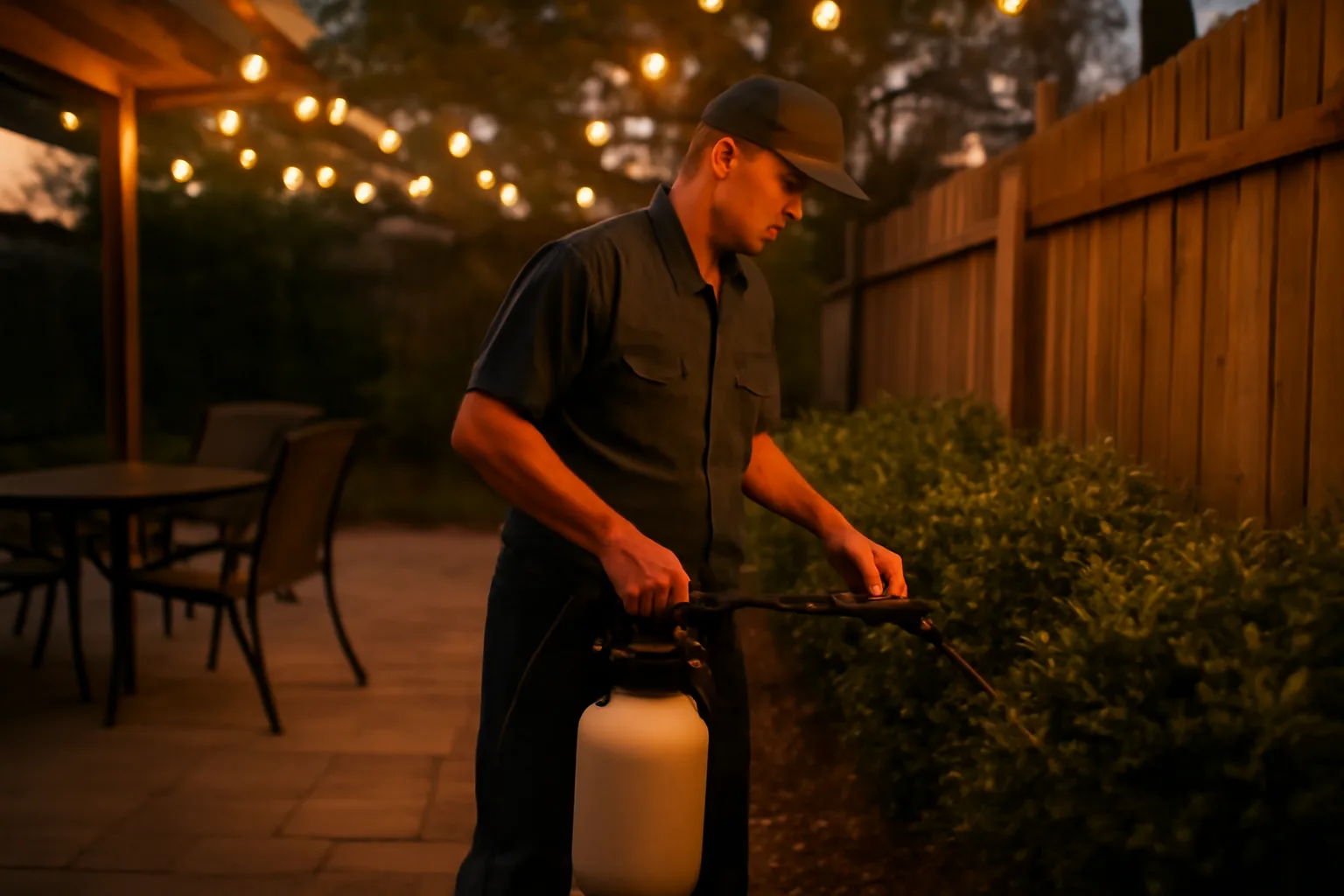
Keeping mosquitoes away long-term is a maintenance schedule, not a single treatment. Think of it in three time horizons: daily habits, a two-week spray cycle, and seasonal shutdown/startup. Daily or every-few-days: check and empty anything holding water. This includes trash can lids, kiddie pools, saucers under potted plants, and low spots in tarps covering firewood or grills. Extension entomologists consistently cite this as the single highest-value habit because it targets the breeding source, more than the adults [3]. Every 10 to 14 days during active season: barrier spray on vegetation, mulch beds, and shaded resting spots, whether you do it yourself with a pump sprayer and an EPA-registered product or have it done. This is the backbone of most professional yard mosquito programs, including the seasonal plan a service like Duskproof runs, because it targets adult mosquitoes where they rest between blood meals. Seasonally: start the barrier cycle when nighttime temperatures reliably stay above roughly 50°F, since most common mosquito species become inactive below that threshold, and stop when they drop back below it in fall [5]. Your local mosquito control district or agricultural extension office will have dates specific to your region, since a Florida season looks nothing like a Minnesota one. A mosquito misting system is the higher-commitment version of the barrier spray: a plumbed system with nozzles along the fence or eaves that release a fine mist on a timer or remote trigger, usually a pyrethrin-based product. It's more consistent than manual spraying and good for people who host outdoor events often, but it costs more upfront to install and still needs refills and seasonal maintenance. For most yards, a scheduled barrier spray service does the job for less money; misting systems earn their keep on larger properties or for households that are outside constantly from May through September.
What plants repel mosquitoes, and do they actually work?
A mosquito repellent plant is any plant whose natural oils are thought to mask the scents mosquitoes use to find hosts, or that produce compounds with mild repellent activity when the leaves are crushed or brushed. Common ones people plant include citronella grass, lemongrass, lavender, marigold, catnip, basil, and rosemary. Here's the honest limitation: the repellent effect comes from oils inside the plant tissue, not from the plant just sitting there. A pot of citronella grass on the patio does close to nothing on its own, because the living leaves release very little of the oil into the air. Crushing the leaves and rubbing them on skin releases more, but at that point you're improvising a weak topical repellent, not relying on the plant. Studies on catnip's active compound, nepetalactone, have shown repellency against mosquitoes in lab settings, in some trials comparable to DEET at certain concentrations, but lab results with concentrated extracts don't translate directly to "plant a pot of catnip and skip the spray" [6]. Treat what plants repel mosquitoes as a nice-to-have layer in a garden bed, not a control method you can rely on by itself. If you want a fuller rundown of which species have real evidence behind them and which are mostly folklore, see our guide to natural mosquito repellent options.
How do you get rid of mosquitoes in your house?
Indoor mosquitoes almost always mean one of two things: they're getting in through a gap, or they're breeding somewhere inside, most often a forgotten water source. First, check screens on windows and doors for tears, and look at door sweeps for gaps at the bottom. Mosquitoes need surprisingly little space to get through. Second, hunt for indoor standing water: a clogged floor drain, an overwatered houseplant saucer, a leaky pipe under a sink, or even water sitting in a reusable water bottle left open for a week. Because the larval stage can complete in about a week in warm conditions, an indoor breeding site can restock the population faster than you'd expect [3]. For mosquitoes already inside, a few work fine: an aerosol labeled for indoor flying insect use (check the EPA registration number on the label and follow it exactly), a plug-in trap near where you see the most activity, or simply running a fan in the room, since mosquitoes are poor fliers against moving air. Bug zappers marketed as mosquito killers are largely ineffective against mosquitoes specifically; university-run field studies have repeatedly found the vast majority of insects killed by zappers are non-biting insects, not the mosquitoes homeowners are trying to target [2]. If you're dealing with a lot of mosquitoes in the house and can't find the source, check window well drains, sump pits, and crawl space moisture. Those are the spots people forget.
How do you get rid of mosquitoes in the backyard specifically?
A backyard needs a slightly different approach than "the yard" in general, because it's the zone you actually use, so exclusion tactics matter more here than anywhere else on the property. Start with the water audit across the full yard, more than the patio: gutters, low spots in the lawn, tarps, unused pots, and anything that collects rain. Then move to vegetation. Mosquitoes rest in shaded, humid spots during the day, which is why the underside of shrub leaves and dense ground cover near a patio matter more for barrier treatment than open lawn does. For the specific zone you sit in, add a physical layer: a strong outdoor fan (mosquitoes struggle to fly against wind over about 1 mph in some observations, though exact thresholds vary by species and study), citronella or other repellent candles as a minor supplement rather than a primary defense, and screened structures if you're building or renovating a patio cover. Timing matters here too. Many common backyard mosquito species, including several Culex and Aedes species, are most active at dawn and dusk, though the invasive Aedes albopictus (Asian tiger mosquito) is known for aggressive daytime biting as well, which is worth knowing before you assume evening is your only risk window [7]. If the yard is bad enough that dinner outside isn't happening, a free yard assessment from a local service will map where mosquitoes are actually resting and breeding on your specific property, which is usually more useful than guessing at generic advice, since every yard's shade, drainage, and vegetation is different.
When do mosquitoes go away for the season?
Mosquitoes go away, or at least stop actively biting, once nighttime temperatures consistently drop below about 50°F, since most species become sluggish and stop host-seeking around that threshold, though the exact number varies by species [5]. Exact timing is regional: parts of the Gulf Coast and Southwest see mosquito activity nearly year-round in mild winters, while northern states often see a hard stop by mid-to-late October. Mosquitoes don't die off entirely with the first cold snap in most climates. Many species overwinter as eggs (laid in a location that will flood come spring) or as adult females that find a sheltered spot, like a crawl space or hollow log, to go dormant until temperatures rise again [7]. That's part of why a mild winter often means a rough mosquito season the following spring: fewer eggs and overwintering adults die off than in a hard freeze. Because "when mosquitoes go away" is so regional, the most reliable answer for your specific area comes from your state or county mosquito control district or your local agricultural extension office, several of which publish seasonal activity charts based on years of trap data specific to that region [5].
How do you get rid of ticks in your yard?
Ticks and mosquitoes get grouped together because both are outdoor pests you'd treat a yard for, but they behave very differently, so the fix isn't identical. Ticks don't fly and don't breed in standing water. They quest, meaning they climb tall grass or leaf litter and wait with front legs extended to grab onto a passing host. The most effective yard-level intervention, according to CDC guidance, is landscaping: keep grass mowed short, clear leaf litter and brush, and create a mulch or gravel barrier at least 3 feet wide between lawn and wooded areas or stone walls, since that barrier significantly reduces tick migration into the yard . Ticks are especially concentrated at the lawn-to-woods edge, so that transition zone deserves more attention than the open lawn. Barrier sprays targeting the perimeter, wood piles, stone walls, and shaded brush do reduce tick populations; studies on residential acaricide applications have shown meaningful reductions in nymphal tick abundance in treated yards compared to untreated ones . Keep play equipment, patios, and decks away from wooded edges when possible, since that's a free layer of protection that doesn't involve any product at all. For pets and people using the yard regularly, pairing yard treatment with a tick repellent applied to skin, clothing, or pets adds a personal layer the yard treatment alone can't cover, especially for anyone walking near the wood line.
Barrier spray vs. misting system: which one fits your yard?
| How it works | Technician sprays foliage, mulch beds, resting spots on a set cycle | Plumbed nozzles release mist automatically or on remote trigger | |
|---|---|---|---|
| Typical cycle | Every 10 to 14 days in season | Automated, often daily or several times a week | |
| Upfront cost | Low; no installation | Higher; requires professional installation | |
| Best fit | Most residential yards, seasonal use | Large properties, frequent outdoor entertaining | |
| Maintenance | Scheduling only | Refills, tank checks, nozzle maintenance | |
| Active ingredients | Varies by product, often synthetic pyrethroids | Often pyrethrin-based, sometimes with linalool | For most homeowners, a scheduled barrier spray on the standard 10-14 day cycle covers the season at lower cost and less equipment to maintain. A misting system makes more sense if you're hosting outdoor events regularly, have a large or heavily wooded lot, or want mosquito suppression running without remembering a service date. Either option should use EPA-registered products applied according to the label; that's a regulatory requirement, not a marketing point [4]. |
Both target adult mosquitoes resting in vegetation, but they differ in commitment, cost structure, and consistency. | Factor | Barrier spray (scheduled service) | Installed misting system |
What should you expect from a professional mosquito service?
A legitimate service starts with looking at your property, more than quoting a flat price over the phone. That means walking the yard to identify standing water sources, shaded resting areas, and vegetation density, since those drive both the treatment plan and how often it needs to happen. Expect a seasonal barrier plan on roughly a 10-14 day cycle during peak mosquito months, adjusted for your region's season length. Expect the technician to name the active ingredient being used and its EPA registration number if you ask; that information is public and any legitimate applicator should have it handy. Expect a discussion of tick risk too if you have wooded edges or tall grass nearby, since the perimeter treatment often overlaps with tick management. What you shouldn't expect: a guarantee of zero mosquitoes. A responsible provider will describe the outcome as significant population reduction, not eradication, because that's what the entomology actually supports. If a company promises to eliminate mosquitoes entirely from an open outdoor space, that's a claim worth being skeptical of. A free yard assessment is the right first step regardless of which company you go with, because pricing and treatment frequency should be based on your yard's actual conditions (lot size, vegetation, standing water, shade) rather than a generic package. If you want to understand the range of professional options before requesting one, our mosquito control overview and mosquito control near me guide both cover what to ask providers before hiring.
What EPA-registered products and repellents actually work?
For personal protection, the EPA maintains a repellent search tool and lists active ingredients with demonstrated effectiveness, including DEET, picaridin, IR3535, oil of lemon eucalyptus (OLE), para-menthane-diol (PMD), and 2-undecanone [4]. The CDC states that EPA-registered insect repellents are "proven to be effective, even for pregnant and breastfeeding women, when used as directed on the product label" [1], though it's worth stressing that's a statement about registered, correctly-applied products, not a blanket safety claim for any repellent regardless of concentration or use pattern. For yard and vegetation treatment, common active ingredients include synthetic pyrethroids (such as bifenthrin or permethrin) for barrier sprays, and pyrethrins (often combined with piperonyl butoxide) in many residential misting systems. These are EPA-registered pesticides, which means they've gone through EPA's review process for label claims and are approved for specific uses when applied according to that label. That is a different statement than calling a product safe or non-toxic outright; always follow label directions on reentry intervals, application near water features, and precautions around pets, pollinators, and edible gardens. Mosquito dunks and granules containing Bti (Bacillus thuringiensis israelensis) are worth a separate mention, since they target the larval stage directly in standing water you can't eliminate (a rain barrel, a fountain, a drainage ditch) and are considered lower-risk to non-target insects than adulticide sprays when used as labeled [1]. Dropping a dunk in a rain barrel or fountain you can't empty is one of the highest-value five-dollar moves in mosquito control.
Frequently asked questions
How do I get rid of mosquitoes fast?
For immediate relief, run fans on outdoor seating areas (mosquitoes fly poorly in moving air), apply an EPA-registered skin repellent like DEET or picaridin, and dump any standing water within view. These give same-day relief. Lasting reduction takes longer and requires ongoing source reduction plus a barrier spray cycle, since one treatment won't hold for a full season.
How do I keep mosquitoes away without spraying chemicals?
Eliminate standing water weekly, run fans on patios and porches, use fine mesh screens, and treat clothing with EPA-registered repellent instead of skin if you prefer. A mosquito repellent plant border helps marginally but isn't a substitute. These non-chemical steps reduce exposure meaningfully but rarely match the consistency of a scheduled barrier program during peak season.
How do you get rid of ticks on your body or in your yard?
On your body: check thoroughly after outdoor time and remove attached ticks promptly with fine-tipped tweezers, pulling straight up. In the yard: mow grass short, clear leaf litter, and create a 3-foot mulch or gravel barrier between lawn and wooded edges, which the CDC identifies as an effective landscaping intervention against tick migration [10].
What is a mosquito repellent plant, exactly?
It's a plant whose natural oils, released when the leaves are crushed or brushed, are thought to mask host-seeking scents mosquitoes rely on. Citronella grass, lemongrass, catnip, lavender, and marigold are common examples. The effect is real in lab tests on concentrated extracts but weak from an intact potted plant just sitting on a patio.
What plants repel mosquitoes most effectively?
Catnip's compound nepetalactone has shown notable repellency in some lab studies, occasionally rivaling DEET at tested concentrations [6]. Citronella, lemongrass, and lavender have weaker, less consistent evidence. None work well as an intact garden plant alone; treat them as a minor supplement to source reduction and barrier treatment, not a primary defense.
How do I get rid of mosquitoes in my house?
Check screens and door sweeps for gaps, hunt for indoor standing water (clogged drains, plant saucers, sump pits), and use an indoor aerosol labeled for flying insects if mosquitoes are already inside. Running a fan in the room helps too, since mosquitoes struggle against moving air. Bug zappers are largely ineffective specifically against mosquitoes [7].
How do I get rid of mosquitoes in the house permanently?
There's no permanent fix if entry points and water sources aren't addressed, since mosquitoes will keep finding their way back in. Seal screen gaps and door sweeps, remove all indoor standing water sources, and pair that with outdoor source reduction and barrier treatment around the home's perimeter so fewer mosquitoes reach your doors and windows in the first place.
How do I get rid of mosquitoes in my backyard?
Audit for standing water weekly, treat shaded vegetation and resting spots with a barrier spray every 10 to 14 days in season, add fans and screening to your seating area, and consider a mosquito dunk for any water feature you can't drain. A free yard assessment can pinpoint your yard's specific breeding and resting sites.
When do mosquitoes go away for the year?
Most species stop actively biting once nighttime temperatures consistently drop below roughly 50°F, though this varies by species and region [5]. Southern and coastal climates may see activity nearly year-round, while northern states typically see a hard stop by mid-to-late October. Check your local mosquito control district for region-specific dates.
Do mosquitoes come back every year, or does winter kill them off?
They come back. Many species overwinter as eggs laid in spots that flood in spring, or as dormant adult females sheltering in protected spaces like crawl spaces or hollow logs [9]. A mild winter often means a worse mosquito season the following year, since fewer overwintering eggs and adults die off compared to a hard freeze.
How often should a yard be sprayed for mosquitoes?
Most professional barrier treatment programs run on a 10 to 14 day cycle during active mosquito season, since the residual product breaks down with sun and rain exposure over roughly that window. Frequency should extend from your local season start (around consistent nights above 50°F) through the first hard cold snap of fall.
Are misting systems better than a sprayed barrier treatment?
Not necessarily better, just different. Misting systems automate frequent, consistent applications and suit large properties or frequent outdoor entertaining, but cost more to install and maintain. A scheduled barrier spray on a 10-14 day cycle covers most residential yards effectively for less money and equipment upkeep.
Can a mosquito service actually eliminate mosquitoes from my yard?
No responsible service will promise full elimination. Adult mosquitoes fly in from surrounding areas, and females can travel over a mile from where they hatched [2]. A well-run barrier program significantly reduces the biting population on your property, but it manages the problem rather than eliminating it entirely.
Sources
- CDC, Preventing Mosquito Bites: Four core levers of mosquito control: standing water removal, skin repellents, treated clothing, and control around the home
- CDC, Mosquito Life Cycle and Behavior: Adult mosquitoes can fly significant distances from breeding sites
- EPA, Mosquito Life Cycle: Mosquitoes can complete their life cycle from egg to adult in about a week to 10 days in warm conditions and need only small amounts of standing water
- EPA, Find the Repellent that is Right for You: EPA-registered repellent active ingredients include DEET, picaridin, IR3535, oil of lemon eucalyptus, PMD, and 2-undecanone
- University of Notre Dame / entomological field studies on electric insect traps: Bug zappers kill mostly non-target, non-biting insects rather than mosquitoes
- CDC, Aedes albopictus (Asian Tiger Mosquito): Aedes albopictus is known for aggressive daytime biting, unlike many dawn/dusk-active species
- CDC, Preventing Ticks in the Yard: A 3-foot mulch or gravel barrier between lawn and wooded areas reduces tick migration into yards