Last updated 2026-08-14
TL;DR
A mosquito service typically means a technician applies an EPA-registered barrier spray to vegetation and resting sites every 10 to 14 days through the season, or installs an automated misting system. Neither eliminates mosquitoes; both knock populations down substantially when paired with removing standing water. Ticks need a separate yard treatment approach focused on leaf litter and lawn edges.
What is a mosquito service, exactly?
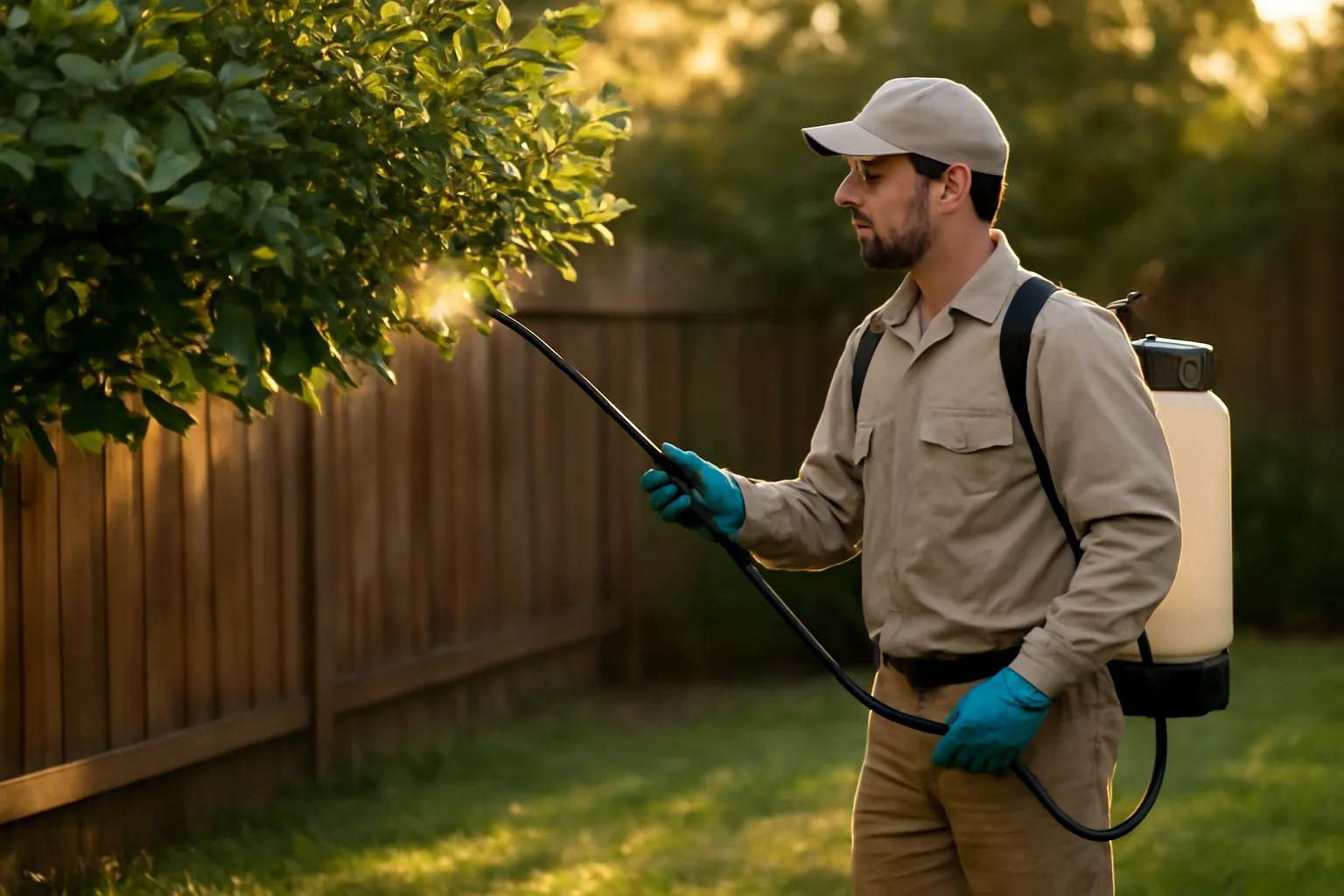
A mosquito service is a recurring yard treatment, usually done by a licensed pest control company, aimed at reducing the adult mosquito population on your property. It is not a one-time fix and it is not the same as fogging for a single event, though some companies offer that too as a standalone option. Most residential programs use one of two delivery methods. The first is a barrier spray: a technician walks the property with a backpack sprayer and applies an EPA-registered insecticide to the underside of leaves, shrubs, fence lines, and other spots where adult mosquitoes rest during the day. This is typically repeated on a 10 to 14 day cycle through mosquito season, because the residual effect of most labeled products fades over roughly two weeks depending on the active ingredient, weather, and plant growth. The second is an installed misting system, a network of tubing and nozzles around the property that releases a fine mist automatically at set times, usually dawn and dusk. Both approaches target adult mosquitoes on contact and through residual exposure on treated surfaces. Neither approach touches mosquito larvae developing in water sources on neighboring properties, and neither will get you to zero. The EPA is direct about this: mosquito control is about suppression, not elimination, because adult mosquitoes fly in from surrounding areas and eggs can survive in soil for months waiting for water [1]. A reasonable service also includes source reduction, meaning the technician looks for standing water on your own property (clogged gutters, plant saucers, tarps, low spots in the yard) and either treats it or tells you to dump it. Skipping this step is the most common reason a barrier program underperforms. If you're comparing options before you call anyone, the mosquito control overview covers the method categories in more depth, and mosquito control near me walks through what to ask a company before you book.
How to get rid of mosquitoes: what actually reduces numbers
The single highest-leverage action is eliminating standing water, because most container-breeding mosquito species (the ones biting you in the backyard) need still water to complete their life cycle in as little as 7 to 10 days depending on temperature. The CDC recommends checking your property at least once a week and dumping or scrubbing anything holding water: buckets, tires, plant pot saucers, birdbaths, clogged gutters, kiddie pools, and even bottle caps [2]. After source reduction, the next tier is larvicide for water you can't drain, like ornamental ponds or rain barrels. Products containing the bacterium Bacillus thuringiensis israelensis (Bti) are commonly sold as mosquito dunks and are registered by the EPA specifically because they target mosquito larvae with low toxicity to fish, birds, and mammals when used as labeled [3]. A single dunk generally treats about 100 square feet of water surface for roughly 30 days, though label directions vary by product and should be followed exactly. For adult mosquitoes already flying around your yard, a barrier spray program is the most effective option available to a homeowner, because it treats the vegetation where adults rest between blood meals. Do-it-yourself versions of this exist (hose-end sprayers with permethrin-based concentrates from hardware stores), but coverage tends to be uneven and most homeowners underestimate how much vegetation needs treating and how often. This is the gap that professional services fill: consistent 10 to 14 day cycles, EPA-registered products applied per label, and someone checking your yard for water sources you missed. Fans and airflow also matter more than most people expect. Mosquitoes are weak fliers, generally topping out around 1 to 1.5 miles per hour in still air, so a box fan or ceiling fan on a patio measurably cuts landing rates during outdoor gatherings. This is genuinely one of the cheapest, most underrated tools available and it has real entomological backing, more than folklore. For a walkthrough of layered prevention tactics before you decide whether to pay for a service, see natural mosquito repellent and mosquito repellent.
How to keep mosquitoes away long-term
Keeping mosquitoes away is a maintenance problem, not a one-time fix. The three things that matter most are a weekly water check, a mowed and trimmed yard (mosquitoes and the humidity they like collect in tall grass and dense shrubs), and, if you want real suppression through the season, a recurring barrier treatment. Timing matters. Barrier sprays are applied on a schedule because the active ingredients break down from UV exposure, rain, and new plant growth covering treated leaf surfaces. A 10 to 14 day cycle is standard across the pest control industry for pyrethroid-based residual products; going longer between visits lets the population rebound before the next treatment, which defeats the purpose. Personal repellents fill the gap between service visits and for moments you're outside the treated zone (a hike, a friend's untreated yard). The CDC and EPA recommend products containing DEET, picaridin, IR3535, oil of lemon eucalyptus (OLE), para-menthane-diol (PMD), or 2-undecanone, all of which are registered active ingredients evaluated for both efficacy and safety when used according to the label [4]. Products with roughly 20% DEET or higher percentages of picaridin generally provide the longest protection windows, often 6 to 8 hours, though exact duration depends on the formulation and concentration. Clothing matters more than people give it credit for. Permethrin-treated clothing, available pretreated or as a spray you apply yourself, kills and repels mosquitoes and ticks on contact and remains effective through multiple washes on factory-treated garments per EPA registration [4].
What plants repel mosquitoes, and do they actually work?
A mosquito repellent plant is any plant whose natural oils are reputed to deter mosquitoes, usually because the plant contains compounds like citronellal, geraniol, or limonene. Common ones people plant include citronella grass, lemongrass, lavender, marigold, catnip, rosemary, and basil. Here's the honest answer: these plants can repel mosquitoes to some degree, but only when their oils are extracted, concentrated, and applied to skin, the way citronella oil is used in some EPA-registered repellent products. Simply growing the plant in a pot on your patio releases far too little of the active compound into the air to meaningfully reduce mosquito landings. A 2011 review of plant-based repellents in the Malaria Journal found that while many plant extracts show repellent activity in lab testing, most provide substantially shorter protection times than synthetic repellents like DEET, often under two hours versus several hours for registered synthetics. So plant them if you like the look and the herbs are useful in your kitchen, but don't count on a border of marigolds to replace a barrier treatment or a good repellent. Crushing the leaves and rubbing the oil on skin gets you closer to the folklore claim, though it's messy, short-lived, and not something the EPA has evaluated for safety or efficacy in that raw form the way it evaluates registered products. For more detail on which repellent strategies have real evidence behind them, natural mosquito repellent breaks down plant oils versus registered essential-oil-based products, which are different things.
How to get rid of mosquitoes in the house
Indoor mosquitoes almost always mean one of two things: they're coming in through gaps (doors, torn screens, vents) or they're breeding in water somewhere inside, like a forgotten vase, a plant saucer, or a slow drain. Start with entry points. Check window and door screens for tears, make sure door sweeps seal fully, and look at any vents or exhaust fans without screening. A single hole in a screen is enough for repeated entry over a season. Next, hunt for indoor water. Mosquitoes can lay eggs in surprisingly small amounts of standing water, and it doesn't take much: a vase that hasn't been changed in a week, a drip tray under houseplants, even condensation collecting in an unused sink or a basement floor drain. Dump and dry these out. For mosquitoes already inside, a few options work: a plug-in repellent device using an EPA-registered active ingredient, a fan pointed at problem areas (again, mosquitoes are poor fliers against airflow), or simply removing them with a vacuum or swatting them near where they rest, usually dark corners, under furniture, or behind curtains. Indoor foggers and bug bombs exist but are generally overkill for a handful of mosquitoes and carry their own label precautions around occupied spaces, food surfaces, and pets; read the label fully before using one indoors. If mosquitoes keep getting inside despite sealed screens, the source is often just proximity: a heavily infested yard means more pressure at every opening. That's a case where an outdoor barrier program does double duty, reducing the population trying to get in as well as the one biting you outside.
How to get rid of mosquitoes in the backyard
Backyard mosquito control comes down to four layers, and skipping any one of them weakens the whole system. Layer one: source reduction. Walk the yard weekly and dump anything holding water. Gutters, tarps, unused pots, low spots where water pools after rain. This alone can meaningfully cut backyard mosquito pressure since most nuisance species around homes are container breeders needing very little water and very little time (as fast as a week) to go from egg to biting adult [2]. Layer two: larvicide for water you can't remove. Bti dunks in ponds, rain barrels, or french drains handle water sources you need to keep. Layer three: vegetation and yard maintenance. Mow regularly, trim back dense shrubs, and thin overgrown ground cover where adult mosquitoes rest during the heat of the day. Layer four: barrier treatment. This is where a professional service earns its cost. A technician treats the vegetation, fence lines, and shaded resting spots with an EPA-registered residual product on a repeating cycle, typically every 10 to 14 days through the season. Some homeowners instead choose an installed misting system, which automates the spray on a timer without a technician needing to visit each cycle, though misting systems have their own tradeoffs around chemical usage volume and mechanical upkeep worth asking about directly. This is genuinely the point where a Duskproof free yard assessment earns its keep versus doing it all yourself: a trained eye finds water sources and resting sites homeowners miss, and a consistent schedule matters more than any single treatment. If you want the full comparison of barrier spray versus misting before deciding, see mosquito control.
How to get rid of ticks in the yard
Ticks and mosquitoes need different yard strategies because ticks don't fly and don't breed in water. They climb onto grass and low vegetation and wait for a host to walk by, a behavior called questing. The most effective structural change is what the CDC and university extension programs call a tick-safe zone: keep a mowed lawn, create a barrier of wood chips or gravel at least 3 feet wide between lawn and wooded areas or stone walls, and remove leaf litter and brush where ticks hide, since ticks lose moisture quickly and die in open, sunny, dry areas [5]. A University of Rhode Island TickEncounter Resource Center study found that reducing leaf litter around the yard perimeter and treating that same perimeter zone can lower the questing tick population substantially, because the vast majority of ticks that eventually encounter humans are found within the perimeter zone near woods, not out in the open lawn [6]. For active treatment, professional applications typically target that same perimeter zone (the strip where lawn meets woods) with an EPA-registered acaricide on a seasonal schedule, often spring and again in early summer, since Ixodes species like the blacklegged tick generally have two active periods: nymphs from roughly May through August and adults in fall and again in early spring depending on region and local climate [5]. Other yard steps that help: keep woodpiles stacked neatly and off the ground, discourage deer with fencing since deer are a primary host for adult blacklegged ticks, and consider fencing to keep out other wildlife that transport ticks onto your property. For a deeper look at repellent options that work on ticks specifically (not all mosquito repellents are labeled for ticks), see tick repellent.
Barrier spray vs. misting system: which service should you choose?
| Feature | Barrier spray program | Installed misting system | |
|---|---|---|---|
| Application | Technician visits every 10-14 days | Automated, timer-based (often dawn/dusk) | |
| Coverage | Targeted to vegetation, resting sites | Fixed nozzle zones around property | |
| Chemical usage | Applied only on service days | Applied on every cycle, more frequent | |
| Upfront cost | Low, no equipment install | Higher, requires tubing/nozzle installation | |
| Maintenance | None for homeowner | Tank refills, nozzle clogs, system upkeep | |
| Best for | Most yards, seasonal use | Frequent outdoor entertaining, larger properties | Barrier spray programs work well for most yards and most budgets because there's no equipment to install or maintain, and the technician can adjust the treatment plan as the yard changes through the season, more vegetation growth in early summer, drought stress in August, and so on. Misting systems make sense for households that spend a lot of time outdoors and want mosquito suppression running automatically without waiting for a service visit. The tradeoff is more frequent chemical application (since the system runs on a timer regardless of actual mosquito pressure that day) and mechanical upkeep: nozzles clog, tanks need refilling, and the tubing needs occasional inspection. Neither method is inherently better across the board. It genuinely depends on your yard size, budget, and how much manual upkeep you're willing to take on. A free yard assessment from a local provider is the fastest way to get a straight answer for your specific property rather than guessing from a general comparison. |
When do mosquitoes go away for the season?
Mosquitoes generally become inactive once temperatures drop consistently below about 50°F, since most species stop flying and feeding at that point, though the exact threshold varies by species. Many overwinter as eggs (laid in soil that later floods) or as adult females that find a sheltered spot to go dormant until spring . This means the timeline is entirely regional. In northern states, that first hard frost, typically anywhere from late September to mid-October depending on the year and location, effectively ends the season. In the Gulf Coast, Florida, and much of the Southwest, mosquitoes can remain active nearly year-round because temperatures rarely stay below that 50°F threshold for long. Local mosquito control districts and agricultural extension offices track these patterns closely and are the best source for your specific area; national averages don't mean much when your county's frost date is what actually matters. Because the season length varies so much by region, so does the right length for a barrier treatment program. A homeowner in Minnesota might run a program from May through September. A homeowner in coastal Georgia or Texas might reasonably run treatments nearly year-round with only a slowdown in the coldest weeks of winter. Check with your state or county extension office or local health department for typical first-frost dates and mosquito activity windows in your specific area .
How much does a mosquito service cost?
Pricing varies significantly by region, yard size, and treatment type, and any company quoting a firm number without seeing your property is guessing. That said, industry surveys give a useful range: barrier spray programs from national pest control companies commonly run in the range of $40 to $100 per treatment visit, billed on the 10 to 14 day cycle through the season, while installed misting systems typically cost several thousand dollars upfront for equipment and installation plus ongoing refill costs. Yard size, vegetation density, and whether you need combined tick treatment all move the price. A heavily wooded half-acre lot with a lot of shrub cover costs more to treat properly than a quarter-acre lot with a simple, open lawn, because the technician needs more product and more time to cover the resting sites thoroughly. This is exactly why quote-based pricing, rather than a flat online price, tends to be more honest for this category: two neighboring houses on the same street can have very different mosquito pressure and vegetation, and a fair quote reflects that. A free yard assessment gets you a real number for your actual property instead of a generic estimate that may not hold once a technician walks your yard.
Do mosquito barrier treatments hurt bees, pets, or people?
This is worth taking seriously and worth asking your provider about directly. Products used in residential mosquito barrier treatments are EPA-registered pesticides, which means the EPA has reviewed data on their effects and set specific label instructions for how, when, and where they can be applied; registered does not mean risk-free, and it does not mean harmless, it means the EPA has determined the product can be used without unreasonable adverse effects when the label is followed exactly [3]. Bees are the biggest legitimate concern with residential barrier sprays, since many products used are pyrethroids, which are toxic to bees on direct contact. Reputable companies avoid spraying open flowers and blooming plants where bees actively forage, and time applications to avoid peak pollinator activity. If you have a vegetable garden or a lot of flowering plants, ask your provider specifically how they handle pollinator protection; this is a fair and normal question to ask before you hire anyone. For pets and people, the standard label guidance for most residential mosquito products calls for staying off treated surfaces until the product has dried, typically a matter of hours, and keeping pets off treated lawn areas during that window. Always ask for the specific product label from your provider if you have pets that spend a lot of time outdoors, are pregnant, or have small children who play directly on the lawn; the label is a legal document and it will tell you the actual reentry interval for that specific product.
Can you get rid of mosquitoes and ticks with one service?
Often yes, but it's worth confirming rather than assuming. Many pest control companies offer combined mosquito and tick programs since both target the same vegetation zones (shrub lines, tall grass, wooded perimeters), even though the insects have different life cycles and different products may be labeled specifically for one pest or the other. A combined program typically applies a broader treatment across the whole yard for mosquitoes (since adult mosquitoes rest anywhere shaded) plus a more concentrated perimeter treatment for ticks (since ticks cluster at the lawn-to-woods edge). If you're dealing with both, ask specifically whether the quoted program covers both pests or whether tick treatment is a separate add-on; pricing and product choice often differ between the two.
Frequently asked questions
How do I get rid of mosquitoes fast?
There's no truly instant fix, but the fastest legitimate steps are: dump all standing water on your property today, turn on outdoor fans wherever people gather (mosquitoes fly poorly in moving air), and apply a registered personal repellent with DEET, picaridin, or oil of lemon eucalyptus. For lasting reduction, a barrier spray from a professional service knocks the population down within a day or two of application.
How do I keep mosquitoes away from my patio?
Combine a box fan or ceiling fan (mosquitoes fly around 1-1.5 mph and struggle against airflow), citronella candles or torches for modest short-range effect, standing water removal within 100 feet, and, for real season-long suppression, a professional barrier treatment on the vegetation around the patio every 10 to 14 days.
What plants repel mosquitoes, and should I plant them?
Citronella grass, lemongrass, lavender, marigold, and catnip are commonly cited mosquito repellent plants because they contain oils like citronellal and geraniol. Simply growing them provides minimal protection since the plant releases too little oil into the air; the oils only work meaningfully when extracted and applied to skin in a registered repellent formulation.
How do I get rid of mosquitoes in my house?
Check screens and door seals for gaps, dump any indoor standing water (vases, plant saucers, drain trays), and use a fan or a plug-in repellent with a registered active ingredient for mosquitoes already inside. If mosquitoes keep entering despite sealed screens, an infested yard nearby is likely the real source and outdoor treatment will help indoors too.
When do mosquitoes go away for the year?
Mosquitoes generally stop being active once temperatures drop consistently below about 50°F, which most species treat as too cold to fly and feed. In northern states this usually lines up with first frost, often late September through mid-October. In warm-winter regions like Florida or the Gulf Coast, mosquitoes can stay active nearly year-round.
How do you get rid of ticks in your yard?
Mow regularly, remove leaf litter, and build a 3-foot-wide barrier of wood chips or gravel between lawn and wooded edges, since most ticks that reach humans are found in that perimeter zone rather than open lawn, per University of Rhode Island TickEncounter research. Combine that with a seasonal acaricide treatment focused on the same perimeter zone.
How do I get rid of ticks on my body or clothing?
Remove an attached tick promptly with fine-tipped tweezers, grasping close to the skin and pulling straight up without twisting, then clean the area. For prevention, treat clothing with permethrin and use an EPA-registered repellent on skin; check your whole body and pets after time in grassy or wooded areas.
Do mosquito barrier sprays actually work?
Yes, for suppression, not elimination. A properly applied barrier spray on vegetation and resting sites reduces adult mosquito populations noticeably within a day or two, with effects generally lasting 10 to 14 days before the next application is needed. It will not get your yard to zero mosquitoes, and the EPA is explicit that mosquito control programs are about population reduction, not eradication.
How often should a mosquito service treat my yard?
Most professional barrier programs run on a 10 to 14 day cycle through the active season, since that's roughly how long the residual effect of common products lasts before UV exposure, rain, and new plant growth reduce coverage. Misting systems run more frequently, typically applying a light mist automatically at dawn and dusk.
Are mosquito control chemicals safe for pets and kids?
Products used are EPA-registered, meaning the EPA has reviewed the data and set label instructions for safe use, not that the product is harmless without precautions. Standard guidance is to keep people and pets off treated areas until they've dried, typically a few hours. Ask your provider for the specific product label and reentry interval.
What's the difference between a barrier spray and a misting system?
A barrier spray is applied by a technician on a repeating visit schedule, usually every 10 to 14 days. A misting system is installed equipment that automatically releases a mist on a timer, often at dawn and dusk, without a technician visiting each cycle. Misting systems cost more upfront and apply product more frequently.
Can I get rid of mosquitoes without spraying chemicals?
You can reduce them substantially through source reduction (dumping standing water weekly), fans, and screens, but full chemical-free elimination isn't realistic since adult mosquitoes fly in from neighboring properties. Bti larvicide dunks are a lower-toxicity option for water you can't drain, registered by the EPA specifically for mosquito larvae.
Sources
- CDC, Controlling Mosquitoes at Home: weekly checks and dumping standing water containers reduces mosquito breeding sites at home
- EPA, Find the Repellent that is Right for You: EPA-registered repellent active ingredients include DEET, picaridin, IR3535, oil of lemon eucalyptus, PMD, and 2-undecanone
- Maia & Moore, Malaria Journal (2011): plant-based repellents generally provide shorter protection times than synthetic repellents like DEET
- CDC, Preventing Tick Bites on People: creating a tick-safe zone with mowed lawn and wood chip barriers reduces tick populations near the home
- EPA, Mosquito Life Cycle: mosquitoes overwinter as eggs or dormant adults and become inactive in cold temperatures
- USDA Cooperative Extension System directory: local extension offices track regional mosquito activity and frost date data specific to their area