Last updated 2026-08-14
TL;DR
Mosquito spraying companies apply EPA-registered barrier treatments to vegetation and resting sites on a 10-14 day cycle, or install a misting system that sprays automatically. Barrier treatments knock down populations for one to three weeks; they don't eliminate mosquitoes permanently. Expect a free yard walk-through, a per-treatment or seasonal quote, and a plan that also targets standing water.
what do mosquito spraying companies actually do?
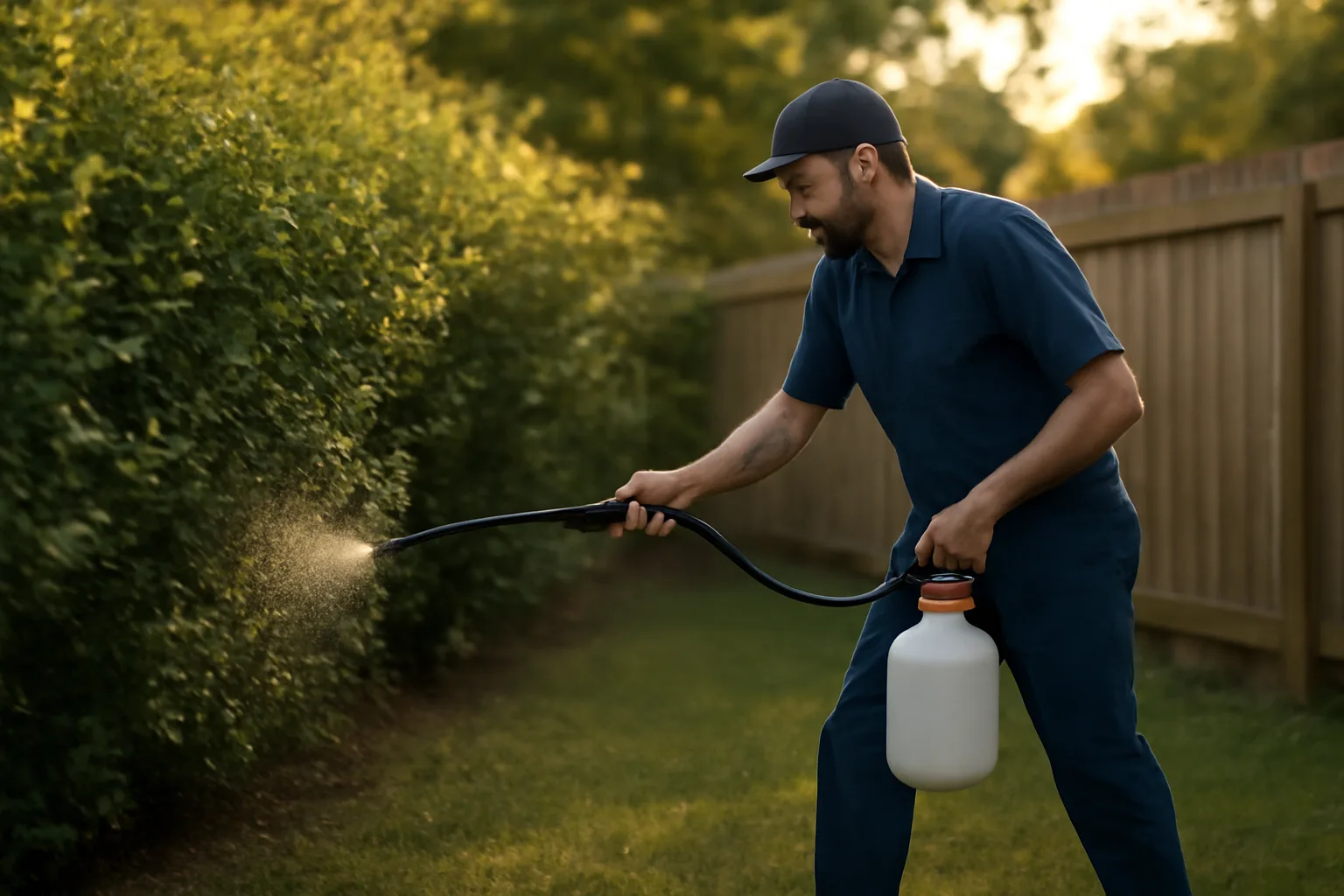
A mosquito spraying company sends a technician to walk your property, identify where mosquitoes rest and breed, and apply a liquid treatment to shrubs, tall grass, mulch beds, fence lines, and the undersides of leaves. Most residential barrier products use synthetic pyrethroids (like bifenthrin or permethrin) or, increasingly, plant-derived options such as nootkatone. The spray coats surfaces mosquitoes land on; when they touch treated foliage, it knocks them down. It's not a fog that kills mosquitoes flying through the yard at the moment of treatment (that's a different method, discussed below). Most companies also do at least a basic inspection for standing water: clogged gutters, plant saucers, tarps, low spots that pool after rain. The CDC frames standing-water removal as the most effective control step homeowners can take, ahead of any spray [1]. A company that only sprays and never mentions your birdbath or gutter isn't giving you the full picture. Treatments are almost always sold as a recurring service, not a one-time fix, because the product breaks down in 2 to 3 weeks depending on rain, sun, and the product used. That's why the 10-14 day retreatment cycle is the industry standard for barrier spraying. A single visit will thin out the population for a week or two and then mosquitoes reinvade from neighboring yards, tree lines, and anywhere water collects.
how to get rid of mosquitoes: barrier spray vs misting system vs DIY
| Professional barrier spray | Technician applies liquid to vegetation and resting spots | Every 10-14 days in season | Most yards, moderate to heavy pressure | Needs recurring visits; rain shortens interval | |
|---|---|---|---|---|---|
| Installed misting system | Nozzles plumbed around the yard, timed or remote-triggered release | Automatic, several times a day or on demand | Heavy-use outdoor spaces, frequent entertaining | Higher upfront cost; still needs refills and maintenance | |
| DIY spray (retail backpack or hose-end) | Homeowner applies pyrethroid or essential-oil product | Weekly or as needed | Small yards, tight budgets | Inconsistent coverage; product concentration usually lower than pro-grade | |
| Source reduction alone | Removing standing water | Ongoing | Every yard, as a baseline | Doesn't touch adult mosquitoes already resting on your property | The CDC states plainly that "the most effective way to control mosquitoes around your home is to eliminate standing water where they lay eggs" while also treating for adult mosquitoes when needed [1]. In practice, that means source reduction and spraying work together, not as competing choices. A company that skips one is only doing half the job. If you want a deeper comparison of methods and how professionals decide which to recommend, see mosquito control. |
There are three real approaches, and they aren't mutually exclusive. Here's how they stack up. | Method | How it works | Typical cycle | Best for | Downside |
how does a misting system compare to scheduled barrier spraying?
A misting system is a network of thin tubing and nozzles installed along fence lines, eaves, and landscaping, connected to a reservoir and a timer or remote trigger. It releases a fine spray automatically, often at dusk and dawn when mosquitoes are most active, and can be run on-demand before a party. Because it's built into the property, there's no truck rolling up every two weeks. The tradeoff is upfront installation cost and ongoing maintenance: reservoirs need refilling, nozzles clog, and the tubing is exposed to weather and lawn equipment. Barrier spraying by a technician has no hardware to maintain, but it depends on someone showing up on schedule and it can't respond instantly to a same-day cookout. Neither approach is install-and-forget. Extension entomologists generally recommend treating misting systems the same way as any pesticide application: read the label, respect reentry intervals, and don't assume more frequent misting means fewer mosquitoes if breeding sites nearby go unaddressed. If you're comparing which fits your yard, a mosquito control near me search will surface local companies who can quote both options against your actual property, which matters more than any generic comparison chart, because lot size, tree cover, and standing water on adjacent land change the math.
how to keep mosquitoes away between treatments
Between professional visits, or if you're not ready to hire anyone, a few habits make a real difference. Dump or refresh any container holding water at least once a week, since that's roughly the length of time it takes many mosquito species to complete their life cycle from egg to biting adult (about 8 to 10 days for Aedes aegypti under warm conditions, per CDC life-cycle data) [2]. Fix a leaky outdoor faucet. Clean gutters twice a year at minimum. Run box fans on a patio; mosquitoes are weak fliers and steady airflow keeps them off you even without any chemical involved. Wear repellent registered with the EPA, containing DEET, picaridin, IR3535, or oil of lemon eucalyptus, and follow the label rate for your skin and age group. For a full rundown of active ingredients and how long each one lasts, see mosquito repellent. Timing matters too. Mosquitoes are most active at dawn and dusk for most species, so scheduling outdoor time midday when it's practical cuts exposure without spending a dime.
what is a mosquito repellent plant, and do they actually work?
A mosquito repellent plant is a plant that contains compounds mosquitoes find irritating or that mask the scent cues (carbon dioxide, body odor) mosquitoes use to find people. Citronella grass, lemon balm, lavender, marigolds, and catnip are the plants most commonly marketed this way. The honest answer: growing these plants in your yard does little on its own. The repellent compounds are in the leaves and need to be crushed, extracted, or distilled into oil to release in useful concentration; a potted citronella plant on the patio is releasing a tiny fraction of what's in a citronella candle or oil-based spray. Research on catnip's active compound, nepetalactone, has been studied for mosquito-repelling activity, and a widely cited laboratory study found it can be an effective spatial repellent at usable concentrations, though those lab results are a long way from a plant sitting in a pot doing the same job outdoors [3]. Plants can be a nice complement to a real barrier plan and they don't hurt, but don't let a nursery display convince you they replace spraying or source reduction. For a fuller list of what plants repel mosquitoes and how to use them (crushed leaves rubbed on skin, oils extracted for diffusers), the natural mosquito repellent guide covers realistic uses versus marketing claims.
what plants repel mosquitoes the best?
Among the commonly cited options, citronella, lemon eucalyptus, catnip, marigold, lavender, and basil show up most often in extension publications and repellent research. Oil of lemon eucalyptus is actually registered by the EPA as an active ingredient in repellent products (not the raw plant, the refined oil, PMD) and has repellency data referenced in CDC guidance as comparable to low-concentration DEET in some studies [2]. Marigolds contain pyrethrum-related compounds and are sometimes planted at garden borders, though the effect on mosquitoes specifically is weaker than on other garden pests. Basil and lavender have anecdotal support and pleasant side benefits (cooking, scent) but limited controlled outdoor testing. The practical takeaway: plant what you like for your garden, don't expect a hedge of lavender to replace an actual repellent or a barrier treatment, and treat these as a minor assist, not a plan.
how to get rid of mosquitoes in the house
Indoor mosquitoes usually mean one of two things: they're coming in through gaps (doors, torn screens, vents) or they're breeding somewhere inside, most often in standing water you haven't noticed, like a plant saucer, a clogged AC drain line, or a vase. Start by checking screens for holes and making sure door sweeps seal. Empty and dry any indoor container that's held standing water for more than a few days. A few mosquitoes hiding in your house can be handled with a flyswatter, a vacuum, or an indoor-labeled aerosol used per the label; don't spray barrier products meant for outdoor vegetation inside your home, since label instructions differ by product and use inconsistent with labeling is a federal pesticide law violation under FIFRA [4]. If mosquitoes keep showing up indoors night after night despite sealed entry points, that points to an indoor breeding source you haven't found yet, not a supply from outside. Track down the water first.
how to get rid of mosquitoes in backyard spaces
Backyard control comes down to three things done together: remove standing water, treat vegetation where adults rest, and reduce entry points from neighboring properties where you can (fences don't stop mosquitoes, but dense hedges can slow drift somewhat). Walk the yard after it rains and note every spot water sits for more than a few days: gutters, low patches of lawn, tarps over firewood, unused planters, and kiddie pools. Mosquito breeding can happen in surprisingly small amounts of water, which is why a full property walk matters more than dumping the one obvious bucket. For active mosquitoes already in the yard, barrier spray on the 10-14 day cycle described earlier is the standard professional approach, timed to your local season. Homeowners doing it themselves can use a hose-end or backpack sprayer with an EPA-registered product labeled for residential outdoor use, focusing on shaded, humid areas: under decks, along fence lines, and dense shrubs, since mosquitoes rest there during the heat of the day.
how to get rid of ticks in your yard
Ticks don't fly and don't disperse far on their own; they wait on vegetation for a host to brush past, a behavior called questing. That means yard tick control focuses on the transition zones between lawn and woods or brush, not the whole property evenly. The CDC's tick-control guidance recommends creating a 3-foot-wide barrier of wood chips or gravel between lawns and wooded areas to restrict tick migration into recreational areas, along with keeping grass mowed short and removing leaf litter where ticks and their rodent hosts live [5]. Stacking wood neatly and in a dry location also helps, since ticks favor moist, shaded leaf litter. Acaricide (tick-killing pesticide) treatments applied to the yard perimeter and wooded edges in spring and again in fall can meaningfully reduce tick numbers, and CDC guidance points to this approach as most effective when combined with the landscaping changes above [5]. A single spray in July without those other steps is a partial fix at best. For repellent options to protect yourself and pets between treatments, see tick repellent.
what does a professional tick treatment for the yard look like?
Professional yard tick treatment usually targets the same transition zones the CDC guidance flags: wood line edges, tall grass borders, stone walls, and leaf litter, rather than blanket-spraying open lawn where ticks rarely quest. Technicians apply an EPA-registered acaricide labeled for tick control, often the same active ingredient families used for mosquito barrier work, since several pyrethroids are labeled for both. Timing matters more for ticks than for mosquitoes in some regions: many companies schedule a spring application timed to nymph activity and a fall application before adult ticks become active again, since tick life stages and peak activity vary by species and region. Check your state extension service or state health department for the exact windows where you live, since blacklegged tick activity in the Northeast, for example, doesn't match tick season in the Southeast or West. Combine any yard treatment with checking pets and people daily during tick season, since even a well-treated yard can have ticks carried in by wildlife.
when do mosquitoes go away for the season?
Mosquito activity generally drops once nighttime temperatures fall consistently below the mid-50s Fahrenheit, since most mosquito species become inactive or die off in sustained cold, though eggs of some species (notably Aedes) can overwinter and hatch again the following spring. That means the actual date mosquitoes "go away" varies enormously by region: parts of the Gulf Coast and Southwest see mosquito activity nearly year-round, while northern states may see a hard stop by mid-to-late October. There's no single national date, and anyone who gives you one without asking where you live is guessing. Local mosquito control districts and extension offices track first and last frost dates and adult mosquito trap counts specific to their county, and that's a far better source than a national average. Check your state or county extension office for local seasonal data. What's consistent everywhere: standing water and warm, humid stretches restart activity fast, so a late-season warm spell can bring mosquitoes back even after you thought the season was over. This is also why a seasonal barrier plan (starting treatments before mosquitoes are already established in spring and continuing through the first hard frost) tends to outperform a plan that starts only after you've been bitten a few times.
what should you ask a mosquito spraying company before hiring one?
Ask what active ingredient they use and whether it's rotated across the season; repeated use of the same insecticide class can contribute to resistance in local mosquito populations, a concern documented in CDC resistance-monitoring guidance [6]. Ask whether the treatment plan includes a standing-water inspection, more than spraying, since source reduction is the piece companies sometimes skip because it's less billable than a recurring spray visit. Ask about the retreatment interval and what happens if it rains the day after a visit (many pyrethroid products lose effectiveness faster after heavy rain and some companies offer a free retreat in that window). Ask whether they treat for ticks in the same visit or as a separate service, since not every mosquito company also does yard tick control. A reputable company should offer a free yard assessment before quoting a plan, walk the property with you, and explain what they found rather than handing you a flat per-visit price sight unseen. That's the model Duskproof uses: a free walk-through, then a seasonal barrier plan on the 10-14 day cycle or a misting system quote based on what your yard actually needs. You can get a free yard assessment to see what a plan for your property would look like before committing to anything.
is spraying safe for kids, pets, and pollinators?
Products used by licensed applicators are EPA-registered, which means the EPA has reviewed data on the active ingredient and requires specific label instructions for application rate, reentry interval, and precautions; registered is not the same as harmless, and labels exist precisely because the product carries some risk if misused, with off-label use itself being a violation of federal pesticide law under FIFRA [4]. Reentry intervals for common residential mosquito products often run a few hours; always check the specific product label the company uses, since intervals vary by formulation. Pollinator protection is a real consideration. Many state agencies and applicator guidance encourage treating in early morning or evening when bees are less active and avoiding spraying open blooms directly. Ask your company whether they follow pollinator-protection label language and whether they'll skip actively blooming plants during a visit. For pets, keep animals off treated areas until the label's reentry interval has passed, and rinse paws if you're unsure. If you have a backyard beekeeping setup, a fish pond, or a vegetable garden, mention it during the free assessment so the technician can plan around it rather than treating around obstacles they didn't know were there.
Frequently asked questions
How do I get rid of mosquitoes fast?
There's no instant fix, but the fastest combination is dumping all standing water on your property today, running fans on your patio, and using an EPA-registered repellent on skin while you're outside. A professional barrier spray knocks down existing populations within a day or two, but it needs a follow-up visit every 10-14 days to hold.
How do I keep mosquitoes away from my patio?
Remove any standing water within 50 feet, run a box fan (mosquitoes are weak fliers and can't handle steady airflow), and consider a barrier spray on vegetation around the patio's edge. Citronella candles have modest effect at best; a misting system or scheduled barrier treatment does more for a heavily used outdoor space.
How do I get rid of ticks on my property?
Create a 3-foot buffer of wood chips or gravel between lawn and wooded areas, per CDC guidance, keep grass mowed short, clear leaf litter, and consider a professional acaricide treatment to wood line edges in spring and fall. Check pets and people daily during tick season since wildlife can reintroduce ticks.
What is a mosquito repellent plant?
A mosquito repellent plant contains compounds mosquitoes find irritating, like citronella grass, lemon balm, catnip, and lavender. Growing them in a pot releases very little of that compound compared to a distilled oil or candle, so they're a minor complement to real repellent or barrier spray, not a replacement.
What plants repel mosquitoes?
Citronella, lemon eucalyptus, catnip, marigold, lavender, and basil are the most commonly cited. Oil of lemon eucalyptus (as refined PMD) is actually EPA-registered as a repellent active ingredient, unlike the raw plants, which release too little compound on their own to meaningfully repel mosquitoes outdoors.
How do I get rid of mosquitoes in my house?
Check screens and door seals for gaps, then find and eliminate any indoor standing water (plant saucers, AC drain lines, vases) since that's usually the source. Handle stray mosquitoes with a swatter or an indoor-labeled product used per its instructions; don't use outdoor barrier spray products inside.
When do mosquitoes go away for the year?
Mosquito activity generally slows once nighttime lows fall consistently below the mid-50s Fahrenheit, but the exact date varies widely by region, from nearly year-round in parts of the Gulf Coast to a hard stop by mid-October in northern states. Check your local extension office for area-specific data.
How do you get rid of mosquitoes in your backyard?
Eliminate standing water everywhere it collects (gutters, tarps, planters), then treat resting vegetation like shrubs and fence lines with an EPA-registered barrier product, ideally on a 10-14 day cycle during peak season. Skipping either step, water removal or spraying, leaves the other doing all the work alone.
How do you get rid of ticks in your yard without chemicals?
Mow grass short, remove leaf litter, keep woodpiles dry and stacked away from the house, and add a 3-foot wood-chip or gravel barrier between lawn and wooded areas, a method specifically recommended by the CDC to restrict tick migration into yards. This won't eliminate ticks but reduces exposure meaningfully.
How often should a mosquito spraying company treat my yard?
The industry standard is every 10 to 14 days during active mosquito season, since most barrier products break down within that window from rain, sun, and irrigation. Heavy rain can shorten that interval; ask your company whether they offer a free retreat if a storm hits soon after a visit.
Do misting systems work better than a spray technician visit?
Misting systems automate the spray schedule and can trigger on demand, which suits people who entertain outdoors often, but they cost more upfront and need maintenance (refills, nozzle cleaning). Scheduled technician visits have no hardware but depend on the visit schedule. Neither replaces removing standing water.
Is professional mosquito spray safe for kids and pets?
EPA-registered products used per label are reviewed for application rate and reentry intervals, but registered does not mean harmless; always follow the stated reentry interval before letting kids or pets back onto treated areas. Ask your company for the specific product label and interval they use.
Can I do my own mosquito barrier spray instead of hiring a company?
Yes, with an EPA-registered product labeled for residential outdoor use and a backpack or hose-end sprayer, focusing on shaded vegetation and resting sites. It takes more consistency and physical effort than most homeowners keep up for a full season, which is the main reason people switch to a service.
Sources
- CDC, Mosquito Control at Home: Standing-water removal is framed as the most effective first step in mosquito control around homes
- CDC, Mosquito Life Cycle and Repellent Guidance: Mosquito life cycle timing and oil of lemon eucalyptus repellency data
- Bernier UR, et al., "Synthesis and Evaluation of Nepetalactone as Mosquito Repellent," Journal of Medical Entomology, PMID 15535392: Nepetalactone in catnip has shown mosquito-repelling effects at usable concentrations in laboratory research
- 7 U.S.C. 136j, Federal Insecticide, Fungicide, and Rodenticide Act, Unlawful Acts: Using a pesticide product in a manner inconsistent with its label is an unlawful act under federal pesticide law
- CDC, Preventing Tick Bites on People (Yard Management): A 3-foot-wide barrier of wood chips or gravel between lawns and wooded areas restricts tick migration into recreational yard areas
- CDC, Mosquito Insecticide Resistance: Repeated use of the same insecticide class can contribute to insecticide resistance in mosquito populations