Last updated 2026-08-14
TL;DR
Mosquito spray falls into three types: DIY aerosols and foggers (hours of relief), backpack barrier treatments applied every 10-21 days (the standard for yard-wide control), and permanent misting systems (automated, higher cost). None of them eradicate mosquitoes; they knock down populations. Pair spray with standing-water removal for real results.
How do you actually get rid of mosquitoes?
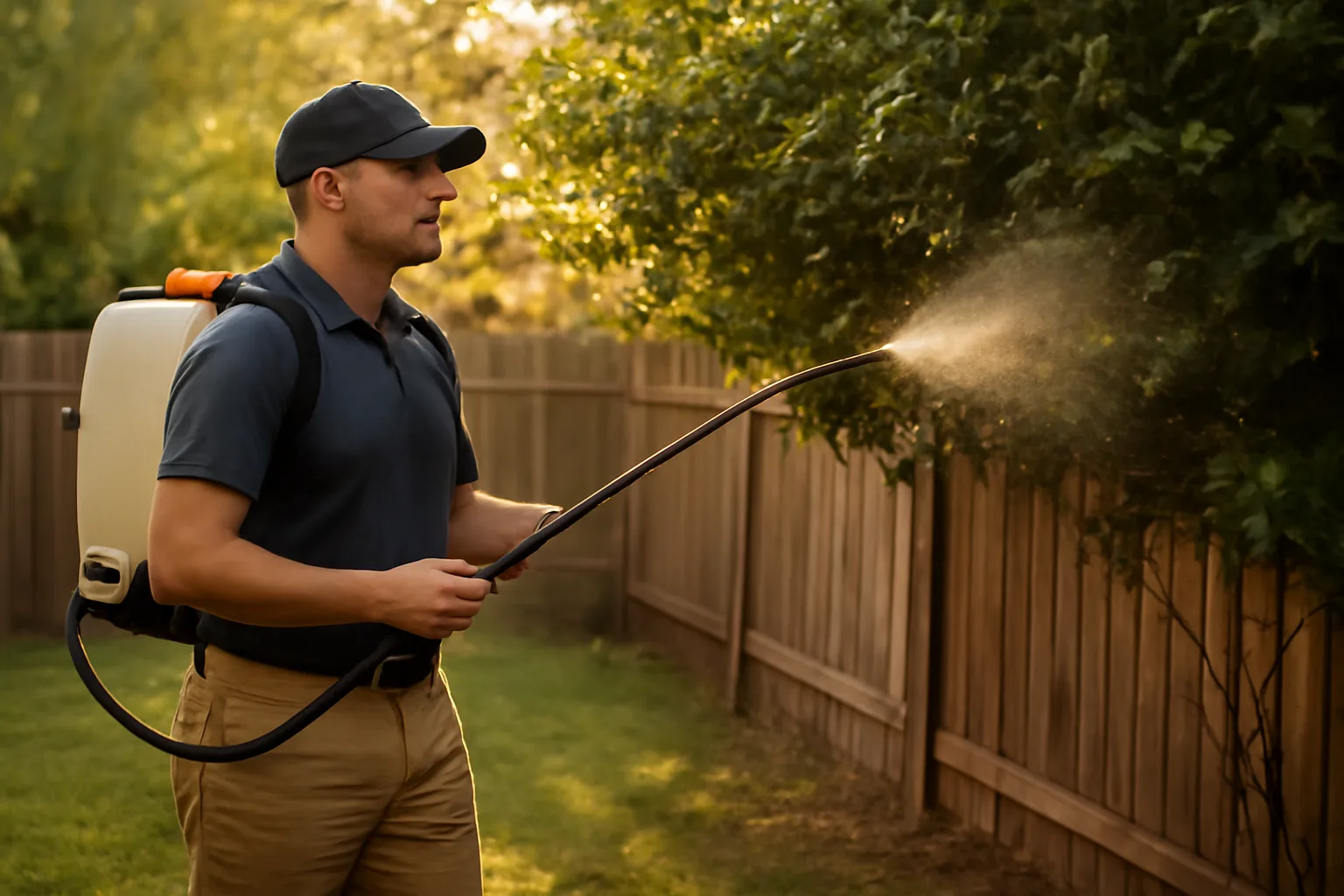
There's no single spray or gadget that gets rid of mosquitoes for good. The mosquitoes buzzing around your porch tonight are probably not the ones that were there two weeks ago; most species live only 2 to 4 weeks as adults, and females can lay 100 to 300 eggs per batch in almost any standing water they find [1]. That means control is really about breaking a cycle, not winning a single battle. The honest answer has three parts. First, eliminate standing water within about 100 to 300 feet of where people gather, since that's the typical flight range for common backyard species like Culex and Aedes [2]. Second, apply a residual barrier spray to vegetation and resting surfaces on a schedule, not a one-time basis. Third, accept that some adult mosquitoes will always fly in from beyond your property line, especially near woods, wetlands, or a neighbor's neglected birdbath. A barrier treatment sprayed by a backpack or truck-mounted sprayer targets the shrubs, tall grass, and shaded areas where adult mosquitoes rest during the day. It's applied to leaf undersides and stems, not as a fog into open air, so it keeps working as mosquitoes land on treated surfaces over the following one to three weeks depending on the product and weather. That's different from a fogger, which kills what's flying at the moment of application and then is gone. If you want a realistic mental model: think of barrier spray as mowing the lawn. You don't mow once and call it done forever. You do it on a cycle, mosquitoes (or grass) keep growing back, and skipping a cycle means you notice fast.
What's the difference between barrier spray, foggers, and misting systems?
| DIY aerosol/fogger | Sprays into open air, kills mosquitoes present at that moment | Hours, sometimes through one evening | A single party or event, tonight | |
|---|---|---|---|---|
| Backpack barrier treatment | Sprayed onto foliage and resting surfaces, residual kill as mosquitoes land | Roughly 10 to 21 days depending on product and rain | Whole-yard control on a recurring schedule | |
| Installed misting system | Fixed nozzles release fine mist automatically on a timer | Minutes per cycle, several times a day | Properties wanting hands-off, frequent knockdown | Foggers and handheld aerosols (the kind you buy at a hardware store) are contact killers. They're reasonable for a backyard barbecue starting in twenty minutes, but they don't stop the next wave of mosquitoes flying in from the tree line an hour later. Barrier treatments are the workhorse for season-long control. A licensed technician sprays an EPA-registered pyrethroid or similar product onto the underside of leaves, mulch beds, fence lines, and other shaded resting spots, applied strictly per the product label [3]. This is the same class of active ingredient (synthetic pyrethroids like permethrin or bifenthrin) used in many EPA-registered mosquito products, and the EPA requires specific label directions on where and how much can be applied [3]. A properly timed program repeats this every 10 to 14 days through the season, which is roughly how long residual efficacy holds up against rain, UV breakdown, and new plant growth. Misting systems are permanently installed tubing and nozzles, usually mounted along a fence or eave line, that release a fine mist on a timer, often at dawn and dusk when mosquitoes are most active. They cost more upfront than a spray subscription because of installation, but they don't require someone to show up every two weeks. For heavy infestations near wetlands or in high-humidity climates, this is often worth it. For a typical suburban quarter-acre lot, a barrier spray program usually does the job for less money. |
These are three different tools for three different jobs, and mixing them up is the most common reason people feel like nothing worked. | Method | How it works | Typical duration | Best for |
How do you keep mosquitoes away between treatments?
Spray buys you time; it doesn't buy you immunity. Between professional visits or DIY applications, a few habits matter more than any single product. Dump or refresh standing water every 3 to 4 days. That's the CDC's specific guidance because it's roughly the time it takes mosquito eggs to hatch and develop into biting adults in warm weather. Check plant saucers, clogged gutters, tarps, old tires, and anywhere rainwater collects, even a bottle cap's worth. Run fans on your patio. Mosquitoes are weak fliers, generally topping out around 1 to 1.5 miles per hour in still air, and a box fan or ceiling fan moving air across a seating area makes it much harder for them to land [4]. Dress for it during peak hours (dawn and dusk for most Culex and Aedes species). Long sleeves and light colors help, and the CDC recommends EPA-registered repellents containing DEET, picaridin, IR3535, oil of lemon eucalyptus (OLE), para-menthane-diol (PMD), or 2-undecanone for skin application [5]. A repellent on your skin and a barrier spray on your yard do different jobs and work well together; see our guide to mosquito repellent options for how to pick one. Keep grass mowed and shrubs trimmed. Adult mosquitoes rest in shaded, humid vegetation during the day; a tidy yard gives them fewer places to hide and gives barrier spray better coverage on the surfaces that matter.
How do you get rid of mosquitoes in your house?
Indoor mosquitoes usually mean one of two things: they're getting in through gaps, or something inside is breeding them. Both are fixable without heavy chemical treatment indoors. Check door sweeps, window screens, and any gaps around AC units or vents. A single missing screen or a door left open for a few minutes on a summer evening is often the entire source. Repair or replace torn screens; it sounds too simple, but it's the number one fix. Look for indoor standing water. Overwatered houseplants with saucers, a forgotten vase, a leaking pipe under a sink, or even a floor drain that stays damp can support mosquito larvae, particularly Culex species that tolerate stagnant, low-oxygen water. Empty and dry plant saucers weekly. For mosquitoes already inside, a residual indoor spray isn't usually necessary or worth the exposure. A flyswatter, a fan pointed at problem rooms, or a plug-in device with an EPA-registered active ingredient handles most indoor situations. If mosquitoes keep reappearing indoors despite sealed entry points, that's a sign of an indoor breeding site you haven't found yet, not a sign you need stronger spray.
How do you get rid of mosquitoes in your backyard?
Backyard control is where barrier spray earns its keep, but spray alone without source reduction is like bailing water without patching the leak. Start with a walk-through looking for anything that holds water for more than 4 days: clogged gutters, tarps, kiddie pools, saucers under potted plants, low spots in the lawn, unused birdbaths, and open rain barrels. The CDC and most state extension services point to this as step one because a single flowerpot saucer can produce dozens of adult mosquitoes in under two weeks. For water you can't drain (ornamental ponds, rain barrels you want to keep), mosquito dunks containing Bti (Bacillus thuringiensis israelensis) are an EPA-registered larvicide that kills larvae without the broader residual impact of an adult spray, and they're labeled safe for use in water features with fish [6]. For the adult population already flying around, a barrier treatment sprayed on shrubs, under decks, along fence lines, and in mulch beds on a 10 to 14 day cycle is the standard professional interval, chosen because that's roughly how long residual efficacy lasts before rain and plant growth wear it down. This is also where a mosquito control service earns its cost versus a one-time DIY spray: the schedule is the product, not any single visit. A lot of homeowners ask about foggers for backyard use. They're fine for a specific evening event, but they don't hold up as a season-long strategy because there's no residual effect once the mist settles.
What plants repel mosquitoes, and are mosquito repellent plants worth it?
A mosquito repellent plant is any plant whose natural oils are believed to discourage mosquitoes from landing or biting when the plant is crushed, brushed against, or its oil extracted and applied to skin. The plant sitting in a pot on your patio, undisturbed, is doing very little on its own. Citronella, lemongrass, catnip, lavender, marigold, and rosemary are the most commonly cited options. Some laboratory research on catnip oil (nepetalactone) has shown repellent activity against mosquitoes comparable to or exceeding DEET in certain lab assays, but those are controlled lab conditions, not a potted plant on your deck [7]. A plant releases far less volatile oil passively than a concentrated extract applied to skin or fabric. Here's the honest take: mosquito repellent plants are a nice-to-have, not a control strategy. They look good, some (like lavender and rosemary) are genuinely pleasant landscaping choices, and crushing the leaves and rubbing them on skin or clothing does release more of the oil than letting the plant sit. But no extension service or entomology department recommends relying on planted citronella instead of source reduction and residual treatment. Consider them a garnish on top of a real plan, not the plan itself. For readers who want to build a chemical-free layer into their approach, see our guide on natural mosquito repellent options that actually have supporting data.
How do you get rid of ticks, and how are they different from mosquito control?
Ticks and mosquitoes get lumped together in yard-care conversations, but they behave very differently, which changes the control approach. Ticks don't fly and they don't breed in standing water. They quest, meaning they climb to the tip of grass blades, leaf litter, or low shrubs and wait with front legs extended for a host to brush past [8]. That means tick control focuses on ground-level and edge habitat, not birdbaths. The CDC and university extension research point to a few concrete steps. Keep grass mowed short. Create a barrier of wood chips or gravel, at least 3 feet wide, between lawns and wooded areas or stone walls, since research from the Connecticut Agricultural Experiment Station and others has found this reduces tick migration into recreational areas [9]. Remove leaf litter and brush where ticks and their rodent hosts (a major reservoir for Lyme disease bacteria) live. For active treatment, yard-applied acaricide (tick-specific pesticide) sprays targeting the leaf litter and lawn edge, not the whole lawn interior, are the standard professional approach. A single well-timed spring application combined with a follow-up in early summer covers the two main nymph and adult activity peaks in most of the continental U.S., though your local extension office can confirm timing for your region since tick season varies notably between the Northeast, upper Midwest, and Pacific coast [10]. If you're dealing with both pests, a combined program (barrier mosquito spray plus edge-focused tick treatment) is more efficient than two separate schedules; see tick repellent for skin and clothing-level protection to pair with yard treatment.
How do you get ticks out of your yard for good?
You can't get ticks out of your yard permanently, since they arrive constantly on deer, rodents, birds, and pets crossing your property. But you can push the population and the risk down hard with consistent habitat and treatment work. The biggest lever most homeowners underuse is the woodchip or gravel border mentioned above. Studies from the Connecticut Agricultural Experiment Station found this kind of barrier, combined with keeping play equipment and patios away from wooded edges, meaningfully reduced tick presence in the yard's used areas [9]. Deer are a major tick transport mechanism for adult blacklegged ticks specifically. Deer fencing or exclusion, where feasible, is one of the few interventions with strong supporting research for reducing tick density over multiple seasons, though it's a bigger project than most homeowners take on for tick control alone. For the chemical side, a licensed applicator treating the yard perimeter, stone walls, and leaf litter zones with an EPA-registered acaricide in spring and again in early summer covers the two activity peaks that matter most for Lyme and other tick-borne disease risk in most regions. Always check tick activity timing with your local health department or extension office, since a tick season in Minnesota doesn't look like one in coastal Georgia [10].
When do mosquitoes go away for the season?
Mosquitoes typically become inactive once temperatures consistently drop below about 50°F, since most species stop flying and feeding at that point, though this varies by species and region . In much of the northern U.S., that means late October through November. In the Gulf Coast, Florida, and southern California, mosquitoes can remain active nearly year-round because temperatures rarely stay cold enough for long enough to force full dormancy . Cold doesn't kill mosquitoes outright in most cases; it triggers diapause. Many species overwinter as eggs (laid in a spot that will flood come spring) or as adult females who find a sheltered, humid spot like a crawl space, hollow log, or storm drain and go dormant until temperatures rise again [1]. That's why a mild winter often means a rough mosquito season the following spring: more eggs and dormant females survive to restart the cycle. The practical takeaway for treatment timing: barrier spray programs typically run from the first consistent 50°F+ stretch in spring through the first hard, sustained cold snap in fall. Stopping treatment for the season doesn't need to wait for the calendar; it needs to wait for your local weather pattern. Check with your local extension office or health department for typical first and last frost dates in your area, since that's a better predictor than any generic date .
How much does professional mosquito spray cost, and is it worth it?
Pricing varies a lot by region, lot size, and whether you're buying a seasonal barrier program or an installed misting system, and any legitimate company should give you a number based on walking your actual property, not a flat national rate. The standard seasonal model is a recurring barrier treatment every 10 to 14 days through mosquito season, priced per visit or per season based on yard size and vegetation density. An installed misting system carries higher upfront installation cost but lower ongoing labor since it runs automatically. What actually determines value is less about the price tag and more about three things: whether the technician treats the resting surfaces (shrub undersides, fence lines, mulch beds) and more than open lawn, whether the schedule holds through the season instead of a one-and-done spray, and whether standing water on your property gets addressed as part of the plan, not ignored while spray gets reapplied around it. This is the model Duskproof runs on: a free yard assessment first, so you know what you're actually dealing with before committing to anything, then a barrier plan on that 10 to 14 day cycle, or an installed misting system if that fits your property better. If you want a real number for your yard rather than a guess, get a free yard assessment.
Is mosquito spray safe for kids, pets, and pollinators?
This is worth answering carefully because it's the question every homeowner should ask before hiring anyone, and the honest answer has real qualifications, not a blanket yes. EPA-registered mosquito control products, when applied according to the label, have gone through EPA review for the intended use pattern, but that doesn't mean a product is harmless or that all precautions disappear. The EPA specifically states that pesticide products must be used consistent with the label, and re-entry intervals (how long to stay off treated grass or keep pets away) are printed on that label for a reason [3]. Most professional barrier treatments recommend keeping people and pets off treated foliage and lawn until the spray dries, typically a few hours, and beekeepers and pollinator advocates generally recommend avoiding spraying open flowers directly, since pyrethroids are toxic to bees on contact before the residue dries . A responsible applicator sprays foliage and resting surfaces, not blooming flower heads, and times applications to avoid peak pollinator activity. If you have a vegetable garden, fish pond, beehives, or specific health sensitivities, tell whoever you hire before the first visit. Ask what active ingredient is being used, ask to see the label, and ask about the interval before it's safe to let kids and pets back on the lawn. Any company that can't answer those questions clearly isn't one to hire.
Frequently asked questions
How do you get rid of mosquitoes fast?
For same-day relief, a fogger or aerosol spray kills what's flying right now, and a fan on the patio makes it hard for new mosquitoes to land. For anything longer than one evening, you need standing water removed and a residual barrier spray on shrubs and resting surfaces, since foggers offer no lasting protection once the mist settles.
How do you keep mosquitoes away without spraying chemicals?
Remove standing water every 3 to 4 days, run fans on outdoor seating areas since mosquitoes are weak fliers, wear long sleeves at dawn and dusk, and use an EPA-registered skin repellent like picaridin or oil of lemon eucalyptus. These steps reduce exposure meaningfully but won't match the population reduction of a scheduled barrier treatment.
How do you get rid of ticks in your yard?
Mow grass short, clear leaf litter and brush, and install a 3-foot-wide wood chip or gravel barrier between lawn and wooded edges, a method with supporting research from the Connecticut Agricultural Experiment Station. Add a professional acaricide treatment to yard edges in spring and early summer for the two main activity peaks.
What is a mosquito repellent plant?
A mosquito repellent plant contains natural oils, like citronella's citronellal or catnip's nepetalactone, that show repellent activity in lab studies when extracted and concentrated. Left growing undisturbed in a pot, these plants release far less oil than a concentrated repellent, so they help a little but shouldn't replace source reduction or barrier spray.
What plants repel mosquitoes?
Citronella, lemongrass, catnip, lavender, marigold, and rosemary are the most commonly cited mosquito repellent plants. Catnip oil has shown repellent activity comparable to DEET in some lab studies, but that's under concentrated lab conditions, not from a plant sitting on a patio. Crushing leaves onto skin releases more oil than the plant alone.
How do you get rid of mosquitoes in your house?
Check window screens and door sweeps for gaps, since a single opening is often the whole problem. Look for indoor standing water in plant saucers, vases, or leaky pipes. For mosquitoes already inside, a flyswatter, fan, or plug-in EPA-registered device usually handles it without needing a residual indoor spray.
How do you get rid of mosquitoes in the house permanently?
There's no permanent fix without ongoing habits: repair screens, seal gaps around AC units and vents, and inspect weekly for indoor standing water like plant saucers or condensation trays. If mosquitoes keep reappearing despite sealed entry points, there's likely an indoor breeding source you haven't found yet.
When do mosquitoes go away for the year?
Most species become inactive once temperatures consistently drop below about 50°F, typically late October through November across much of the northern U.S. In warmer regions like Florida, the Gulf Coast, and coastal California, mosquitoes can stay active nearly year-round. Check your local extension office for typical dates in your specific area.
How do you get rid of mosquitoes in your backyard?
Remove or treat all standing water first, since a single saucer can breed dozens of mosquitoes in under two weeks. Then apply a residual barrier spray to shrubs, fence lines, and mulch beds on a 10 to 14 day cycle through the season. Skipping either step leaves the other doing all the work alone.
How do you get rid of ticks from your yard naturally?
Keep grass mowed short, clear leaf litter and brush piles, and create a wood chip or gravel barrier at least 3 feet wide between lawn and wooded edges. These habitat changes reduce tick migration into yards without pesticide, though they work best combined with a targeted acaricide treatment on high-traffic edges.
How often should mosquito barrier spray be reapplied?
Most professional programs reapply every 10 to 14 days during active season, since that's roughly how long residual efficacy holds up against rain, UV exposure, and new plant growth covering treated surfaces. Heavy rain or a lot of new foliage growth can shorten that window and call for an earlier follow-up visit.
Does mosquito spray kill ticks too?
Standard mosquito barrier products and tick-specific acaricides often share active ingredient classes (like pyrethroids), but they're applied differently: mosquito spray targets shrub foliage and resting surfaces, while tick treatment focuses on lawn edges and leaf litter where ticks quest for hosts. A combined program treats both zones rather than assuming one spray covers everything.
Sources
- CDC, Mosquito Life Cycle: Mosquito lifespan, egg-laying behavior, and overwintering/diapause biology
- American Mosquito Control Association, Mosquito Biology: Typical flight range of common backyard mosquito species
- CDC, Controlling Mosquitoes at Home: Recommendation to dump or refresh standing water every 3-4 days
- CDC, Prevent Mosquito Bites: CDC-recommended EPA-registered repellent active ingredients (DEET, picaridin, IR3535, OLE, PMD, 2-undecanone)
- Journal of Medical Entomology, Chauhan et al., 'Feeding Deterrent Effects of Catnip Oil': Catnip oil (nepetalactone) repellent activity against mosquitoes compared to DEET in lab testing
- CDC, Tick-Borne Diseases: Ticks Questing Behavior: Tick questing behavior and how ticks find hosts
- Connecticut Agricultural Experiment Station, Tick Management Handbook: Wood chip/gravel border research reducing tick migration into yards
- CDC, Tick Season and Regional Activity: Regional variation in tick activity timing across the U.S.
- CDC, Mosquito Habits and Lifecycle: Temperature threshold around 50°F for mosquito activity decline and regional variation in season length
- US EPA, Pollinator Protection and Pesticide Labels: Pyrethroid toxicity to bees on contact before residue dries and recommendation to avoid spraying open blooms