Last updated 2026-08-14
TL;DR
Effective mosquito treatment combines source reduction (dumping standing water weekly), a barrier spray on a 10-14 day cycle during your active season, and targeted repellents for skin. No single method eliminates mosquitoes; barrier treatments knock populations down for a couple weeks at a time, not forever. Ticks need a separate yard-perimeter approach.
How do you get rid of mosquitoes for good?
You don't, not permanently. Mosquitoes fly in from neighboring yards, drainage ditches, and wooded areas no matter what you do to your own property, so the honest goal is knockdown and suppression, not eradication. The CDC's own guidance on mosquito control describes an integrated approach: remove standing water, use approved repellents on skin, and consider larvicides or adulticides for problem areas [1]. The practical stack that actually moves the needle, in order of what to do first: dump standing water weekly, apply a residual barrier spray to vegetation and shaded resting spots on a 10 to 14 day cycle through your region's mosquito season, and use EPA-registered skin repellents when you're outside during peak biting hours (usually dawn and dusk for most Culex and Aedes species). What doesn't work well on its own: bug zappers (studies going back decades show they kill mostly harmless insects, not much for actual mosquito reduction), ultrasonic devices (no credible peer-reviewed evidence they repel mosquitoes), and citronella candles beyond a very small radius. They're not scams exactly, they're just weak tools being asked to do a job they can't finish alone. If your yard has a chronic problem (shade, poor drainage, a creek nearby), source reduction and a single spray probably won't hold. That's the case where a seasonal barrier plan or an installed misting system on a fixed cycle makes sense, because the population keeps rebuilding from eggs and larvae you can't see. For a broader look at how professional programs structure this, see mosquito control.
How do you keep mosquitoes away from your yard and patio?
Keeping mosquitoes away is mostly about denying them two things: standing water to breed in, and shady, humid vegetation to rest in during the heat of the day. Mosquitoes don't travel far from where they hatch. The Asian tiger mosquito (Aedes albopictus), one of the most common backyard biters in the eastern and southern US, typically flies less than 600 feet from its larval habitat over its lifetime [2]. That short flight range is good news: it means your own yard's water sources are probably driving most of your bite problem, not some pond a half mile away. Walk your property after any rain and dump anything holding water for more than 4 to 7 days, which is roughly the minimum time it takes many mosquito species to complete their life cycle from egg to adult in warm weather [3]. Common culprits: clogged gutters, saucers under potted plants, tarps, kiddie pools, old tires, birdbaths that aren't changed weekly, and low spots in the lawn that puddle. Beyond water, keep grass and shrubs trimmed since mosquitoes rest in dense shade during the day, and consider a residual barrier spray applied to the underside of leaves, fence lines, and mulch beds where adults hide. Some people also plant mosquito-repellent plants near seating areas, more on how much that actually helps below. If you want a rundown of the personal-repellent side (sprays, wearables, and what the EPA actually vets), check mosquito repellent and natural mosquito repellent for the plant-oil options.
What is a mosquito repellent plant, and do they actually work?
A mosquito repellent plant is any plant that contains natural compounds, usually in its leaves or oils, that mosquitoes are thought to avoid or that produce a scent believed to mask the carbon dioxide and body odor cues mosquitoes use to find people. Citronella grass, lemongrass, catnip, marigolds, lavender, and rosemary are the plants most commonly sold under this label at garden centers. The catch: having the plant in your yard does very little on its own. The repellent compounds are inside the plant tissue and only become airborne in meaningful concentration when the leaves are crushed or the oil is extracted and applied to skin. A living, undisturbed lavender bush releases a faint scent, nowhere near the concentration used in a bottled repellent. There is some real research behind individual compounds. Nepetalactone, the compound in catnip, has been studied for repellent activity and some lab work has found it comparably effective to DEET against certain mosquito species in controlled settings, though field performance (wind, sweat, movement) is a different story than a lab dish [4]. Citronella oil is registered by the EPA as a biopesticide active ingredient and can provide some repellency, generally for shorter duration than DEET or picaridin-based products. Bottom line: plant them if you like how they look and want a marginal, unreliable assist. Don't count on a border of marigolds to replace a real repellent on your skin or a barrier treatment on your yard.
What plants repel mosquitoes most effectively?
| Catnip (Nepeta cataria) | Nepetalactone | Lab studies show notable repellency; crushed leaves needed [4] | |
|---|---|---|---|
| Citronella grass | Citronellal, geraniol | EPA-registered as biopesticide active ingredient; oil extraction needed | |
| Lemon eucalyptus | PMD (para-menthane-3,8-diol) | EPA-registered repellent active ingredient, effective as an extracted oil product, not from the plant alone [3] | |
| Lavender | Linalool | Weak, short-lived repellency in some small studies | |
| Marigold | Pyrethrin-related compounds | Mostly anecdotal for whole-plant effect | |
| Rosemary, basil | Various terpenes | Minimal standalone evidence | The one on this list with the strongest official backing is oil of lemon eucalyptus, and that's specifically because the EPA registers PMD, its refined active compound, as a repellent ingredient you'll find in real bottled products, not because planting a eucalyptus tree does anything for your patio [3]. Same logic with citronella: the EPA-registered use is the extracted oil in a product with directions and a concentration, not the ornamental grass clump by your fence. If you want a real repellent effect from plants, your best move is crushing the leaves and rubbing the oil directly on skin or fabric (many people do this with catnip and citronella), understanding that duration is shorter than a formulated product and reapplication needs are frequent. |
Ranked by how much actual research backs the claim, more than garden-center folklore, here's what to know before you plant a mosquito border. | Plant | Active compound | Evidence level |
How do you get rid of mosquitoes in the house?
Indoor mosquitoes almost always mean one of two things: they're getting in through a gap (torn screen, door left open, a gap under a door) or they're breeding somewhere inside, most often a forgotten water source like a clogged drain, a plant saucer, or a humidifier reservoir. Start with entry points. Check window and door screens for holes, even small ones, and make sure screens are actually latched flush against the frame, more than resting in the track. Mosquitoes need surprisingly little gap to get through. Next, hunt for indoor standing water. Check under sinks for slow drips, empty and dry any indoor plant saucers, check basement floor drains (a dry trap can let mosquitoes breed in the residual water and also lets sewer gas in, so this is worth fixing regardless), and look at anything that collects condensate, like a window AC unit or dehumidifier. For the mosquitoes already inside, a few options in order of hassle: a fan on a table or nightstand disrupts their weak flight enough to keep them away from you at night, an indoor aerosol labeled for flying insects (read and follow the label, since indoor-use directions differ from yard products), or simply hunting them down when they land, since a fed mosquito rests for a while afterward and is easier to swat. If mosquitoes keep reappearing indoors despite sealed screens, that points hard at an internal breeding source you haven't found yet, not an ongoing invasion from outside.
How do you get rid of mosquitoes in the house long-term, and why do they keep coming back?
Recurring indoor mosquitoes after you've fixed screens and obvious water sources usually trace back to one of a few overlooked spots: a sump pump pit, the tray under a refrigerator, a rarely-used toilet with a low water level, or gutters so clogged that water backs up near an attic vent. Mosquito eggs of some species (notably Aedes) can survive dry conditions for months and hatch once water returns, which is why a spot that seemed dry during your inspection can suddenly produce mosquitoes after a humid week or a leak [3]. Checking once isn't enough; recheck after any period of high humidity or after running water-using appliances you don't use often. If you have a finished basement, check the sump pit itself; standing water sitting in an uncovered pit for more than a few days is a classic hidden hatchery. A tight-fitting sump lid solves this and is a one-time fix. For a home that backs up to woods, a marsh, or a retention pond, some indoor pressure is simply going to be outdoor mosquitoes drifting in whenever a door opens, and no amount of indoor searching fixes that. In that case the fix is outside: a barrier treatment on the vegetation nearest your doors and a look at whether a door sweep or improved weatherstripping is worth the twenty dollars.
How do you get rid of mosquitoes in the backyard?
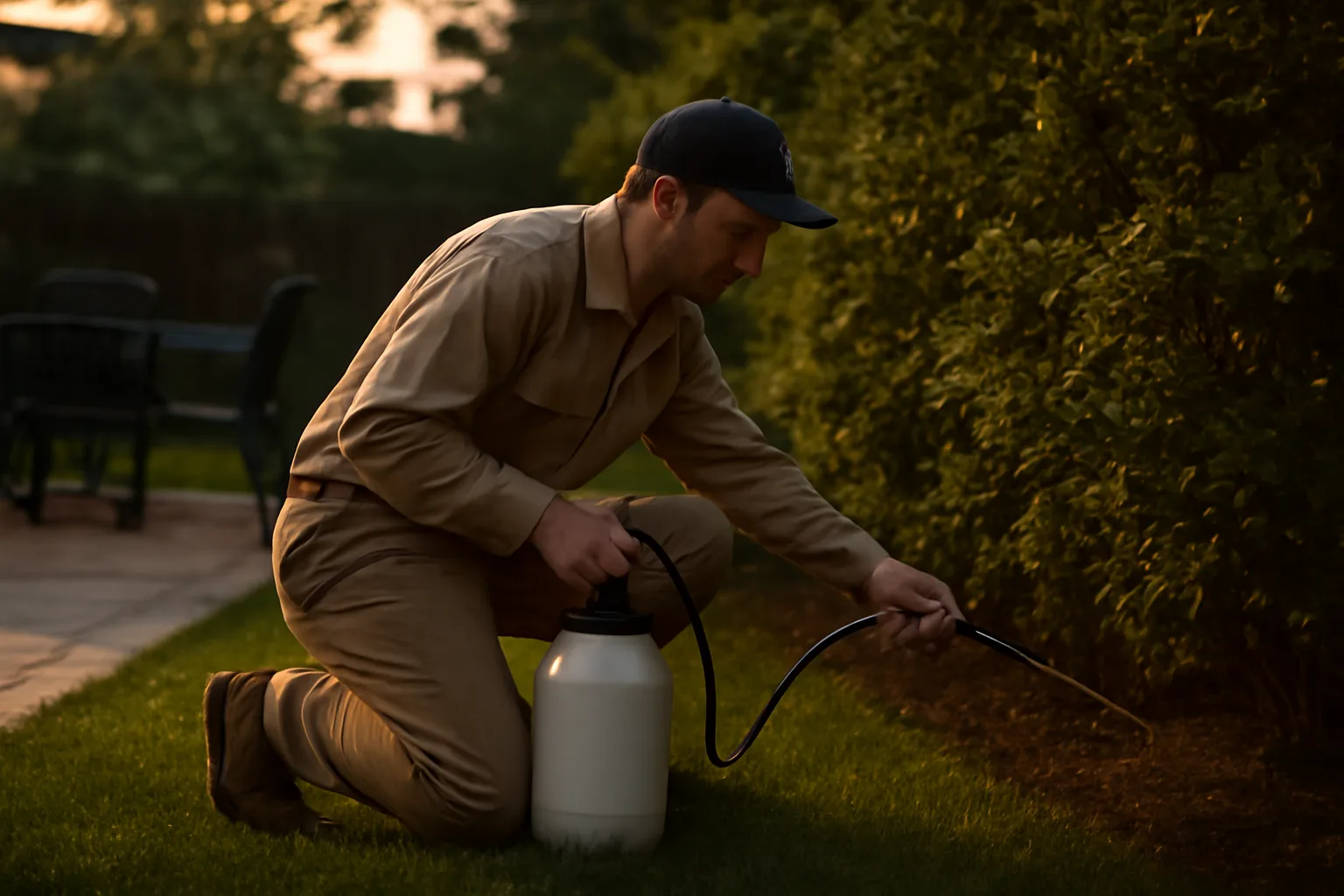
Backyard mosquito control works best as a layered system, not a single product. Here's the order that actually holds up. First, source reduction. This is unglamorous and it's also the highest-leverage thing you can do, because a single neglected bucket can produce hundreds of mosquitoes. Walk the yard weekly during mosquito season and dump, drain, or cover anything holding water for more than a few days [3]. Second, a residual barrier spray. Professional and DIY barrier treatments use EPA-registered pyrethroid products applied to the underside of leaves, shrubs, mulch beds, and shaded structures, the exact spots where adult mosquitoes rest during the day. These treatments are typically reapplied every 10 to 14 days through the active season because the residue breaks down with UV exposure, rain, and time, and because new adults keep emerging from eggs laid before treatment [5]. Always applied per label directions; nobody should call these products safe or non-toxic outright, they're EPA-registered pesticides used according to a legal label, and that label is what governs where, how much, and how often you can apply them [6]. Third, consider an installed misting system if your property has chronic pressure (heavy shade, standing water nearby, frequent evening entertaining). These systems release a fine mist of an EPA-registered insecticide on a timed schedule, usually dawn and dusk, from nozzles routed around the yard perimeter and patio. They cost more upfront than a spray-only plan but need less manual scheduling once installed. Fourth, personal repellent for anyone actually sitting outside, since no yard treatment gets every single mosquito, especially near a property line abutting untreated woods or a neighbor's uncut yard. This is genuinely where a professional assessment earns its cost for a lot of homeowners, because getting the barrier spray timing right for your specific yard (shade patterns, water sources, wind exposure near the mister nozzles) is harder to dial in by eye than it sounds. Duskproof starts every plan with a free yard walk to find the actual breeding and resting spots before recommending a 10 to 14 day barrier cycle or a misting system, and you can get a free yard assessment to see what your property actually needs before spending on either.
When do mosquitoes go away for the season?
Mosquito activity drops off once temperatures fall consistently below the range most species need to stay active, generally in the mid-50s Fahrenheit and lower, though this varies a lot by species and region. Many adult mosquitoes die off after the first hard frost, while others go dormant and overwinter as eggs or as adults sheltering in protected spots, ready to resume once temperatures climb back up in spring [7]. That means the real answer is regional, not a fixed calendar date. In the Upper Midwest and Northeast, meaningful mosquito activity often winds down by mid to late October with a hard freeze. In the Gulf Coast, Florida, and much of the Southwest, mosquitoes can stay active nearly year-round during mild winters, especially in urban heat-island areas. Because of that spread, your local mosquito control district or agricultural extension office is a better source for your actual season end date than any national rule of thumb; conditions like an unusually warm fall or a wet October can extend activity by weeks in either direction. Search for your state's extension service (for example, a state land-grant university's entomology extension page) for region-specific mosquito activity windows. One practical note: the tail end of the season is often when barrier treatments matter most, since a lot of homeowners stop spraying in September assuming they're done, right as a warm stretch brings mosquitoes back for one more few weeks of biting.
How do you get rid of ticks?
Getting rid of ticks starts with understanding they don't fly or jump; they wait on grass and low vegetation for a host to brush past, a behavior called questing. That means tick control is almost entirely about managing the vegetation and habitat where they wait, not spraying open lawn. The CDC and most state health departments recommend a layered approach: keep grass mowed short, clear leaf litter and brush at the yard's edge, create a barrier of wood chips or gravel between lawn and wooded areas (the CDC specifically notes a 3-foot-wide wood chip or gravel barrier can help restrict tick migration into recreational areas), and treat the yard perimeter with an EPA-registered acaricide . For pets, tick preventives (topical, oral, or collar, discussed with a veterinarian) matter because pets can carry ticks into the house and yard even from a single walk elsewhere. For people, checking your body after any time in tall grass, brush, or woods, and showering within two hours, are both specifically recommended by the CDC as ways to catch and remove ticks before they attach for the length of time needed to transmit disease . If you find an attached tick, remove it with fine-tipped tweezers, grasping it as close to the skin as possible and pulling straight up with steady, even pressure, per CDC guidance . Don't twist, don't use petroleum jelly or a hot match, both are old wives' tale methods that don't work reliably and can increase disease transmission risk by agitating the tick.
How do you get rid of ticks from your yard specifically?
Yard-level tick control focuses on three zones: the lawn edge, the leaf litter and wood line, and any spots where deer or rodents pass through, since ticks depend on those animals for blood meals at different life stages. The most-cited structural fix is the same wood chip or gravel barrier mentioned by the CDC, placed between mowed lawn and adjacent woods or stone walls, roughly 3 feet wide, which research from the Connecticut Agricultural Experiment Station and others has shown reduces tick movement into the yard because the dry, sun-exposed material is inhospitable to nymphal ticks . Beyond the barrier, mow regularly and keep grass short, since ticks lose moisture quickly in direct sun and short, dry grass is a poor environment for them. Remove leaf litter, brush piles, and tall weeds at the yard's edge where ticks quest and where rodents nest. If deer are a regular presence in your yard, a fence or deer-resistant landscaping reduces the number of adult ticks getting dropped off at your property line in the first place, since deer are the primary host for adult blacklegged ticks in much of the eastern US . For active treatment, professional and DIY perimeter sprays using EPA-registered acaricides applied to the yard edge, stone walls, and wood piles in spring and again in early summer target the areas ticks actually occupy, rather than blanket-spraying the whole lawn, which wastes product on ground ticks rarely use. If ticks are a persistent problem alongside mosquitoes, a combined seasonal plan covering both pests on the same visit schedule is usually more efficient than treating them separately; see tick repellent for the personal-protection side of this.
Barrier spray vs. misting system: which mosquito treatment is right for your yard?
| Upfront cost | Lower | Higher (installation + hardware) | |
|---|---|---|---|
| Ongoing cost | Per-visit or seasonal plan | Refill/service cost, lower per-visit labor | |
| Effort | Scheduled visits every 10-14 days | Automated, minimal ongoing effort | |
| Best for | Moderate pressure, seasonal use | Chronic pressure, frequent outdoor entertaining | |
| Flexibility | Easy to pause/resume seasonally | Fixed installation, less flexible to move | Neither one eliminates mosquitoes; both knock down the population for a window of days before it needs reapplication, because new adults keep emerging from unhatched eggs and from mosquitoes flying in from beyond your property line. For most yards with moderate, seasonal pressure, a barrier spray plan is the better value. For yards with chronic wet conditions, heavy shade, or frequent evening use of the patio, the misting system's automation tends to be worth the extra upfront cost. A mosquito control near me search plus a free yard walk will usually tell you which category your property falls into faster than guessing. |
These are the two main professional-grade options homeowners choose between, and the right one depends more on your yard's chronic pressure level than on personal preference. A barrier spray is a liquid application, usually a pyrethroid, sprayed directly onto vegetation, mulch beds, fence lines, and other resting surfaces by a technician (or a homeowner with a pump sprayer) every 10 to 14 days through the season. It needs a scheduled visit or a recurring DIY task, but there's no hardware installed and no ongoing equipment maintenance. A misting system is installed plumbing, tubing and nozzles routed around the yard perimeter and patio, connected to a reservoir and timer, that releases a fine insecticide mist automatically, usually at dawn and dusk. It costs more to install but removes the scheduling burden and can respond faster to a sudden mosquito spike (some systems allow a manual burst) than waiting for the next spray visit. | Factor | Barrier spray | Misting system |
Frequently asked questions
How do I get rid of mosquitoes fast before a backyard event?
For a same-day fix, a quick spray of an EPA-registered outdoor aerosol or a professional rapid barrier treatment on shaded vegetation a few hours before guests arrive knocks down resting adults. Add fans on the patio (mosquitoes are weak flyers) and personal repellent for guests. This isn't a long-term fix, just a short window of relief.
How often should mosquito yard treatments be reapplied?
Most residual barrier sprays are reapplied every 10 to 14 days through the active season because UV exposure, rain, and mowing break down the residue, and new adult mosquitoes keep emerging from eggs laid before the last treatment. Misting systems typically run automatically at dawn and dusk instead of a fixed reapplication interval.
Are mosquito treatments safe for pets and kids?
EPA-registered mosquito products are legal for residential use only when applied according to their label, which specifies reentry times, application areas, and concentration. They are not labeled 'safe' or 'non-toxic' outright; follow posted reentry intervals and keep pets and kids off treated areas until the label-specified time has passed.
Do mosquito repellent plants really keep mosquitoes away?
Only marginally, and only if you crush the leaves and apply the oil to skin. Living, undisturbed plants like citronella grass, catnip, or lavender release very little repellent compound into the air. Some individual compounds, like nepetalactone in catnip, show real lab-tested repellency, but the whole intact plant sitting in a pot does far less.
How do I get rid of mosquitoes in my house overnight?
Check and seal window and door screens, run a fan near where you sleep since mosquitoes fly weakly, and hunt down any resting mosquitoes on walls or curtains after dusk when they're less active and easier to catch. An indoor aerosol labeled for flying insects, used per the label, can clear a room before bed.
When do mosquitoes go away for the year in cold climates?
In the Upper Midwest and Northeast, mosquito activity typically winds down by mid to late October with the first hard freeze, though a warm fall stretch can extend it. Some species overwinter as eggs or dormant adults and return once spring temperatures climb, so a single frost doesn't guarantee the season is fully over.
Do mosquitoes ever come back in warm winter climates?
Yes. In Florida, the Gulf Coast, and much of the Southwest, mild winters mean mosquitoes can stay active nearly year-round, especially in urban areas that hold heat. Homeowners in these regions often need a barrier treatment plan that runs closer to twelve months instead of a defined spring-through-fall season.
What's the fastest way to get rid of ticks in the yard?
Mow the lawn short, clear leaf litter and brush at the wood line, and add a 3-foot-wide wood chip or gravel barrier between lawn and woods, a method the CDC specifically recommends to restrict tick movement into recreational yard areas. Follow with an EPA-registered acaricide applied to the yard perimeter and wood piles, not the open lawn.
Can I get rid of ticks without chemicals?
Habitat management alone (short grass, cleared leaf litter, a wood chip barrier, deer fencing) reduces tick populations meaningfully but rarely eliminates them, especially in yards bordering woods. Most integrated tick management programs combine habitat changes with a targeted, EPA-registered acaricide application at the yard perimeter for reliable control.
What attracts mosquitoes to my yard specifically?
Standing water is the top driver since it's where eggs are laid and larvae develop; even a bottle cap of water can support larvae. Shade, tall grass, and dense shrubs give adults places to rest during the day. Body heat, carbon dioxide, and sweat then attract adults to people once they emerge.
Do bug zappers or ultrasonic devices actually work on mosquitoes?
Not well. Studies on bug zappers have repeatedly found they kill mostly non-biting insects rather than mosquitoes, and there's no credible peer-reviewed evidence that ultrasonic repellent devices affect mosquito behavior at all. Both are weak substitutes for source reduction, a real barrier treatment, and EPA-registered skin repellent.
How long does a mosquito barrier treatment last?
Most residual barrier sprays remain effective for roughly 10 to 14 days before reapplication is needed, though rain, mowing, and strong UV exposure can shorten that window. This is why seasonal plans schedule visits on a fixed cycle rather than a single one-time application.
Sources
- CDC, Preventing Mosquito Bites: CDC's integrated approach of source reduction, repellents, and control products for mosquito management
- CDC, Aedes albopictus fact sheet: Asian tiger mosquito flight range and life cycle basics
- EPA, Mosquito Life Cycle: Mosquitoes complete egg-to-adult development in as little as 4-7 days in warm conditions
- EPA, Repellent products and oil of lemon eucalyptus: Oil of lemon eucalyptus (PMD) is an EPA-registered repellent active ingredient
- CDC, Mosquito species and ranges: Mosquito activity can persist nearly year-round in warm US regions
- CDC, Preventing Tick Bites on People: 3-foot wood chip or gravel barrier recommendation, checking body after outdoor exposure, and showering within two hours
- CDC, Tick Removal: Correct tick removal technique using fine-tipped tweezers with steady upward pressure