Last updated 2026-08-14
TL;DR
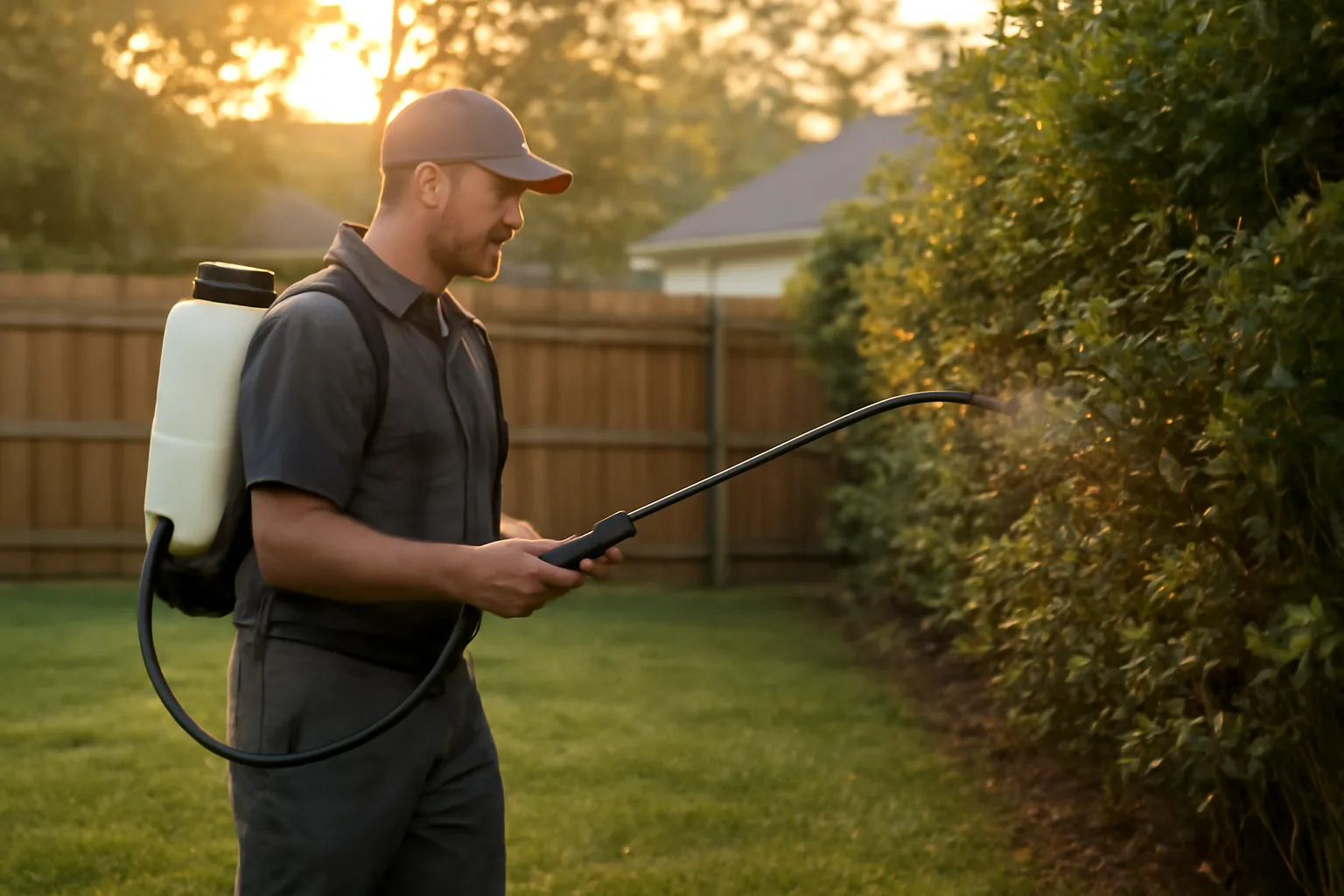
A mosquito spray company treats your yard's vegetation and resting sites with an EPA-registered barrier spray, usually on a 10 to 14 day cycle during mosquito season, or installs a misting system. It knocks populations down for two to three weeks per visit; it does not eliminate mosquitoes. Combine it with standing-water removal for the best results.
How do I get rid of mosquitoes in my yard?
The fastest real-world reduction comes from stacking two things: removing standing water and treating vegetation with a barrier spray. Neither one alone does the job well. Mosquitoes need standing water to breed, and the CDC notes that some species can complete their life cycle in as little as 7 to 10 days once water is present [1]. That means a bottle cap of rainwater sitting in a plant saucer for a week can produce a new batch of biting adults before you've noticed the puddle. Walk your property after every rain and dump anything holding water: saucers, buckets, tarps, clogged gutters, kiddie pools, old tires. Once standing water is under control, a barrier treatment handles the adult mosquitoes already resting in your shrubs, under deck rails, and in tall grass during the day. Professional applicators use EPA-registered products applied according to the label, targeting the shady, humid spots where mosquitoes rest between blood meals. A well-timed spray knocks the resting population down hard for roughly two weeks, which is why most companies, including mosquito control services, run visits on a 10 to 14 day cycle through the season rather than a single one-time application. DIY yard sprays from the hardware store work on the same principle but usually use lower concentrations and cover less thoroughly than a backpack or truck-mounted sprayer aimed at every rest site. If you're doing it yourself, focus on the underside of leaves, the base of shrubs, tall grass edges, and shaded areas under decks and porches, since that's where adult mosquitoes actually hide during the day, not out in open sun on your lawn. No treatment, DIY or professional, eliminates mosquitoes from an area. Adults fly in from neighboring yards, drainage ditches, and wooded edges constantly. The realistic goal is knocking the population down enough that you can sit outside at dusk without getting eaten, not a mosquito-free zone.
How do I keep mosquitoes away long term?
Long-term mosquito control is really about denying three things: breeding water, daytime rest sites, and easy access to you. Do all three and you'll see a real difference within a couple of weeks. Start with source reduction, which entomologists generally agree is the single highest-leverage step homeowners can take [2]. Check every container that holds water weekly during warm months. Clogged gutters are a chronically underrated source; a gutter with standing leaf debris can hold water for the entire season. Corrugated drainage extensions and French drains are another common miss. Next, keep vegetation trimmed. Adult mosquitoes rest in dense, shaded, humid plants during the heat of the day; thinning shrubs and mowing tall grass reduces the real estate available to them and makes any spray you apply reach further. For the evenings you actually want to use your yard, a fan on the patio helps more than most people expect. Mosquitoes are weak fliers, and the CDC notes that fans can help reduce mosquitoes' ability to land on people by disrupting their flight [3]. Barrier sprays and misting systems are the tools that scale this up across an entire property instead of just one porch. A mosquito control near me search usually turns up companies offering both a seasonal spray plan and installed misting systems; the spray plan treats vegetation every 10 to 14 days, while a misting system runs on a timer and mists the yard automatically, which trades a higher upfront install cost for less scheduling hassle.
How do I get rid of ticks in my yard?
Tick control in the yard works differently from mosquito control because ticks don't fly and don't breed in water. They live in leaf litter, tall grass, and brush, and they wait there for a host to walk by. Cutting off that habitat is the core of yard-level tick reduction. The CDC's tick prevention guidance recommends creating a 3-foot-wide barrier of wood chips or gravel between lawns and wooded areas, since ticks rarely cross dry, open borders like that [4]. It also recommends keeping grass mowed short, clearing leaf litter and brush, and stacking woodwork neatly in a dry area, since all of these reduce the humid microhabitat ticks need to survive between meals. Placing playground equipment, patios, and seating areas away from yard edges and in sunny spots also helps, since ticks dry out and die in direct sun and low humidity. On the chemical side, professional tick treatments target the same edge habitat: the leaf litter line, brush piles, stone walls, and the border where lawn meets woods. This is usually a separate or add-on treatment from mosquito barrier spraying because the target zones only partly overlap; mosquito sprays focus on shaded vegetation and standing water sites, while tick treatments focus on ground-level leaf litter and the woodland edge specifically. A tick repellent applied to skin and clothing before you're in tick habitat, plus a daily tick check, rounds out a full approach; the CDC recommends checking your body for ticks within 2 hours of coming indoors after any time in tick habitat [4].
How do you get rid of ticks from your yard specifically (more than prevent them)?
Existing tick populations in a yard respond to a combination of habitat modification and targeted acaricide (tick-killing pesticide) application, ideally timed to the local tick's active season. The habitat side comes first because it makes any chemical treatment more effective and longer-lasting. Mow regularly, remove leaf litter especially at the woodland edge, and keep the woodpile stacked and dry. The 3-foot wood chip or gravel barrier mentioned by the CDC is one of the few yard modifications with real supporting logic behind it: it creates a dry, hot, open zone that ticks avoid crossing [4]. On top of that, targeted spraying of leaf litter, stone walls, and shrub edges with an EPA-registered acaricide, applied according to label directions, reduces tick numbers in the treated zone. Timing matters a lot here. Nymphal blacklegged ticks, the life stage responsible for most Lyme disease transmission, are typically most active from late spring through mid-summer in much of the northeastern and upper midwestern US, though your local extension office or health department can confirm timing for your specific region since it varies by species and climate [5]. One treatment will not solve an established tick population in wooded, high-grass, or leaf-litter-heavy properties. Reapplication on a schedule through the tick season, alongside the habitat changes, is what actually holds numbers down.
What is a mosquito repellent plant, and do they actually work?
A mosquito repellent plant is a plant that's commonly claimed to deter mosquitoes, usually because it contains aromatic compounds (like citronellal, geraniol, or linalool) that mosquitoes seem to find unpleasant when the plant's oils are released or crushed. The honest answer on effectiveness: intact, living plants provide minimal to no measurable reduction in mosquito landings in your yard. The compounds that make citronella, lemongrass, lavender, and similar plants smell the way they do are the same compounds found in some plant-based repellent products, but the concentration matters enormously. A citronella plant sitting in a pot on your patio releases far too little of its essential oil into the air to create a protective zone around you. You'd need to crush the leaves and apply the oil directly, similar to how a repellent product concentrates and applies it. That said, planting them isn't a waste of a garden bed. They smell nice, some (like lavender) also repel other pests, and if you're going to plant something anyway, there's no downside to choosing one of these over a plant with no reported repellent properties. Don't let a few potted plants replace an actual mosquito reduction plan for your yard, though. For actual evening protection, a topical or clothing-applied mosquito repellent, or a natural mosquito repellent formulated at an effective concentration, does far more than the plants themselves.
What plants repel mosquitoes, and which ones are worth planting?
| Citronella grass | Source of citronella oil, a registered biopesticide active ingredient | Living plant: minimal; oil form: yes, at proper concentration | |
|---|---|---|---|
| Lemongrass | Contains citronellal | Minimal as a potted plant | |
| Lavender | Contains linalool, also repels some other insects | Minimal as a potted plant; nice for the garden regardless | |
| Marigold | Often marketed as a mosquito deterrent | Little to no solid evidence for whole-plant effect | |
| Catnip | Contains nepetalactone, studied in some lab trials | Lab studies show potential; living plant impact in a yard is unproven | |
| Basil, rosemary | Culinary herbs, contain aromatic oils | Minimal as living plants; fine for the kitchen garden | Citronella oil itself is actually registered by the EPA as a biopesticide active ingredient for use in repellent products [6], so the underlying chemistry has some legitimate backing. The gap is between the concentrated, extracted oil in a registered product and a plant sitting in a pot doing none of that extraction for you. If you like the idea of a repellent garden bed, plant away. Just don't treat it as your yard's mosquito control plan. |
The plants most commonly cited for mosquito-repellent properties include citronella grass, lemongrass, lavender, marigolds, catnip, basil, and rosemary. Several of these have been studied for the repellent activity of their extracted essential oils, though usually in lab settings using concentrated oil, not as a living plant in a yard. Here's a rough comparison of what's commonly claimed versus what the plant form actually delivers in a real yard: | Plant | Commonly claimed benefit | Realistic yard impact |
How do I get rid of mosquitoes in my house?
Indoor mosquitoes almost always trace back to one of two things: a gap letting them in, or a source breeding inside. Start by checking window and door screens for holes and gaps, especially where screens meet frames, since even a small tear is enough entry for a mosquito. Next, look for indoor standing water. Overwatered houseplants with saucers that stay wet, unused vases with old water, or a basement floor drain that stays damp can all support mosquito breeding indoors, though it's less common than outdoor sources. Empty and dry any standing water you find. For mosquitoes already inside, a few approaches work: an indoor-labeled aerosol spray applied per the label in problem areas (not general living space fumigation), a plug-in repellent device, or simply an old-fashioned approach of turning off lights near open doors at dusk, since mosquitoes and other flying insects are drawn toward light and will follow you in in through a briefly open door. A box fan in the room also helps for the same reason it helps on a patio: mosquitoes are weak fliers and struggle against consistent air movement [3]. If mosquitoes keep showing up indoors despite screens being intact, the source is very likely outside your door, in resting vegetation right next to entry points, which is where a yard-level barrier treatment matters even for an indoor mosquito problem.
How do I get rid of mosquitoes in the house if it keeps happening?
A recurring indoor mosquito problem, as opposed to an occasional single mosquito, points to either a persistent breeding source nearby or an entry point that isn't being fixed. Treat this as a two-step diagnosis: find the source, then seal the entry. Walk the perimeter of your house and check every screen, especially ones on frequently-used doors, since those get more wear. Check weep holes and any gaps around utility penetrations (where pipes or cables enter the house), since mosquitoes are small enough to use surprisingly tiny gaps. Then widen the search outside. Gutters, downspout extensions, low spots in the yard that hold rainwater, birdbaths that aren't changed regularly, and even a tarp with a low spot collecting rain are all classic sources within flying distance of a house. Mosquitoes generally don't range far from where they emerge; many common species stay within a few hundred yards of their breeding site over their lifespan, though flight range varies significantly by species [2]. If you've checked screens and eliminated obvious water sources and mosquitoes are still getting in regularly, a barrier treatment on the vegetation immediately around your house's foundation and entry points, done on a seasonal schedule, addresses the resting population before they ever reach your door.
When do mosquitoes go away for the season?
Mosquitoes typically become inactive once nighttime temperatures consistently drop into the 50s Fahrenheit, and most species stop being a real nuisance once there's been a hard frost, since adult mosquitoes generally die off in freezing temperatures while eggs and some overwintering adults survive to restart the cycle in spring [2]. The exact timing varies enormously by region. In the Gulf Coast and parts of the Southwest, mosquito activity can continue nearly year-round during mild winters. In the Upper Midwest and Northeast, the season commonly runs from around May through the first hard frost in October, though this shifts year to year with weather patterns. Your local mosquito control district or agricultural extension office tracks actual trap counts for your area and is the most reliable source for when your specific season starts and ends, since national averages don't reflect local conditions well. This regional variability is exactly why a one-time spring or fall treatment doesn't cover a season. Companies that run barrier treatments on a 10 to 14 day cycle through the active months are matching the actual life cycle and rest-and-refeed pattern of adult mosquitoes, not an arbitrary schedule.
Should I hire a mosquito spray company, and what should the visit include?
Hiring a company makes the most sense if you've already tackled the free stuff (standing water, screens, vegetation trimming) and you're still getting bitten, or if your property has enough acreage, wooded edge, or drainage complexity that thorough DIY coverage isn't realistic. A good first visit, sometimes marketed as a free yard assessment, should include the technician walking your property to identify standing water sources, shaded resting vegetation, and any wooded or brushy edges relevant to tick risk. They should be able to tell you what's actually driving your mosquito pressure, more than quote you a flat price over the phone without seeing the yard. From there, expect one of two service models: a seasonal barrier spray plan, where a technician treats vegetation and rest sites every 10 to 14 days through your local mosquito season, or an installed misting system, where nozzles plumbed around the yard's perimeter release a fine mist automatically on a timer. The spray plan generally costs less upfront but needs recurring visits; the misting system costs more to install but runs without a technician present each time. Duskproof runs this exact model: a free yard assessment first, then either the 10 to 14 day barrier cycle or a misting system install, quoted for your property rather than sold as a flat package. If you want a professional look at what's actually breeding and resting on your specific property, Get a free yard assessment. Whatever company you choose, ask what active ingredient they use, confirm it's EPA-registered and applied per its label instructions, and ask how they handle pollinator protection, since responsible operators avoid spraying open flowers where bees are actively foraging.
Barrier spray vs. misting system vs. DIY: which actually works better?
| Professional barrier spray | Every 10 to 14 days in season | Resting vegetation, shaded areas, foundation perimeter | Needs recurring visits; no equipment install cost | |
|---|---|---|---|---|
| Installed misting system | Automatic, often daily or per-timer | Perimeter mist zone around the yard | Higher upfront install cost; less scheduling hassle | |
| DIY hose-end or backpack spray | As often as you're willing to do it | Whatever areas you personally treat | Cheapest; effectiveness depends heavily on thoroughness and consistency | |
| Source reduction (water removal) | Weekly check, especially after rain | Breeding sites, not adults | Free; addresses the root cause but not existing adult population | The honest framing: source reduction is the foundation no matter which other method you choose, since it's free and addresses new mosquitoes before they exist. Barrier spray and misting systems both address the existing adult population, and the choice between them is really about how much you want to think about scheduling versus how much you want to spend upfront on equipment. DIY works fine for small, open yards without much brush or standing water complexity. It becomes a lot less effective per hour of effort on larger properties, heavily wooded edges, or yards with drainage features that are hard to fully dry out. |
Each approach has a real tradeoff; none of them is a scam and none of them is magic. Here's how they actually compare. | Method | Typical schedule | What it treats | Tradeoff |
Frequently asked questions
How much does a mosquito spray company typically charge?
Pricing depends heavily on yard size, vegetation density, and your region, and most companies quote after seeing the property rather than posting a flat rate. Because pricing varies so much by market and property, get a specific quote for your yard rather than relying on a national average; a free yard assessment is the standard first step most local companies offer.
How often should a mosquito company spray my yard?
Most professional barrier treatments run on a 10 to 14 day cycle throughout the local mosquito season, since that matches roughly how long the knockdown effect lasts on treated vegetation before mosquito activity rebounds. A single treatment does not last all season; recurring visits are the standard model for actual season-long control.
Is mosquito spray safe for pets and kids?
Products used by licensed applicators are EPA-registered and must be applied according to their label instructions, which include re-entry timing to let treated areas dry. No pesticide should be called harmless or non-toxic; ask your applicator for the specific product's label and re-entry interval and keep kids and pets off treated areas until it's dry.
Does a mosquito spray company also treat for ticks?
Many do, though it's often a separate service or add-on since tick treatments target ground-level leaf litter and woodland edges rather than the shaded shrub vegetation mosquito sprays focus on. Ask specifically whether a company's plan includes tick-zone treatment or whether you'd need to request it separately.
What plants repel mosquitoes the best?
Citronella grass, lemongrass, lavender, and catnip are the most commonly cited plants, mainly because their essential oils contain compounds like citronellal and linalool. As living plants in the ground or a pot, their real-world repellent effect in a yard is minimal; the concentrated extracted oils used in registered repellent products work far better.
How do I get rid of mosquitoes in my house fast?
Check screens for gaps, remove any standing water in saucers or vases, and use an indoor-labeled aerosol spray per its label in the affected room. A box fan running in the space also helps, since mosquitoes are weak fliers and struggle against consistent airflow. Persistent indoor mosquitoes usually mean an outdoor source near an entry point.
When do mosquitoes go away for the year?
Most mosquito activity drops off once nighttime temperatures consistently sit in the 50s Fahrenheit and stops almost entirely after the first hard frost, since adult mosquitoes generally can't survive freezing temperatures. Timing varies a lot by region; warm-climate areas can see activity nearly year-round, so check with your local extension office for typical dates.
How do you get ticks out of your yard for good?
You can't remove ticks permanently, but you can push numbers down hard with habitat changes (short grass, cleared leaf litter, a 3-foot wood chip or gravel barrier at wooded edges) plus targeted acaricide treatment of leaf litter and brush during your local tick season. Recheck and retreat through the season since new ticks move in from adjacent wooded areas.
Do ultrasonic mosquito repellers actually work?
There's no solid, independent evidence that ultrasonic devices meaningfully reduce mosquito bites; most controlled studies have found no significant repellent effect. If you're considering one, treat it as unproven rather than a replacement for source reduction, screens, or an actual repellent product.
What's the difference between a barrier spray and a misting system?
A barrier spray is applied by a technician on a recurring schedule, typically every 10 to 14 days, directly onto resting vegetation and shaded areas. A misting system is installed plumbing around your yard's perimeter that releases a fine mist automatically on a timer, trading a higher upfront cost for less ongoing scheduling.
Can I get rid of mosquitoes in my backyard without chemicals?
You can meaningfully reduce numbers through source reduction (removing all standing water weekly), trimming dense shaded vegetation where adults rest, adding a patio fan to disrupt their weak flight, and using screened outdoor structures. This won't eliminate mosquitoes, but combined with personal repellent it can make a yard usable without any sprayed pesticide.
How do I know if I need a professional mosquito company versus doing it myself?
If you've already removed standing water, trimmed vegetation, and are still dealing with heavy mosquito pressure, or your property has significant wooded edge, brush, or drainage complexity, a professional barrier treatment or misting system usually outperforms DIY effort. Smaller, open, well-maintained yards often do fine with consistent DIY source reduction alone.
Sources
- CDC, Mosquito Life Cycle: Some mosquito species can complete their life cycle in as little as 7 to 10 days
- CDC, Controlling Mosquitoes at Home: Source reduction (removing standing water) is a primary recommended step for homeowner mosquito control, and mosquitoes generally stay within a limited range of their breeding site
- CDC, Mosquito Bite Prevention: Mosquitoes are weak fliers and fans can help reduce their ability to land on people
- CDC, Preventing Tick Bites on People: A 3-foot wide barrier of wood chips or gravel between lawns and wooded areas restricts tick migration, and checking for ticks within 2 hours of coming indoors is recommended
- CDC, Lyme Disease Transmission: Nymphal blacklegged ticks, responsible for most Lyme disease transmission, are most active in late spring and summer
- US EPA, Citronella (Oil of Citronella) Registration Review Final Decision, EPA-HQ-OPP-2011-0359: Citronella oil is registered by the EPA as a biopesticide active ingredient used in insect repellent products