Last updated 2026-08-14
TL;DR
Professional mosquito spray for yards uses an EPA-registered barrier treatment applied to vegetation and shade areas every 10 to 14 days through the season, cutting mosquito activity noticeably within 24 to 48 hours. It reduces populations, it does not eliminate them. Pair it with standing-water removal for the best results.
How do you get rid of mosquitoes in your yard?
You get rid of most of the mosquitoes in a yard by combining two things: killing the adults that are already there and removing the water where new ones are born. Neither one alone does the full job. A barrier spray (sometimes called a barrier treatment) is a liquid pesticide applied to the underside of leaves, shrubs, mulch beds, fence lines, and other shady spots where adult mosquitoes rest during the day. Mosquitoes don't fly around in open sun much; they hide in vegetation until dusk. When they land on a treated surface, they pick up the residue and die, usually within hours to a day. Products used for this typically contain pyrethroids like bifenthrin or permethrin, which the EPA registers for outdoor residential use when applied according to the label [1]. The water side matters just as much. A female mosquito can lay 100 to 300 eggs at a time in standing water, and some species complete their whole life cycle from egg to biting adult in about 8 to 10 days in warm weather [2]. A bottle cap of water is enough for some species to breed in. Clogged gutters, plant saucers, tarps, kiddie pools, and old tires are the usual offenders. Most homeowners who want lasting control end up doing both: a recurring barrier spray on a 10 to 14 day cycle (because that's roughly how long the residue stays effective and how long it takes populations to rebound) and a weekly walk-around to dump anything holding water. Skip the water step and you're just re-treating a breeding factory every two weeks. If you're comparing your options for mosquito control near you, the honest answer is that barrier spray is the fastest way to get your yard usable again this weekend, while source reduction is what keeps next month from being just as bad.
What does professional mosquito spray for yards actually involve?
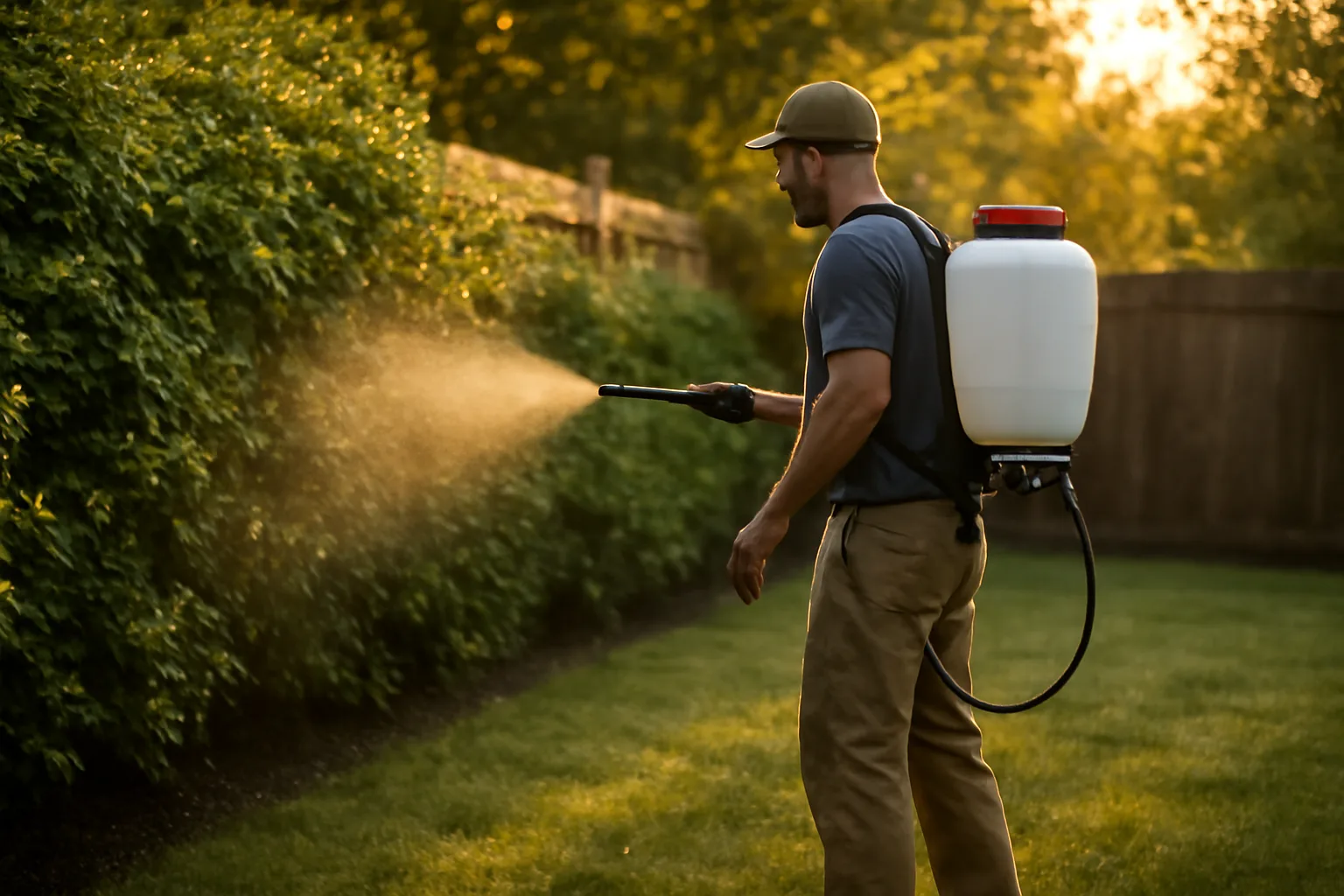
A typical visit starts with a walk of the property to spot standing water, dense vegetation, and resting sites, then a backpack or truck-mounted sprayer applies a fine mist of an EPA-registered pesticide to shrubs, tall grass, tree lines, and shaded structures. The technician usually skips flowering plants in bloom to reduce pollinator contact, and treatments generally need 30 minutes to a couple hours to dry before pets or kids go back outside. Most residential services run on a 2 to 3 week (commonly marketed as 10-14 day) recurring schedule during mosquito season, because that's about how long the barrier residue keeps working before it degrades from sun, rain, and lawn watering. A single treatment is not a long-term fix; it buys you a couple of weeks of relief. Cost varies a lot by region, yard size, and whether the company also treats for ticks in the same visit. Expect a wide range depending on your market and how many linear feet of perimeter need coverage; a legitimate company should give you a free walk-through quote rather than a flat number over the phone, since a quarter-acre lot with heavy woods behind it takes a lot more product and time than a small fenced yard. Misting systems are the other main option: a plumbed-in system with nozzles along the fence line or landscape beds that automatically releases a fine mist on a timer, usually at dawn and dusk. These cost more upfront (installation plus a refill contract) but need less ongoing labor. They work well for people who host outdoor events often or have a large, wooded lot where a truck-based technician would need a long visit every time. If you're checking what's actually available in your zip code, a mosquito control near me search will turn up a mix of national franchises and small local operators; ask each one what active ingredient they use, how long the residual lasts, and whether they treat standing water sources during the same visit.
How do you keep mosquitoes away between treatments?
Between sprays, the goal is to remove what attracts and breeds mosquitoes and to make the yard less hospitable for them to rest in during the day. None of these steps replace a barrier treatment, but they stretch the time it stays effective. Dump or cover standing water weekly: plant saucers, birdbaths, clogged gutters, tarps, unused pots, and kiddie pools. The CDC recommends checking for and removing standing water at least once a week, since that's roughly the minimum time some species need to complete a life cycle [2]. For water you can't dump, like ornamental ponds or rain barrels, mosquito dunks containing Bti (Bacillus thuringiensis israelensis) kill larvae without harming fish or pets when used per label [3]. Keep grass and shrubs trimmed. Adult mosquitoes rest in cool, shaded vegetation during the heat of the day; a tightly mowed lawn with trimmed shrub lines gives them fewer places to hide. Run fans on the patio. Mosquitoes are weak fliers, and even a box fan on a porch measurably cuts landing rates, which is a cheap trick a lot of people overlook. Use a topical or spatial repellent for skin protection during peak hours (usually dusk and dawn). The EPA and CDC both point to repellents registered with the EPA, including those containing DEET, picaridin, IR3535, oil of lemon eucalyptus (OLE), or 2-undecanone, as effective when used as directed [4]. For a rundown of what to look for on a label, see our guide to mosquito repellent options, and if you'd rather skip synthetic repellents, our natural mosquito repellent piece covers what has real evidence behind it and what's mostly marketing.
What plants repel mosquitoes, and do they actually work?
| Citronella grass | Citronellal | Weak unless oil is extracted/burned |
|---|---|---|
| Lemon eucalyptus | PMD (para-menthane-diol) | Effective when extracted into registered repellent [4] |
| Lavender | Linalool | Mild, localized, short-lived |
| Marigold | Pyrethrum-related compounds | Minimal as a living plant |
| Catnip | Nepetalactone | Some lab studies show repellency, field data weak |
A mosquito repellent plant is one that contains natural compounds, usually in its leaves or oils, that mosquitoes find irritating or that mask the scent cues they use to find people. Common examples include citronella grass, lemon eucalyptus, lavender, marigolds, catnip, basil, and rosemary. The honest answer on whether they work: the intact, living plant does very little on its own. University extension entomologists generally agree that planting citronella grass or marigolds around a patio doesn't create a meaningful repellent zone, because the plant has to be crushed or its oil extracted and concentrated to release enough compound to matter [4]. A live lemongrass plant sitting in a pot is not the same as citronella oil in a candle or spray. That said, the compounds themselves aren't nonsense. Oil of lemon eucalyptus, when extracted and formulated as a registered repellent (more than growing in the yard), is recognized by the CDC as effective enough to sit alongside DEET and picaridin on their list of recommended active ingredients [4]. So the plant matters less than what you do with it. Bottom line: mosquito repellent plants make a decent-looking border and a nice talking point, but don't count on them to do the job of a barrier spray or a topical repellent. Think of them as a minor bonus, not a control strategy. | Plant | Repellent compound | Real-world effect |
How do you get rid of mosquitoes in your house?
Getting rid of mosquitoes in the house starts with finding how they're getting in, because indoor mosquito problems are almost always an entry-point issue, not a breeding issue (with one exception: check anything holding water indoors, like a forgotten vase or a plant saucer). Check window and door screens for tears or gaps, and make sure doors seal well at the bottom. Mosquitoes need very little space to slip through; a hole the size of a pencil eraser is enough for some species. For mosquitoes already inside, a few options work: an indoor aerosol labeled for flying insects, a plug-in repellent device, or simply an old-fashioned approach of turning off lights and using a flashlight to spot them resting on walls or ceilings at night, then swatting or vacuuming them up. If you're dealing with mosquitoes in the house repeatedly, even with intact screens, look outside your windows for resting sites right up against the house, like dense foundation plantings or ivy. A barrier treatment applied close to the structure (which most professional services include as standard) cuts down on the number trying to get inside in the first place, since it kills them on contact with treated foundation plantings before they ever reach a door or window.
When do mosquitoes go away for the season?
Mosquitoes generally become inactive once nighttime temperatures drop consistently below about 50°F, since most species stop flying and feeding much below that threshold, though the exact cutoff varies by species and region. In the northern U.S., that's often mid-to-late October; in the Deep South, Gulf Coast, and parts of the Southwest, mosquitoes can stay active nearly year-round during mild winters. Adult mosquitoes don't just vanish, though. Many species overwinter as eggs that survive freezing temperatures in dried-out breeding sites, ready to hatch the moment water and warmth return in spring. A few species, including some Culex mosquitoes, overwinter as adult females in sheltered spots like culverts, crawl spaces, or hollow logs, going dormant rather than dying [5]. That's why a single fall cleanup doesn't prevent next year's population. It's also why barrier treatment programs usually run from spring through the first hard frost rather than year-round in most climates: there's no adult population to treat once temperatures drop, but early-season treatment before eggs hatch has an outsized effect on the whole season's numbers. Because the exact start and end dates shift by region and even by year depending on weather, check your local agricultural extension office or health department for mosquito activity data specific to your area rather than going by a national average.
How do you get rid of ticks in your yard?
Getting rid of ticks in a yard relies on three things working together: cutting back the humid, shaded habitat ticks need to survive, treating the highest-risk zones with an appropriate product, and reducing the wildlife (especially deer and rodents) that carry ticks onto your property. Ticks don't tolerate dry, sunny, open areas well. The CDC and university extension research both point to the same core yard changes: keep grass mowed short, clear leaf litter and brush, and create a 3-foot-wide barrier of wood chips or gravel between lawn and wooded areas, since ticks rarely cross a dry, sun-exposed border to reach a lawn . Targeted spray treatment (sometimes called a tick barrier or perimeter treatment) focuses on the edge of the woods, stone walls, and shaded brush rather than the whole lawn, because that's where ticks actually live; they don't hang out in the middle of an open, mowed lawn. Products used are typically the same pyrethroid class used for mosquitoes, and a properly timed spring and early-summer application targets the nymph stage, which is small, hard to spot, and responsible for most human Lyme disease cases according to CDC data . Stack the deck further by moving swing sets, bird feeders, and firewood piles away from the woodline, since those all draw the small mammals that ticks feed on. If you have a deer problem drawing ticks onto the property, fencing helps more than any spray. For a closer look at repellent options you wear versus what you spray on the yard, see our guide to tick repellent.
How is mosquito control different from tick control in the same yard?
Both use similar pesticide chemistry, but the target zones and timing are different enough that a good service treats them as two separate jobs even during the same visit. Mosquito treatment focuses on standing water, shrubs, tall grass, and shaded resting sites across the whole property, applied on a 10 to 14 day cycle through the warm season because adult mosquitoes are mobile and the residue breaks down. Tick treatment focuses narrowly on the woodland edge, stone walls, leaf litter, and tall grass borders, usually applied 2 to 4 times a season (spring, early summer, and sometimes fall) rather than every two weeks, because ticks don't roam the way mosquitoes fly and a well-timed treatment against nymphs and adults covers a longer window. A yard bordering woods, in a region with high deer tick activity, usually needs both programs running at once. A small, fenced, mostly-paved yard with no woodline might only need mosquito treatment. This is exactly the kind of thing a free walk-through assessment is good for, since it's hard to judge tick risk without someone looking at your actual treeline and grass height.
DIY spray vs. professional barrier treatment vs. misting system: which one fits your yard?
| Option | Typical cost pattern | Effort | Best for | |
|---|---|---|---|---|
| DIY hose-end or backpack spray | Lower cost, buy every application | High (you apply it yourself every 2-3 weeks, correct dilution and coverage matters) | Small yards, hands-on homeowners, tight budgets | |
| Professional barrier treatment | Recurring service fee, often billed per visit or season | Low (technician handles application) | Most residential yards, especially with woods or heavy vegetation nearby | |
| Installed misting system | Higher upfront install cost, plus refill/service contract | Very low (automatic timer) | Large lots, frequent outdoor entertaining, people who forget to reapply | DIY sprays from a garden center use the same general chemical classes as professional products, but the equipment matters. A cheap hose-end sprayer often doesn't reach the underside of leaves or the top of a tall hedge, which is exactly where mosquitoes rest. Under-application is the most common DIY mistake, and it wastes money because the mosquitoes just aren't there yet when it sprays over their heads. Professional barrier treatment costs more per application than a DIY jug, but the technician has commercial equipment built for even coverage and knows to hit gutters, decking undersides, and mulch beds that most homeowners skip. For most people with a normal suburban lot bordered by any trees or brush, this is the better value once you count the time and hassle of doing it yourself every two weeks all season. Misting systems make the most sense for larger properties or anyone who hosts outdoor gatherings often, since the automatic timer means you're never caught off guard before a barbecue. The tradeoff is a bigger upfront installation cost and ongoing refill service, so it's worth comparing that total cost against a season of recurring barrier visits before deciding. A lot of homeowners land somewhere in between: professional barrier treatment on the recurring cycle for the season, with a can of DIY spray on hand for one-off events between visits. That's a reasonable way to balance cost and convenience without overspending on infrastructure you don't need. |
What should you ask before hiring a mosquito spray service near you?
Ask what active ingredient they use and whether it's EPA-registered for residential outdoor use; a reputable company should answer this without hesitation and can show you the product label [1]. Products applied per label instructions are registered for that use; no legitimate technician should ever tell you a pesticide carries zero risk, since EPA registration means the product met specific use requirements, not that it's risk-free in every circumstance. Ask about the treatment cycle. A 10 to 14 day schedule is standard for barrier sprays during peak season; anything longer than 3 weeks between visits likely means gaps in coverage as the residue wears off. Ask whether they check and treat standing water during the same visit, or whether that's on you. Some companies include larvicide treatment for features like ponds or low spots as part of the service; others only do the adult barrier spray and expect you to handle water removal yourself. Ask how they handle pollinator protection, particularly around flowering plants, since responsible technicians typically avoid direct treatment of blooms to reduce bee exposure. Ask for a walk-through before a price. Yard size, vegetation density, and whether you also want tick coverage all change the job significantly, so a legitimate quote should come after someone actually looks at your property, not off a phone call alone. That's the model most local services, including Duskproof, use: a free yard assessment first, then a seasonal plan built around what your specific yard needs, whether that's the recurring barrier cycle or an installed misting system for a larger or high-traffic property.
Does mosquito spray hurt bees, pets, or kids playing in the yard?
Pyrethroid-based barrier sprays, the class most commonly used for residential mosquito control, are toxic to bees on direct contact, which is why responsible applicators avoid spraying flowering plants where pollinators are actively foraging [1]. Once the spray dries (typically within an hour or two, depending on humidity and temperature), the risk to pollinators drops substantially because they're not walking through wet residue on non-flowering surfaces. For pets and kids, the standard guidance from most service providers and product labels is to stay off treated areas until the application dries, generally 30 minutes to a couple of hours. After that, dried residue on treated foliage carries much lower exposure risk than wet spray, though the EPA doesn't classify any pesticide as harmless; registration means the product met use requirements when applied per label, not that exposure carries zero risk under any circumstances. If you have a vegetable garden, fish pond, or beehive, tell your provider before treatment, since these all need special handling (buffer zones, timing around bloom, or skipping certain plants entirely) that a good technician will build into the plan rather than treating your whole property as one uniform target.
Frequently asked questions
How do I get rid of mosquitoes in my backyard fast?
The fastest results come from a professional barrier spray applied to shaded resting sites (shrubs, tall grass, fence lines) plus immediate removal of any standing water. Most services report a noticeable drop in activity within 24 to 48 hours of treatment. DIY spray works too, but coverage quality (getting the underside of leaves) matters more than the product you choose.
How do I keep mosquitoes away without spraying chemicals?
Remove standing water weekly, run fans on the patio (mosquitoes are weak fliers), wear EPA-registered repellent during dusk and dawn, and keep grass and shrubs trimmed to reduce daytime resting sites. These steps reduce mosquito pressure meaningfully but don't match the population knock-down of a barrier treatment, since they don't kill existing adults directly.
How do you get rid of ticks in your yard without hiring a company?
Mow grass short, clear leaf litter and brush, and build a 3-foot dry barrier of wood chips or gravel between lawn and woods, since ticks avoid crossing open, sun-exposed ground [8]. DIY perimeter sprays targeting the woodland edge, applied in spring and early summer, cover the nymph stage responsible for most Lyme disease cases [9].
What is a mosquito repellent plant and does it really work?
A mosquito repellent plant contains natural compounds, like citronellal or PMD, that can irritate mosquitoes or mask the scents they use to find people. Living plants release very little of the compound on their own; it generally needs to be extracted or concentrated (as in citronella oil or lemon eucalyptus repellent) to have a measurable effect [5].
What plants repel mosquitoes best?
Citronella grass, lemon eucalyptus, lavender, marigolds, catnip, basil, and rosemary all contain compounds mosquitoes tend to avoid. As living plants in the ground, their effect is minor; the same compounds work much better when extracted into an oil, candle, or EPA-registered repellent formulation like oil of lemon eucalyptus [4].
How do I get rid of mosquitoes in my house?
Check window and door screens for gaps, seal doors well, and remove any standing water indoors (vases, plant saucers). For mosquitoes already inside, use an aerosol labeled for flying insects or a plug-in device. Repeated indoor problems usually point to resting sites right outside windows, which outdoor barrier treatment near the foundation helps address.
When do mosquitoes go away for the winter?
Most species become inactive once nighttime temperatures consistently drop below about 50°F, often mid-to-late October in northern climates, though warm-winter regions like the Gulf Coast can see activity nearly year-round. Many species survive winter as eggs, not adults, which is why early spring treatment before eggs hatch matters for the whole season.
How often should a yard be sprayed for mosquitoes?
Most professional barrier treatments run on a 10 to 14 day cycle through mosquito season, since that's roughly how long the pesticide residue stays effective before sun, rain, and lawn watering break it down. Waiting longer than 3 weeks between treatments usually leaves a gap where populations rebound before the next visit.
Is mosquito yard spray safe for pets and kids?
EPA-registered barrier sprays are applied per label instructions, which typically call for staying off treated areas until the application dries (usually 30 minutes to a couple hours). No pesticide is classified as harmless; EPA registration means the product met specific use requirements, not zero risk under any exposure.
Does mosquito spray also get rid of ticks?
The same pyrethroid-class products used for mosquitoes can also kill ticks, but the application zones differ: mosquito treatment covers the whole yard's shaded and wet areas, while tick treatment focuses narrowly on the woodland edge and tall grass borders. A yard near woods usually benefits from both programs run together.
What's the difference between a barrier spray and a misting system?
A barrier spray is applied by a technician on a recurring visit schedule, typically every 10 to 14 days. A misting system is a permanently installed set of nozzles that automatically releases mist on a timer, usually at dawn and dusk, without a technician visit each time. Misting systems cost more upfront but need less ongoing scheduling.
How much yard space does a mosquito treatment cover?
Coverage depends on vegetation density and perimeter length more than raw square footage; a quarter-acre lot with heavy woods takes more product and time than a similarly-sized open, mowed lot. Because of that variability, most legitimate providers quote after a walk-through rather than a flat per-acre rate over the phone.
Sources
- CDC, Controlling Mosquitoes at Home: Standing water should be checked and removed at least weekly to disrupt mosquito breeding cycles
- CDC, Prevent Mosquito Bites: CDC recommends EPA-registered repellents containing DEET, picaridin, IR3535, oil of lemon eucalyptus, or 2-undecanone
- University of Florida IFAS Extension, Mosquito Information Website: Repellent Plants: Living repellent plants release limited compound and generally need extraction or crushing to have a meaningful repellent effect
- CDC, Mosquito Life Cycle: Mosquito activity and life cycle are temperature-dependent, with most species becoming inactive as temperatures drop
- CDC, Preventing Tick Bites on People: A 3-foot-wide barrier of wood chips or gravel between lawn and wooded areas restricts tick migration into recreational yard areas
- CDC, Lyme Disease Data and Surveillance: Nymph-stage ticks are responsible for most human Lyme disease cases